



















Hotel Rakuragu Hotel Rakuragu Hotel Rakuragu
- 敷地 site 场地
-
東京都中央区日本橋本町1-7-9
Tokyo, JAPAN
日本東京
- 主要用途 program 主要功能
-
ホテル
Hotel
酒店
- 敷地面積 site area 场地面積
-
83.47 ㎡
83.47 ㎡
83.47 ㎡
- 建築面積 architectural area 建筑面积
-
60.66㎡
60.66㎡
60.66㎡
- 延床面積 floor area 建筑面积
-
441.62㎡
441.62㎡
441.62㎡
- 高さ hight 高度
-
29.17m
29.17m
29.17m
- 階数 floor 排
-
9階/14部屋
9 floors/14 rooms
9階/14部屋
- 構造 struction 構造
-
鉄骨造(ブレース併用ラーメン構造)
Steel Structure(Ramen structure with braces)
鉄骨造(ブレース併用ラーメン構造)
- 施主 client 业主
-
株式会社A.M
A.M Inc.
A.M Inc.
- 設計 design 设计
-
株式会社小大建築設計事務所
kooo architects
小大建筑设计事务所
- 担当 staff 负责人
-
小嶋伸也・小嶋綾香・中村靖怡
Shinya Kojima・Ayaka Kojima・Yasue Nakamura
小嶋伸也・小嶋綾香・中村靖怡
- 施工 construction 施工
-
株式会社日向興発
HYUGA KOUHATSU CORPORATION
HYUGA KOUHATSU CORPORATION
- 写真 photo 摄影
-
堀越圭晋/ SS Tokyo
KEISHIN HORIKOSHI/SS
堀越圭晋/ SS
- 構造設計 structure design 構造設計
-
株式会社田中哲也建築構造計画
TETSUYA TANAKA STRUCTURAL ENGINEERS
TETSUYA TANAKA STRUCTURAL ENGINEERS
- 設備設計 facility design 設備設計
-
ZO設計室
ZO COSULTING ENGINEERS
ZO COSULTING ENGINEERS
- 照明デザイン lignt design 照明設計
-
株式会社大好照明
DAISUKI LIGHT
DAISUKI LIGHT
- サインデザイン sighn design
-
鈴木哲生
Tetsuo Suzuki
鈴木哲生
- 1階アート art design of 1st floor 一階美術
-
we+
we+
we+
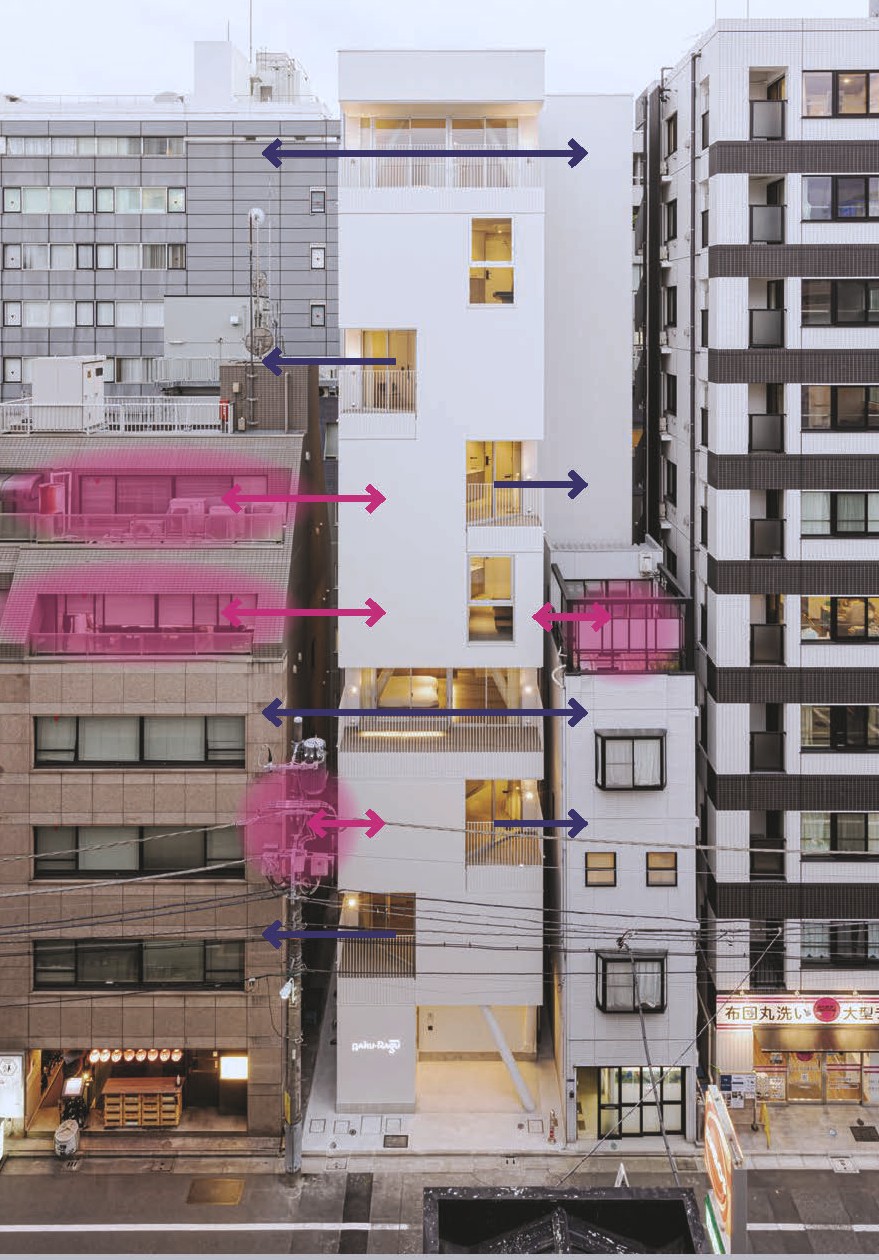
都心の狭い敷地というネガティブな面を払拭するために、私達は都市の隙間に着目して視線の抜けをテーマにし設計。
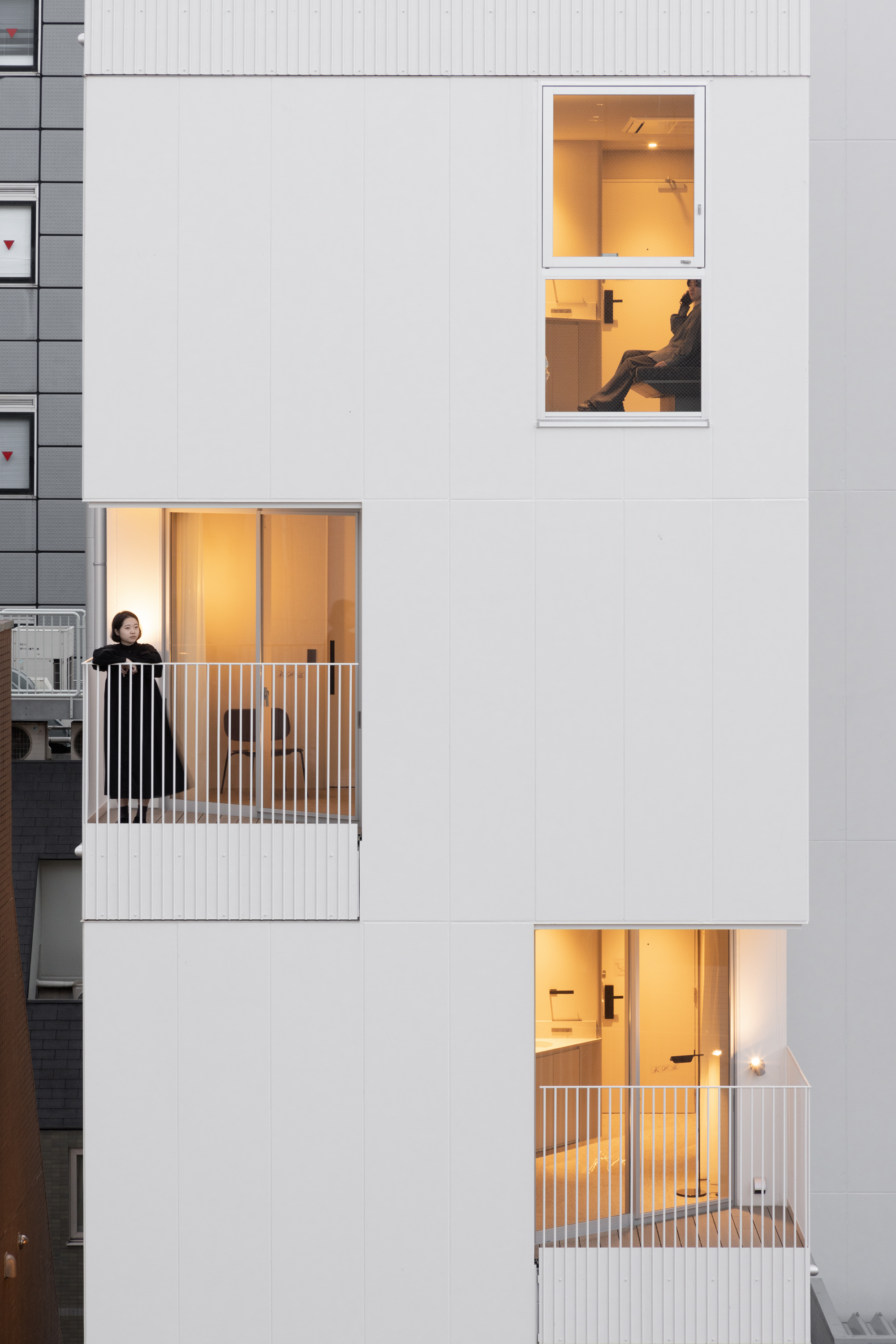
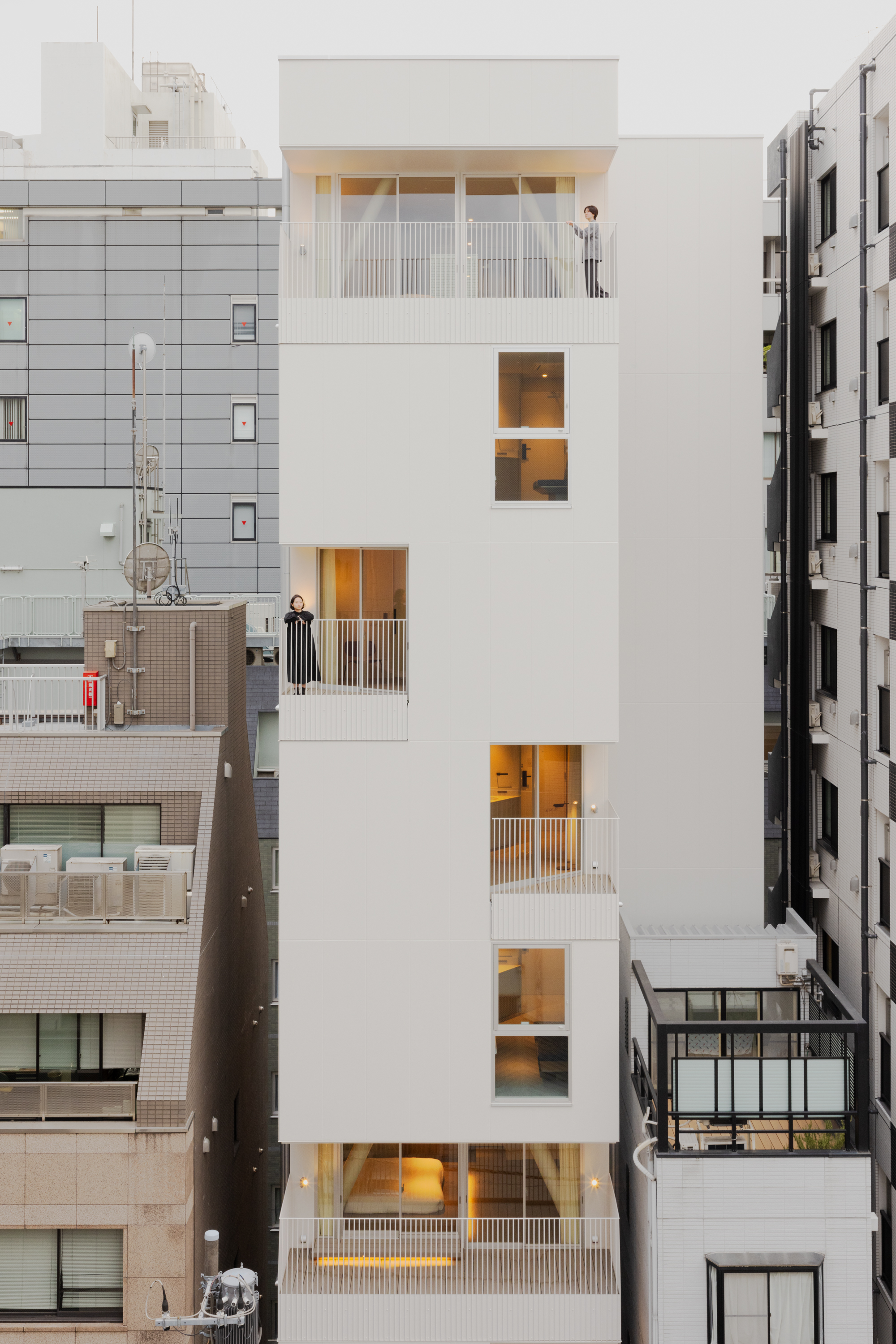
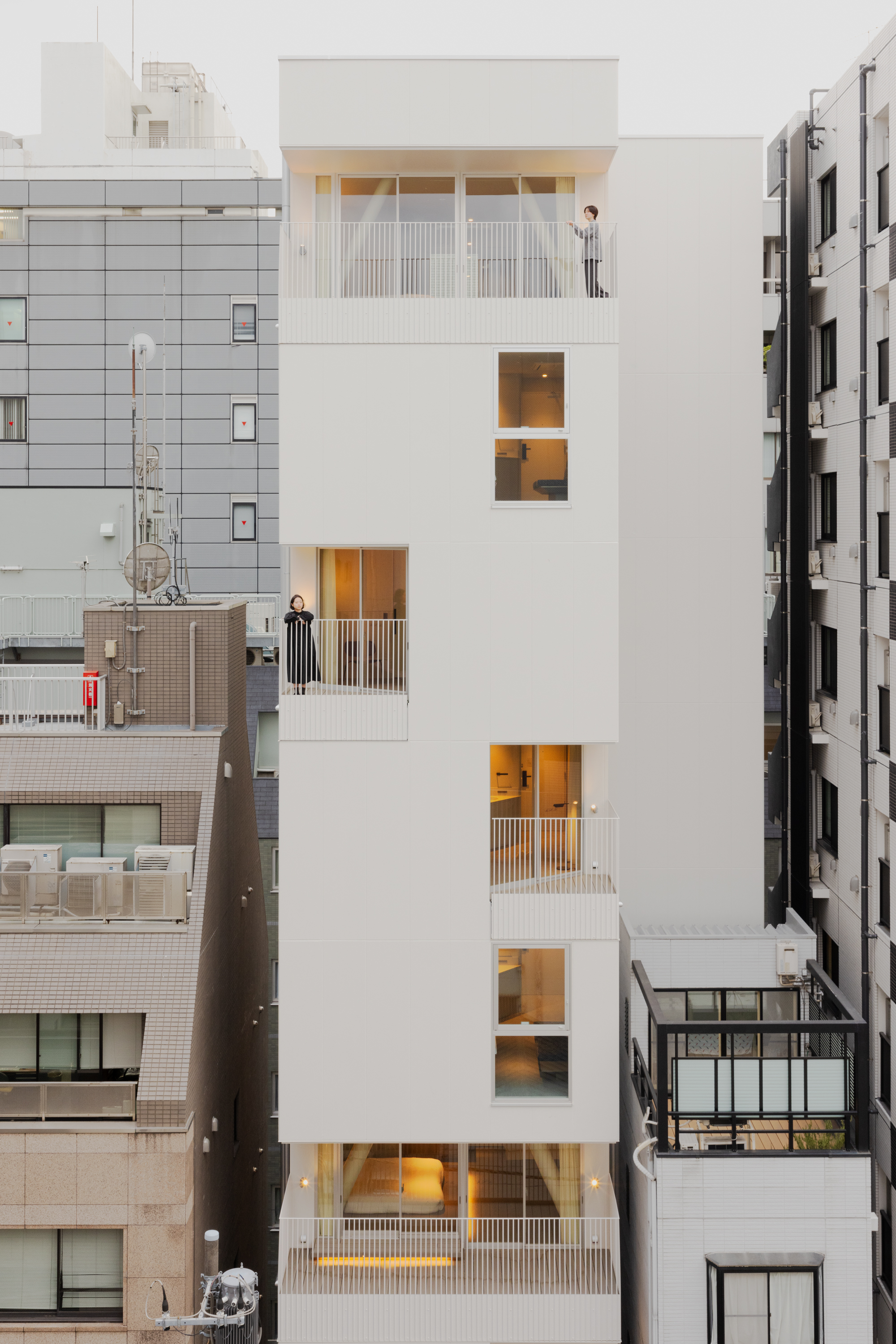
周りの建物形状を観察することで、建物が密集するエリアの中においても気持ちよく外に開ける方角を各階毎に見つけた。周囲の風景を考えながら客室ごとに異なる方向にバルコニーを設けることで、各階各部屋から異なる景色を楽しむことができる。また同時に、縦長の建築をランダムにくり抜いたような個性豊かなファサードをつくり出すことで、都心の狭小地という制約をポジティブに捉え、デザインへと昇華した新しい都市型ホテルを目指した。
各階の端部X4-X5通りのワンスパンに構造の変化を与え、3 種類の異なるバルコニー形式を実現させた。
X1-X4通りは上下階で変化せず、経済的に建物を作っている。ホテルの客室数の制限を効率よくクリアしつつ、最後のワンスパンの操作で作られたバルコニーは建築のファサードとして個性的な表情を作り出している。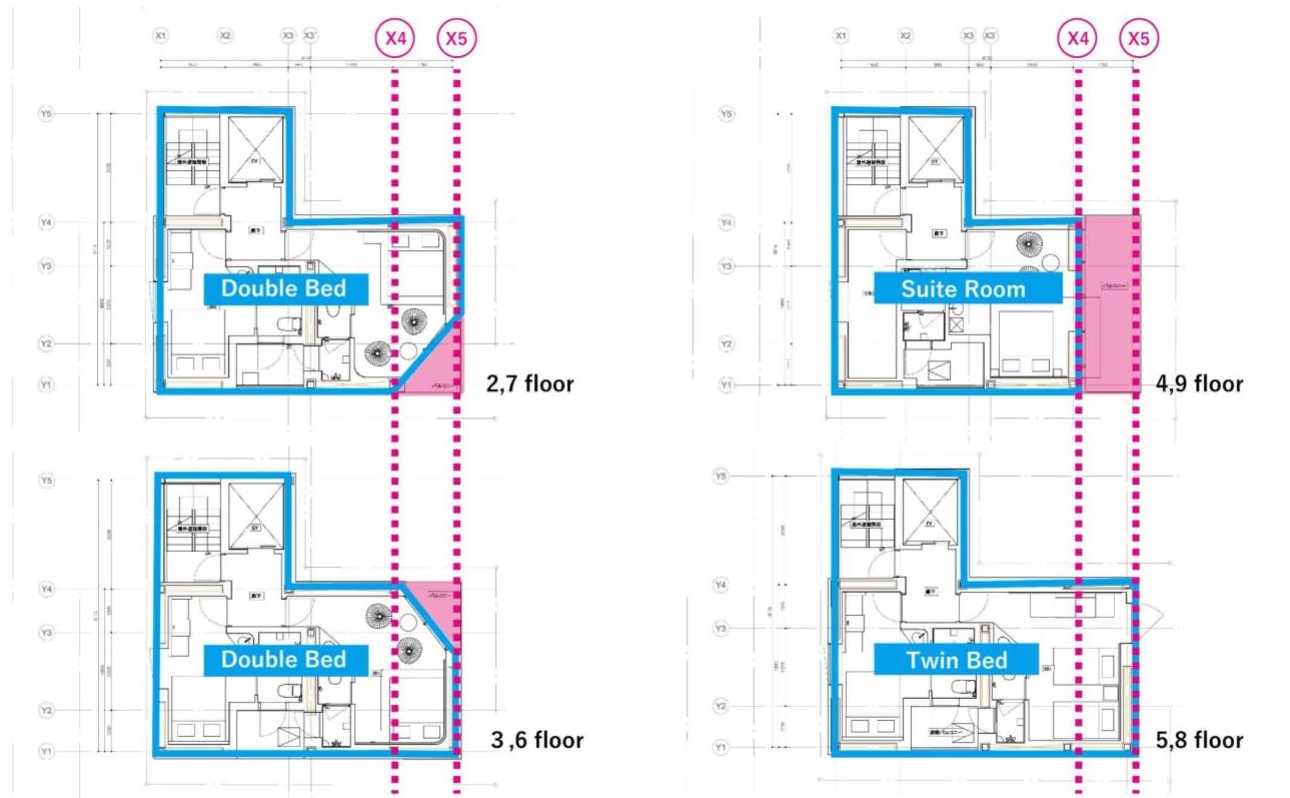
白い直方体をくり抜いていったような外観の形状を成立させるための構造形式が大きな特徴。ゲストの外への視線を遮らないようにバルコニーには柱が落ちていない。
各階毎に左右に三角にくり抜いたようなバルコニーもあれば、前面を全て大きくバルコニーにしたり、リズム感があるファサードだが、その形状を実現するために、一般的な柱梁のラーメン構造ではなく、ブレース併用ラーメン構造を採用することで、柱配置をある程度プランに合わせて自由にすることができ今回のような空間を作り出せた。
都市の隙間に向けて開かれたバルコニーでアイコニックな形でありながら、ほかのシティホテルにはない東京の多面的な表情をゲストユーザーに見せる構成になっている。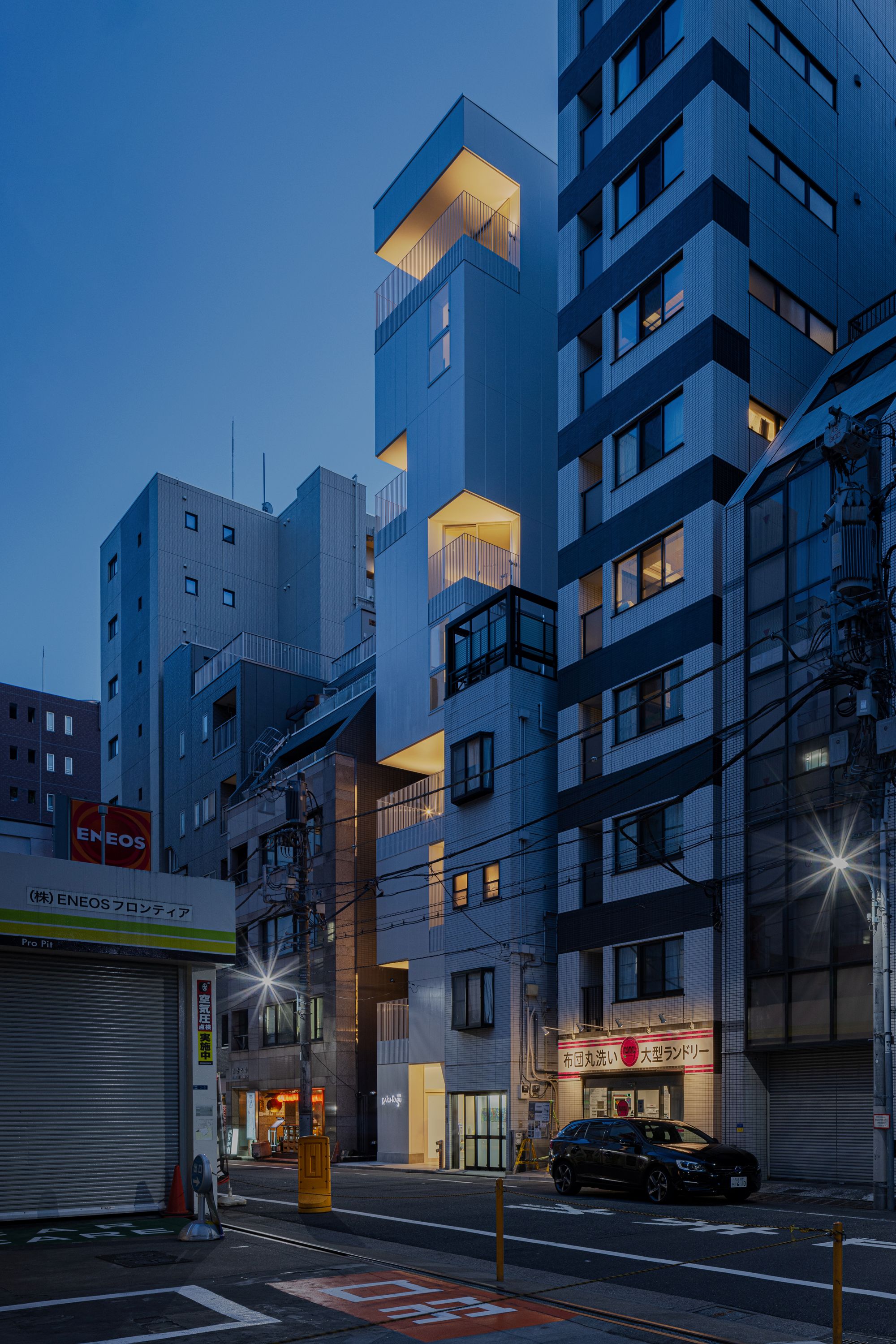
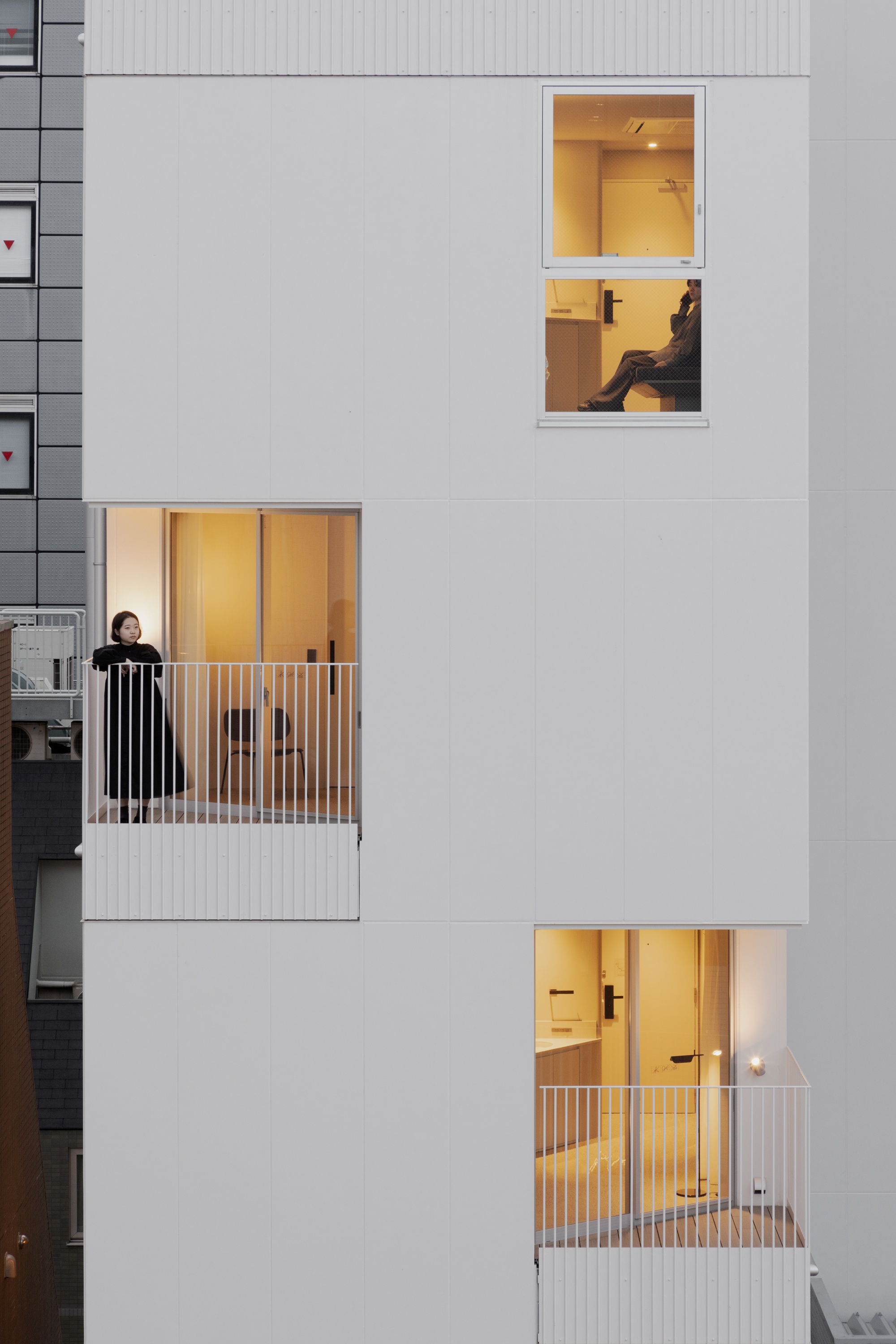
プランやファサードの切り換えを無理なく実現させるためにブレース併用ラーメン構造とした。室内空間を最大化するために、柱・梁断面を抑えて、9階建て鉄骨造を基本梁せい300㎜、柱の直径は150~200㎜で組み立てている。
柱の断面サイズが小さいので、壁の中に納まることができ、自然光が途切れることなく室内の壁に沿って入る。
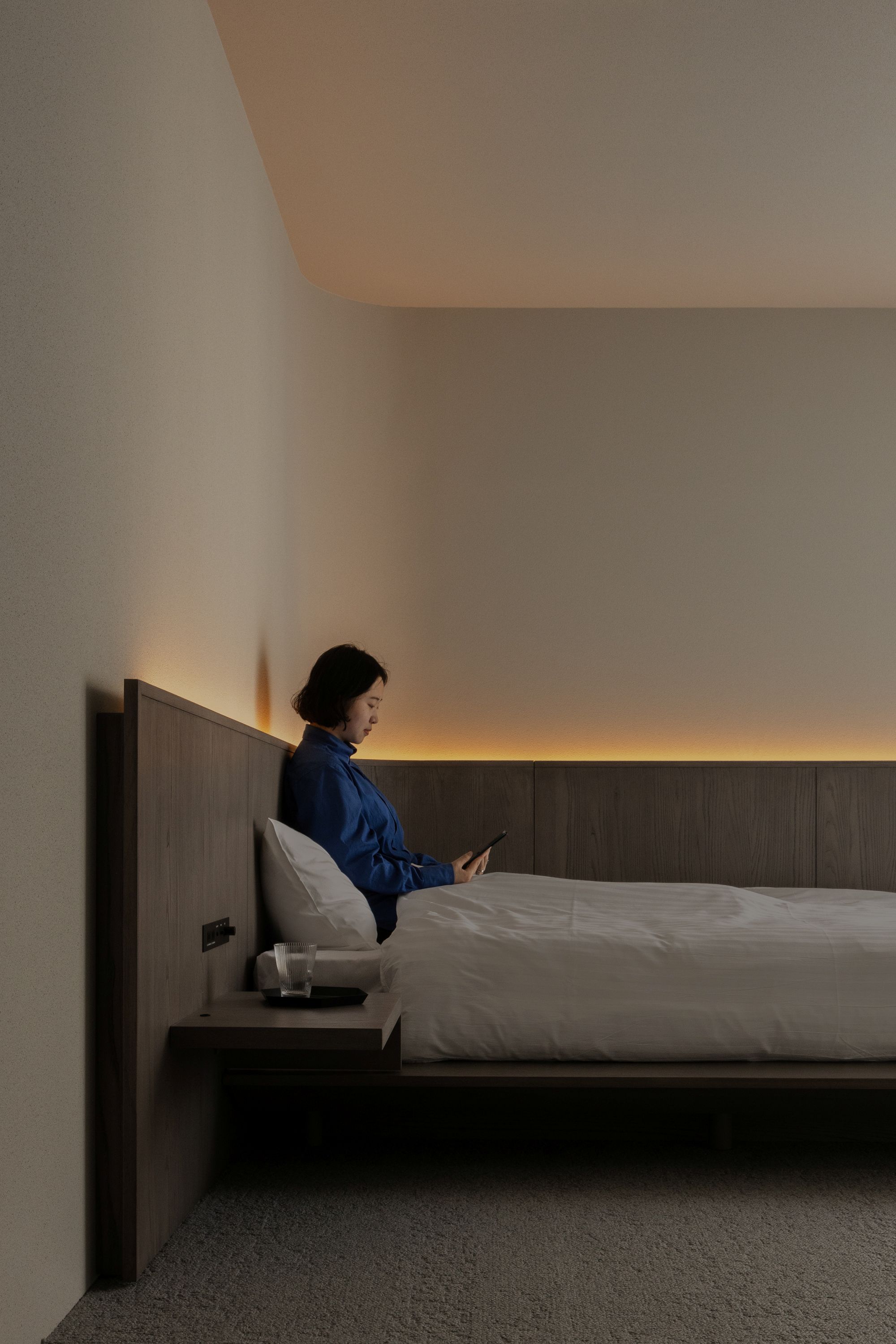
客室の壁はアールの壁面になっており、包み込まれた内部空間が外部まで連続的につながる空間とし、空間の広がりを感じることができる。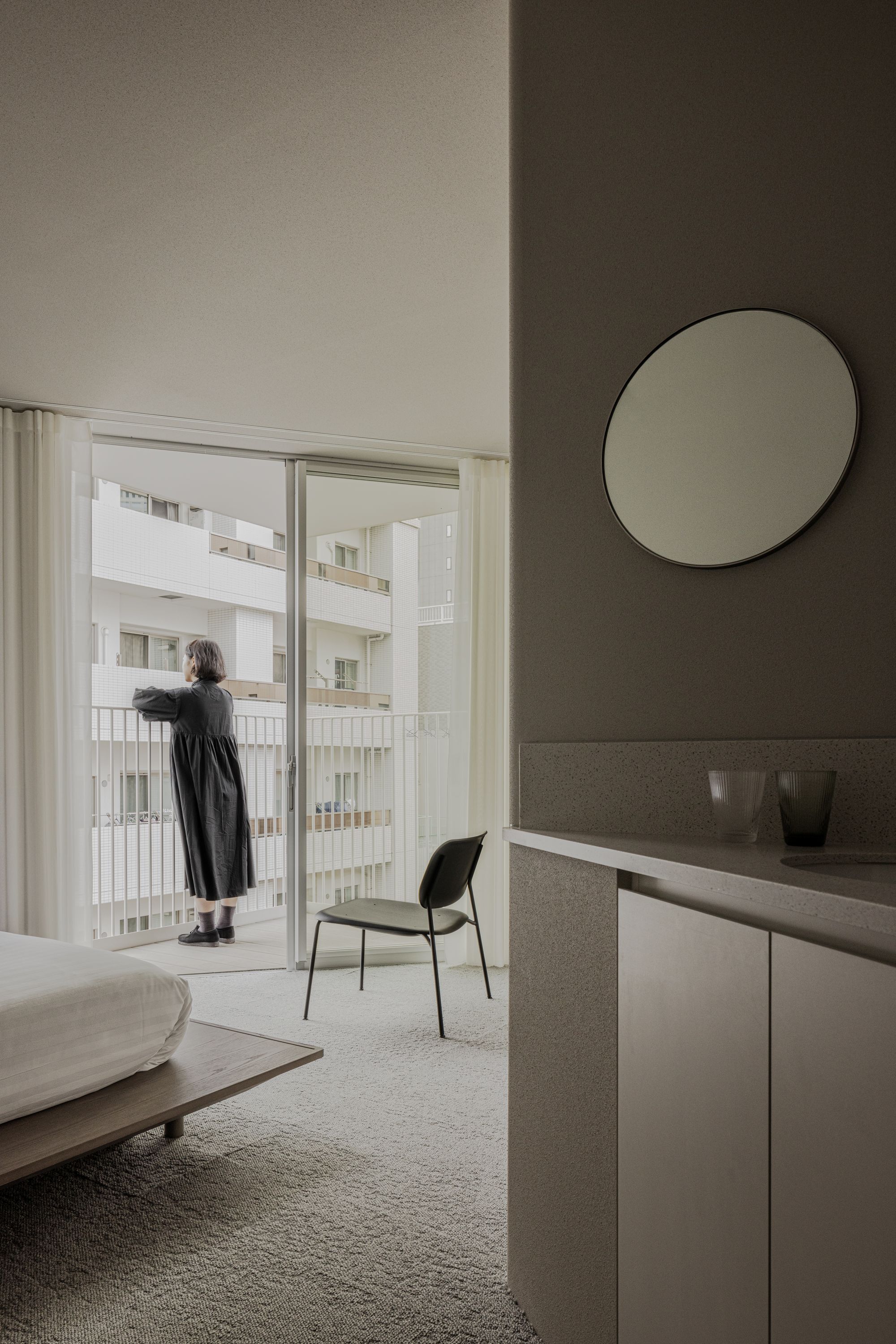
周囲は東京都心の典型的な雑居ビル群に囲まれているエリアで、景勝地にような遠方へのビューはなく、高さも幅も素材も開口部に関しても、統一されたデザインコードがないビルに囲まれた場所である。東京の一般的なシティホテルは客室面積を最大化するために、バルコニーを意図的に作ることは多くない。
目を引く外観デザインを恣意的に作るより、バルコニーのコンセプトが建築のアイコニックなファサードを生み出し、バルコニーの違いによるプランがそのままホテルのルームミックスもバランスよく生み出すことを重視した。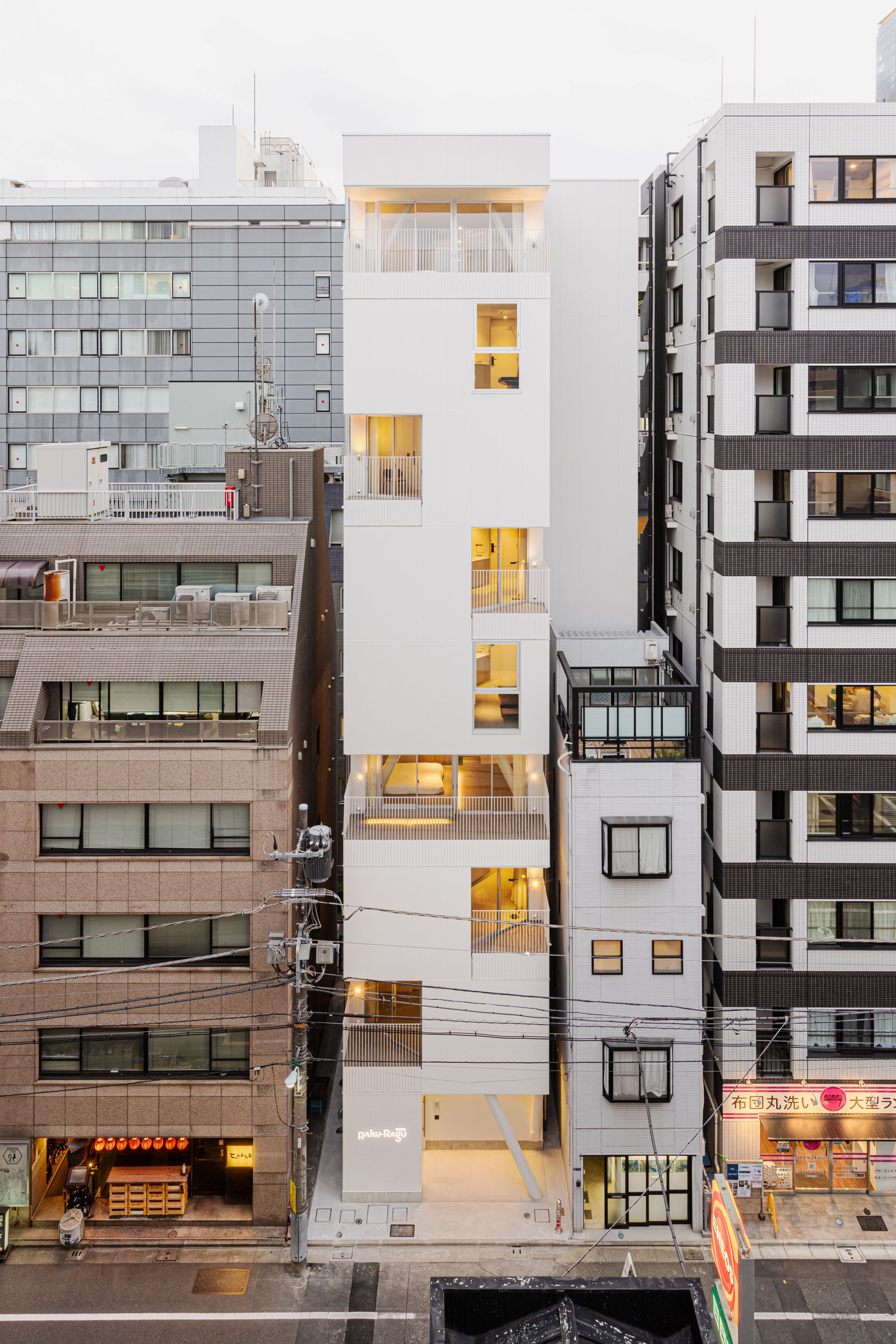
1つの少ない手数で多くの問題を解決し価値に変えていくというアプローチが、狭い住空間を賢く利用する日本的であり、東京らしさを感じる滞在ができるデザインだと考えた。
In order to counteract the negative connotations of a narrow urban site, we focused on the notion of “urban gaps,” developing a design theme around sightlines and openness. By carefully observing the surrounding building forms, we identified directions on each floor where the interior could extend comfortably outward, even within a dense context. Balconies were oriented differently for each guestroom, allowing every floor and room to enjoy a distinct view. At the same time, the staggered arrangement of openings produced a lively façade—appearing as though a slender volume had been randomly carved—transforming the limitations of a tight site into a positive, architectural identity for a new type of urban hotel.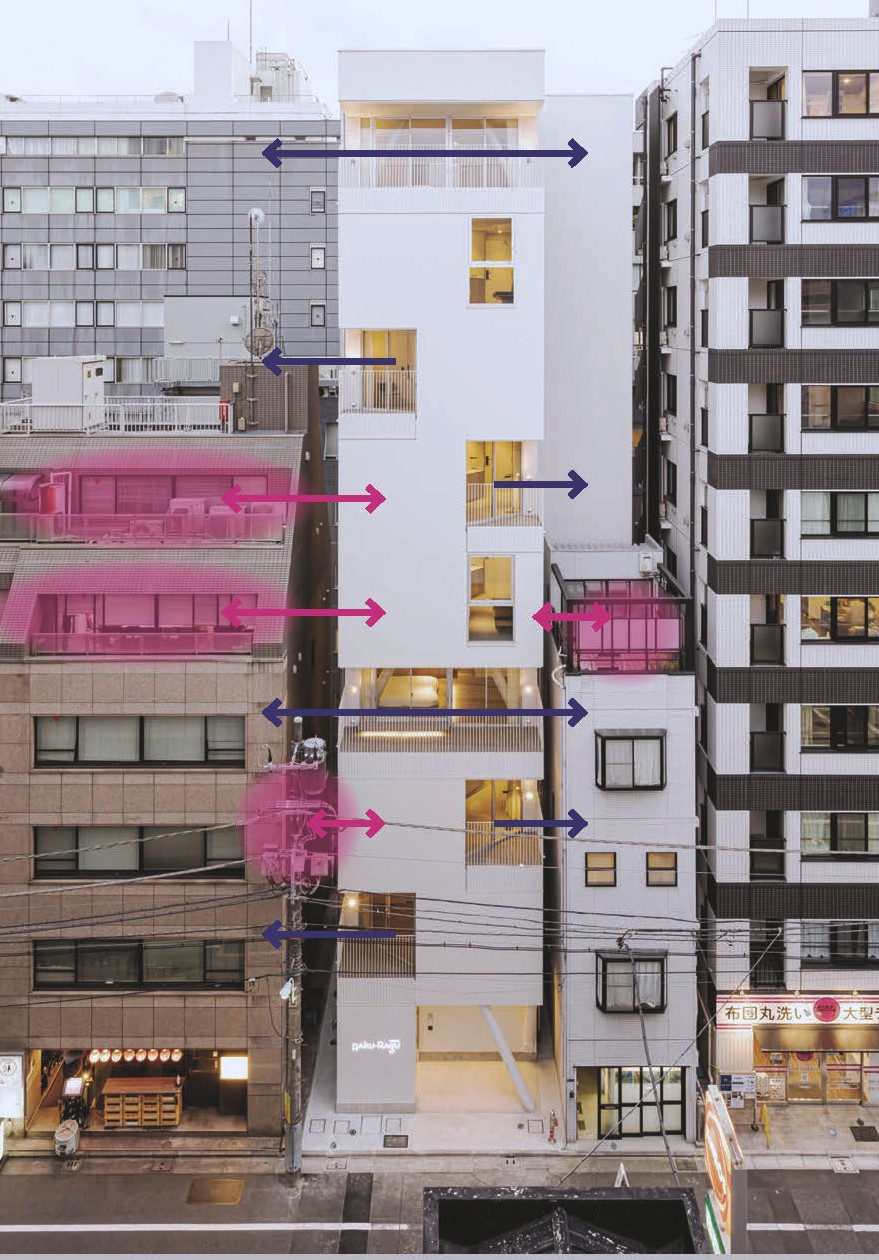
On each floor, structural adjustments were introduced at the edge bays (X4–X5), enabling three distinct balcony configurations. The other bays (X1–X4) remain consistent across levels, achieving construction efficiency while maximizing room count. Through this strategy, the final edge bay becomes the site of architectural expression, giving rise to a façade with unique character.
The exterior reads as a white rectangular prism carved away to form balconies—its structural system a key feature. To preserve unobstructed outward views, no columns drop within the balconies. Some are triangular cutouts offset to either side, while others span the full frontage as large terraces, resulting in a rhythmic, iconic façade. Achieving such variety required more than a conventional moment frame; instead, a braced-frame hybrid system was adopted. This allowed column placement to respond flexibly to the plan and enabled the creation of these distinctive voids. The hotel thus offers guests multiple perspectives of Tokyo, framed through balconies that open into the interstices of the city.
The braced-frame hybrid also allowed smooth transitions between plans and façade expressions. To maximize interior space, structural dimensions were restrained: the nine-story steel structure uses beams at 300mm depth, with slender columns ranging from 150–200mm in diameter. The small column sections fit within walls, permitting natural light to trace uninterrupted along interior surfaces. Guestroom walls are softly curved, generating an enveloping spatial quality that flows seamlessly outward, enhancing the perception of openness.
The site is surrounded by typical central Tokyo mid-rise buildings—heterogeneous in height, materials, and apertures, without any unified design code or distant scenic views. Unlike most city hotels, which rarely incorporate balconies in order to maximize room size, this project derived its architectural identity precisely from them. The balcony system not only created an iconic façade but also generated a balanced room mix, with varied layouts directly shaping the guest experience.
By solving multiple challenges with a single architectural gesture, the design embraces a uniquely Japanese sensibility of compact spatial intelligence. The result is a hotel that offers a distinctly Tokyo-like stay, transforming spatial constraints into opportunities for richness and variety.
为了消解“都心狭小用地”所带来的负面印象,我们关注城市缝隙的可能性,并以“视线的延伸”为主题展开设计。通过观察周围建筑的形态,即使在密集的环境中,我们仍在每一层找到能够舒适向外敞开的方向。每个客房都设置了朝向不同的阳台,让每一层、每一个房间都能欣赏到独特的景观。同时,这些错落的开口在立面上呈现出如同长条体量被随机掏空般的丰富表情,将狭小用地的限制转化为积极的建筑语言,形成了一种全新的都市型酒店。
在每一层的端部(X4–X5)进行结构上的调整,从而实现三种不同形式的阳台。其余的(X1–X4)保持上下层一致,以确保建造的经济性并最大化客房数量。最后一跨的操作不仅满足了客房需求,也成为塑造独特立面的关键。
外观如同一个白色长方体被逐层掏空,形成阳台。为了不阻碍客人的视线,阳台中没有落柱。有的阳台是左右偏移的三角切口,有的则在正面大面积敞开,立面呈现出有节奏的韵律感。为实现这一形式,设计并未采用常规的框架结构,而是采用了“支撑结合框架”的混合体系,使得柱子的布置能够较为自由地顺应平面,进而实现这种独特的空间。借由这些向城市缝隙敞开的阳台,酒店呈现出与其他城市酒店截然不同的东京多面表情。
为了在平面与立面之间实现自然的切换,采用了支撑结合框架结构。为了最大化室内空间,梁与柱的截面均被尽量缩小:九层钢结构中,梁高仅300mm,柱径150–200mm。纤细的柱子可隐藏于墙体之中,自然光得以沿墙面连续渗入。客房的墙体采用弧面处理,营造出包裹感,同时与外部空间连续相连,使人感受到空间的扩展。
项目周边是典型的东京市中心杂居建筑群——高度、尺度、材料、开口各异,缺乏统一的设计语汇,也没有远景可言。一般的城市酒店为了最大化客房面积,往往避免设置阳台。而本项目则以阳台作为核心概念,既塑造了标志性的立面,也自然生成了多样化的客房组合,丰富了酒店的空间构成。
通过“以少制多”的方法解决了多重问题并转化为价值,这种策略具有日本式的紧凑空间智慧。酒店由此为住客提供了一种“东京式”的停留体验——在狭小中创造丰盈,让约束转化为独特的城市魅力。
READ MORE SHOW LESS
- 敷地 site 场地
-
東京都中央区日本橋本町1-7-9
Tokyo, JAPAN
日本東京
- 主要用途 program 主要功能
-
ホテル
Hotel
酒店
- 敷地面積 site area 场地面積
-
83.47 ㎡
83.47 ㎡
83.47 ㎡
- 建築面積 architectural area 建筑面积
-
60.66㎡
60.66㎡
60.66㎡
- 延床面積 floor area 建筑面积
-
441.62㎡
441.62㎡
441.62㎡
- 高さ hight 高度
-
29.17m
29.17m
29.17m
- 階数 floor 排
-
9階/14部屋
9 floors/14 rooms
9階/14部屋
- 構造 struction 構造
-
鉄骨造(ブレース併用ラーメン構造)
Steel Structure(Ramen structure with braces)
鉄骨造(ブレース併用ラーメン構造)
- 施主 client 业主
-
株式会社A.M
A.M Inc.
A.M Inc.
- 設計 design 设计
-
株式会社小大建築設計事務所
kooo architects
小大建筑设计事务所
- 担当 staff 负责人
-
小嶋伸也・小嶋綾香・中村靖怡
Shinya Kojima・Ayaka Kojima・Yasue Nakamura
小嶋伸也・小嶋綾香・中村靖怡
- 施工 construction 施工
-
株式会社日向興発
HYUGA KOUHATSU CORPORATION
HYUGA KOUHATSU CORPORATION
- 写真 photo 摄影
-
堀越圭晋/ SS Tokyo
KEISHIN HORIKOSHI/SS
堀越圭晋/ SS
- 構造設計 structure design 構造設計
-
株式会社田中哲也建築構造計画
TETSUYA TANAKA STRUCTURAL ENGINEERS
TETSUYA TANAKA STRUCTURAL ENGINEERS
- 設備設計 facility design 設備設計
-
ZO設計室
ZO COSULTING ENGINEERS
ZO COSULTING ENGINEERS
- 照明デザイン lignt design 照明設計
-
株式会社大好照明
DAISUKI LIGHT
DAISUKI LIGHT
- サインデザイン sighn design
-
鈴木哲生
Tetsuo Suzuki
鈴木哲生
- 1階アート art design of 1st floor 一階美術
-
we+
we+
we+
PROJECT DATA SHOW LESS
都心の狭い敷地というネガティブな面を払拭するために、私達は都市の隙間に着目して視線の抜けをテーマにし設計。
周りの建物形状を観察することで、建物が密集するエリアの中においても気持ちよく外に開ける方角を各階毎に見つけた。周囲の風景を考えながら客室ごとに異なる方向にバルコニーを設けることで、各階各部屋から異なる景色を楽しむことができる。また同時に、縦長の建築をランダムにくり抜いたような個性豊かなファサードをつくり出すことで、都心の狭小地という制約をポジティブに捉え、デザインへと昇華した新しい都市型ホテルを目指した。
各階の端部X4-X5通りのワンスパンに構造の変化を与え、3 種類の異なるバルコニー形式を実現させた。
X1-X4通りは上下階で変化せず、経済的に建物を作っている。ホテルの客室数の制限を効率よくクリアしつつ、最後のワンスパンの操作で作られたバルコニーは建築のファサードとして個性的な表情を作り出している。
白い直方体をくり抜いていったような外観の形状を成立させるための構造形式が大きな特徴。ゲストの外への視線を遮らないようにバルコニーには柱が落ちていない。
各階毎に左右に三角にくり抜いたようなバルコニーもあれば、前面を全て大きくバルコニーにしたり、リズム感があるファサードだが、その形状を実現するために、一般的な柱梁のラーメン構造ではなく、ブレース併用ラーメン構造を採用することで、柱配置をある程度プランに合わせて自由にすることができ今回のような空間を作り出せた。
都市の隙間に向けて開かれたバルコニーでアイコニックな形でありながら、ほかのシティホテルにはない東京の多面的な表情をゲストユーザーに見せる構成になっている。
プランやファサードの切り換えを無理なく実現させるためにブレース併用ラーメン構造とした。室内空間を最大化するために、柱・梁断面を抑えて、9階建て鉄骨造を基本梁せい300㎜、柱の直径は150~200㎜で組み立てている。
柱の断面サイズが小さいので、壁の中に納まることができ、自然光が途切れることなく室内の壁に沿って入る。
客室の壁はアールの壁面になっており、包み込まれた内部空間が外部まで連続的につながる空間とし、空間の広がりを感じることができる。
周囲は東京都心の典型的な雑居ビル群に囲まれているエリアで、景勝地にような遠方へのビューはなく、高さも幅も素材も開口部に関しても、統一されたデザインコードがないビルに囲まれた場所である。東京の一般的なシティホテルは客室面積を最大化するために、バルコニーを意図的に作ることは多くない。
目を引く外観デザインを恣意的に作るより、バルコニーのコンセプトが建築のアイコニックなファサードを生み出し、バルコニーの違いによるプランがそのままホテルのルームミックスもバランスよく生み出すことを重視した。
1つの少ない手数で多くの問題を解決し価値に変えていくというアプローチが、狭い住空間を賢く利用する日本的であり、東京らしさを感じる滞在ができるデザインだと考えた。
In order to counteract the negative connotations of a narrow urban site, we focused on the notion of “urban gaps,” developing a design theme around sightlines and openness. By carefully observing the surrounding building forms, we identified directions on each floor where the interior could extend comfortably outward, even within a dense context. Balconies were oriented differently for each guestroom, allowing every floor and room to enjoy a distinct view. At the same time, the staggered arrangement of openings produced a lively façade—appearing as though a slender volume had been randomly carved—transforming the limitations of a tight site into a positive, architectural identity for a new type of urban hotel.
On each floor, structural adjustments were introduced at the edge bays (X4–X5), enabling three distinct balcony configurations. The other bays (X1–X4) remain consistent across levels, achieving construction efficiency while maximizing room count. Through this strategy, the final edge bay becomes the site of architectural expression, giving rise to a façade with unique character.
The exterior reads as a white rectangular prism carved away to form balconies—its structural system a key feature. To preserve unobstructed outward views, no columns drop within the balconies. Some are triangular cutouts offset to either side, while others span the full frontage as large terraces, resulting in a rhythmic, iconic façade. Achieving such variety required more than a conventional moment frame; instead, a braced-frame hybrid system was adopted. This allowed column placement to respond flexibly to the plan and enabled the creation of these distinctive voids. The hotel thus offers guests multiple perspectives of Tokyo, framed through balconies that open into the interstices of the city.
The braced-frame hybrid also allowed smooth transitions between plans and façade expressions. To maximize interior space, structural dimensions were restrained: the nine-story steel structure uses beams at 300mm depth, with slender columns ranging from 150–200mm in diameter. The small column sections fit within walls, permitting natural light to trace uninterrupted along interior surfaces. Guestroom walls are softly curved, generating an enveloping spatial quality that flows seamlessly outward, enhancing the perception of openness.
The site is surrounded by typical central Tokyo mid-rise buildings—heterogeneous in height, materials, and apertures, without any unified design code or distant scenic views. Unlike most city hotels, which rarely incorporate balconies in order to maximize room size, this project derived its architectural identity precisely from them. The balcony system not only created an iconic façade but also generated a balanced room mix, with varied layouts directly shaping the guest experience.
By solving multiple challenges with a single architectural gesture, the design embraces a uniquely Japanese sensibility of compact spatial intelligence. The result is a hotel that offers a distinctly Tokyo-like stay, transforming spatial constraints into opportunities for richness and variety.
为了消解“都心狭小用地”所带来的负面印象,我们关注城市缝隙的可能性,并以“视线的延伸”为主题展开设计。通过观察周围建筑的形态,即使在密集的环境中,我们仍在每一层找到能够舒适向外敞开的方向。每个客房都设置了朝向不同的阳台,让每一层、每一个房间都能欣赏到独特的景观。同时,这些错落的开口在立面上呈现出如同长条体量被随机掏空般的丰富表情,将狭小用地的限制转化为积极的建筑语言,形成了一种全新的都市型酒店。
在每一层的端部(X4–X5)进行结构上的调整,从而实现三种不同形式的阳台。其余的(X1–X4)保持上下层一致,以确保建造的经济性并最大化客房数量。最后一跨的操作不仅满足了客房需求,也成为塑造独特立面的关键。
外观如同一个白色长方体被逐层掏空,形成阳台。为了不阻碍客人的视线,阳台中没有落柱。有的阳台是左右偏移的三角切口,有的则在正面大面积敞开,立面呈现出有节奏的韵律感。为实现这一形式,设计并未采用常规的框架结构,而是采用了“支撑结合框架”的混合体系,使得柱子的布置能够较为自由地顺应平面,进而实现这种独特的空间。借由这些向城市缝隙敞开的阳台,酒店呈现出与其他城市酒店截然不同的东京多面表情。
为了在平面与立面之间实现自然的切换,采用了支撑结合框架结构。为了最大化室内空间,梁与柱的截面均被尽量缩小:九层钢结构中,梁高仅300mm,柱径150–200mm。纤细的柱子可隐藏于墙体之中,自然光得以沿墙面连续渗入。客房的墙体采用弧面处理,营造出包裹感,同时与外部空间连续相连,使人感受到空间的扩展。
项目周边是典型的东京市中心杂居建筑群——高度、尺度、材料、开口各异,缺乏统一的设计语汇,也没有远景可言。一般的城市酒店为了最大化客房面积,往往避免设置阳台。而本项目则以阳台作为核心概念,既塑造了标志性的立面,也自然生成了多样化的客房组合,丰富了酒店的空间构成。
通过“以少制多”的方法解决了多重问题并转化为价值,这种策略具有日本式的紧凑空间智慧。酒店由此为住客提供了一种“东京式”的停留体验——在狭小中创造丰盈,让约束转化为独特的城市魅力。
READ MORE SHOW LESS