




































鹿柴山集ホテル望木 Ningshan LuZhai cottages 鹿柴山集精品民宿望木
- 敷地 site 场地
-
中国安康市宁陕县
Ningshan County, Ankang city, CHINA
中国安康市宁陕县
- 主要用途 program 主要功能
-
ホテル
Hotel
酒店
- 建築面積 site area 建筑面积
-
319㎡
319㎡
319㎡
- 延床面積 floor area 占地面积
-
544㎡
544㎡
544㎡
- 施主 client 业主
-
鹿柴山集·渔湾逸谷
Luzhai shanji・Yuwan
鹿柴山集·渔湾逸谷
- 設計 design 设计
-
株式会社小大建築設計事務所
kooo architects
小大建筑设计事务所
- 担当 staff 负责人
-
小嶋伸也・小嶋綾香・北上紘太郎・林鸿缔・井丹・田哲铭
Shinya Kojima・ Ayaka Kojima・Kotaro Kitakami・Hongdi Lin・Dan Jing・Zheming Tian
小嶋伸也・小嶋綾香・北上紘太郎・林鸿缔・井丹・田哲铭
- 施工 construction 施工
-
杭州戚龙建设有限公司(施工)
陕西一诺装饰装修工程有限公司(家具)Hangzhou Qilong construction (construction)
ShaanXiYiNuo(furnituire)杭州戚龙建设有限公司(施工)
陕西一诺装饰装修工程有限公司(家具)
- 写真 photo 摄影
-
堀越圭晋/ エスエス
HORIKOSHI KEISHIN/SS
堀越圭晋/SS
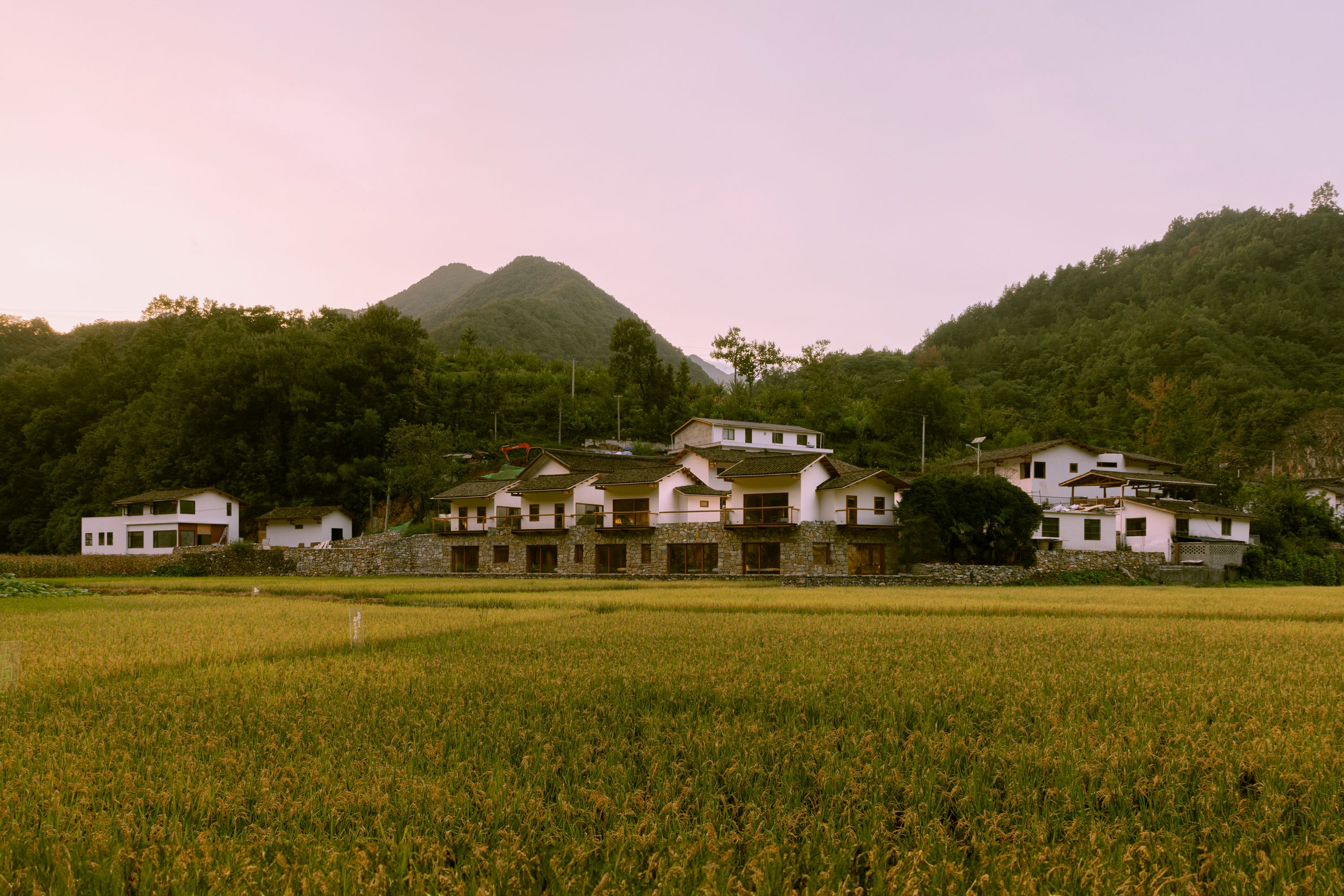
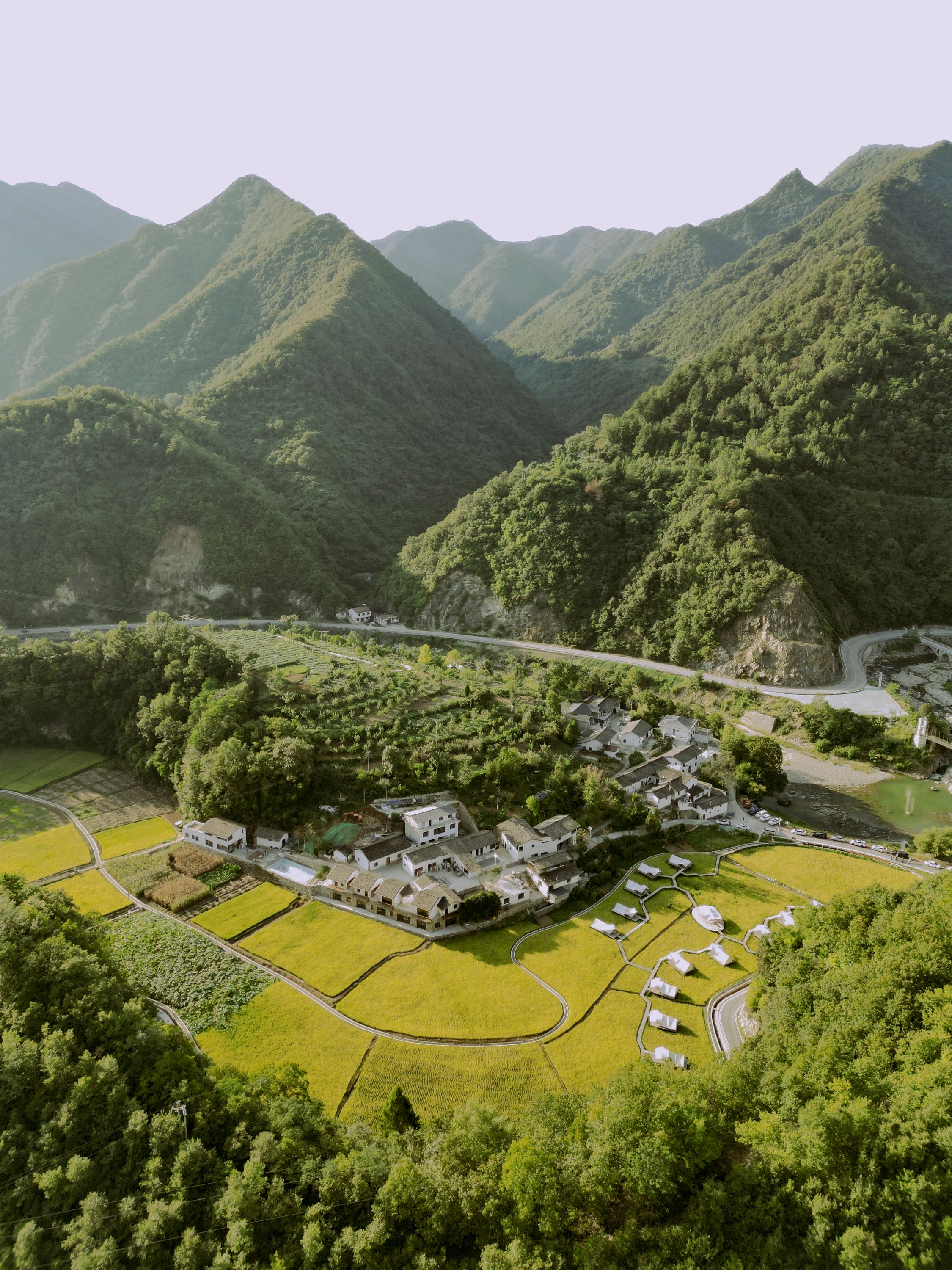
集落と敷地前面に広がる開放的な田園風景
本プロジェクトは、中国・陝西省安康市寧陝県漁湾村に位置し、既存の村落と一体となるよう計画されています。
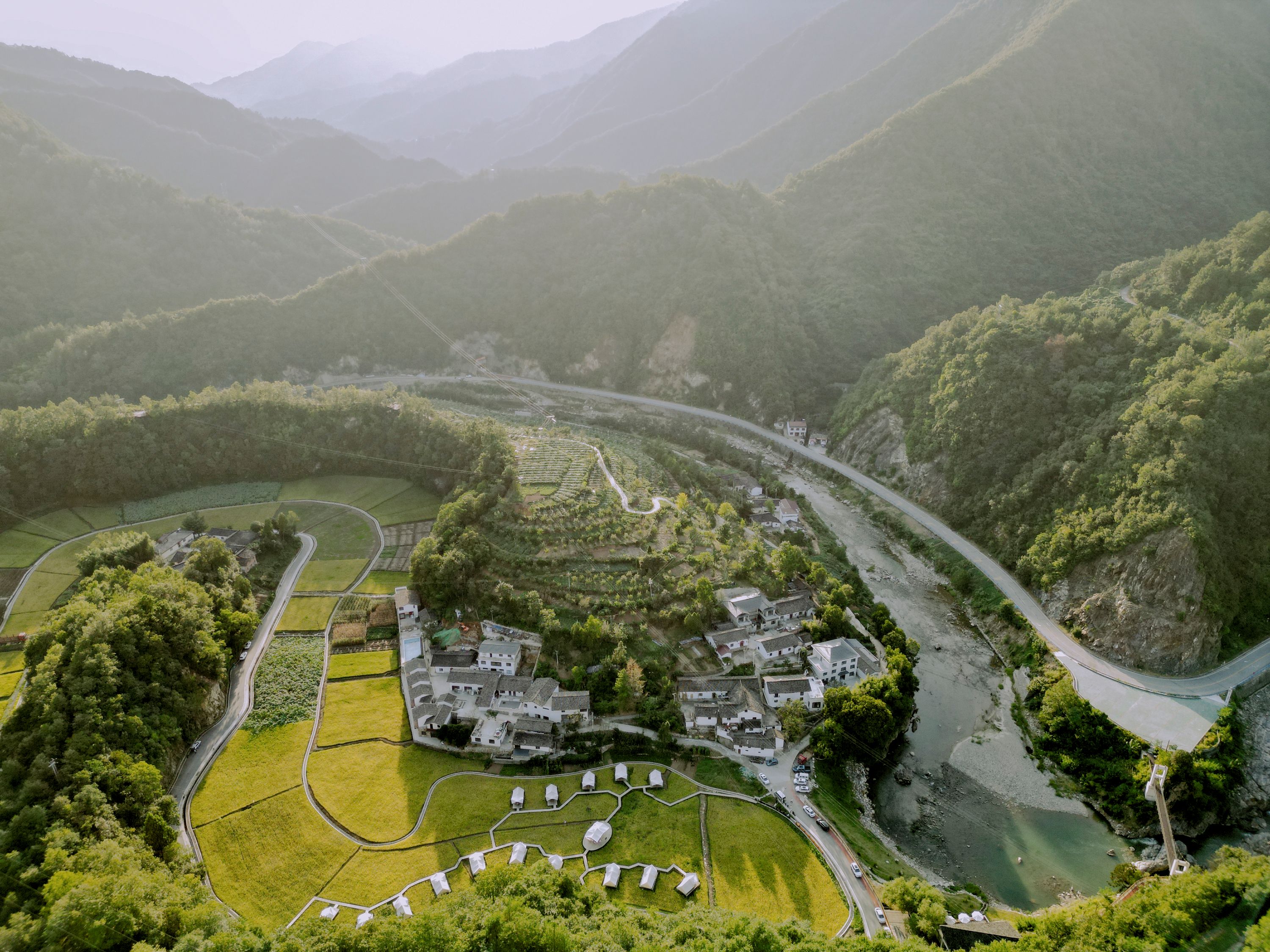
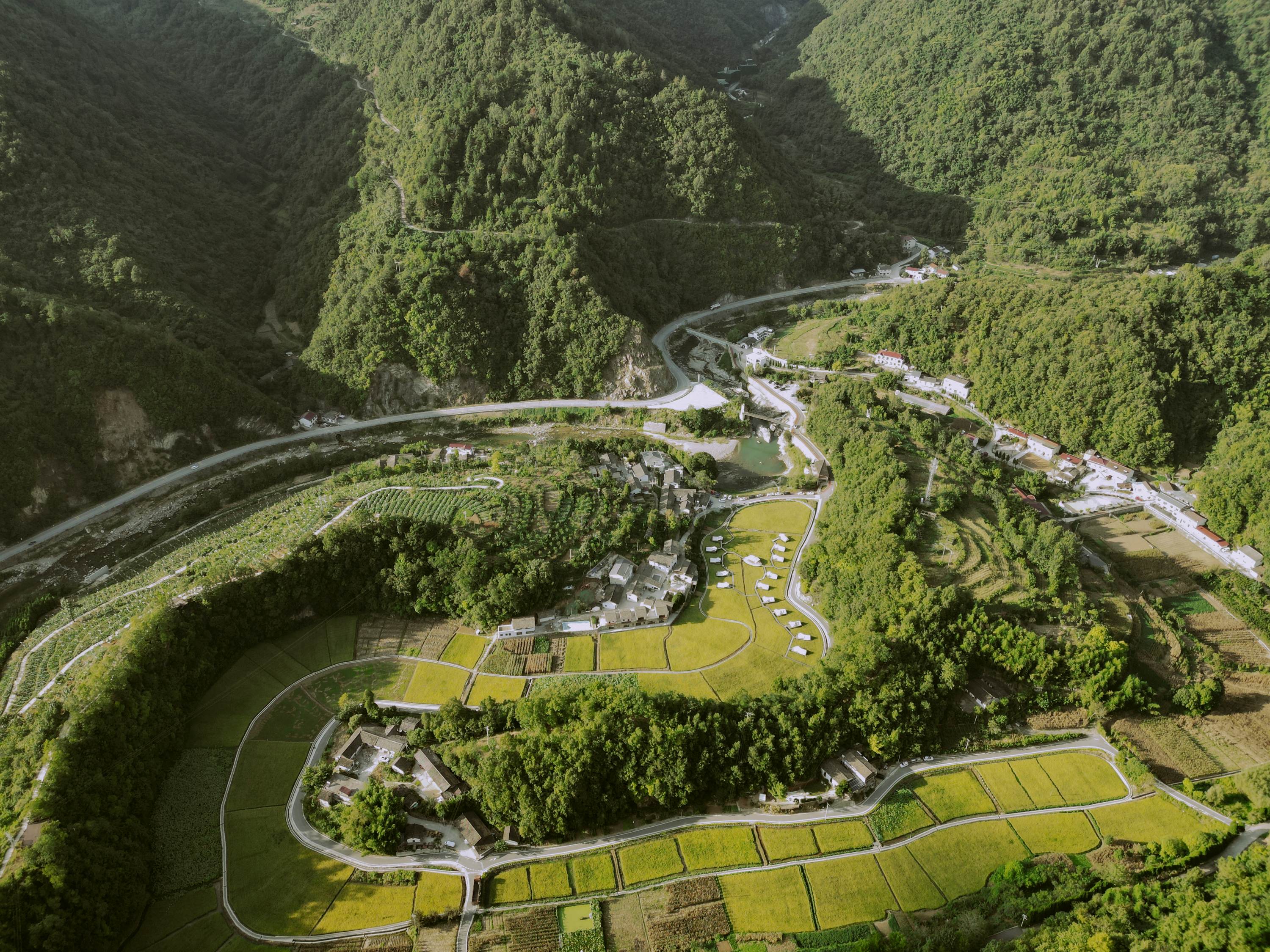
敷地は自然資源に恵まれ、環境も美しく、原生的な自然が良好に保たれた地域であり、トキ(朱鷺)の生息地でもあります。計画地は、段々畑が連なる山腹に位置し、外周には玉石を積み上げた擁壁が巡らされ、正面には開放的な農地の風景が広がる、印象的なロケーションです。
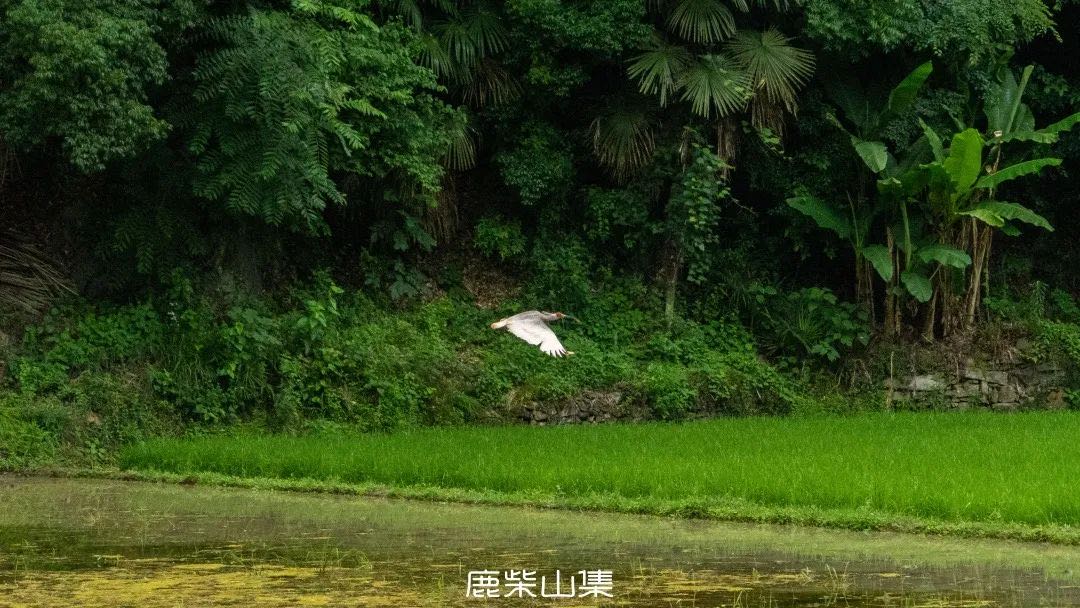
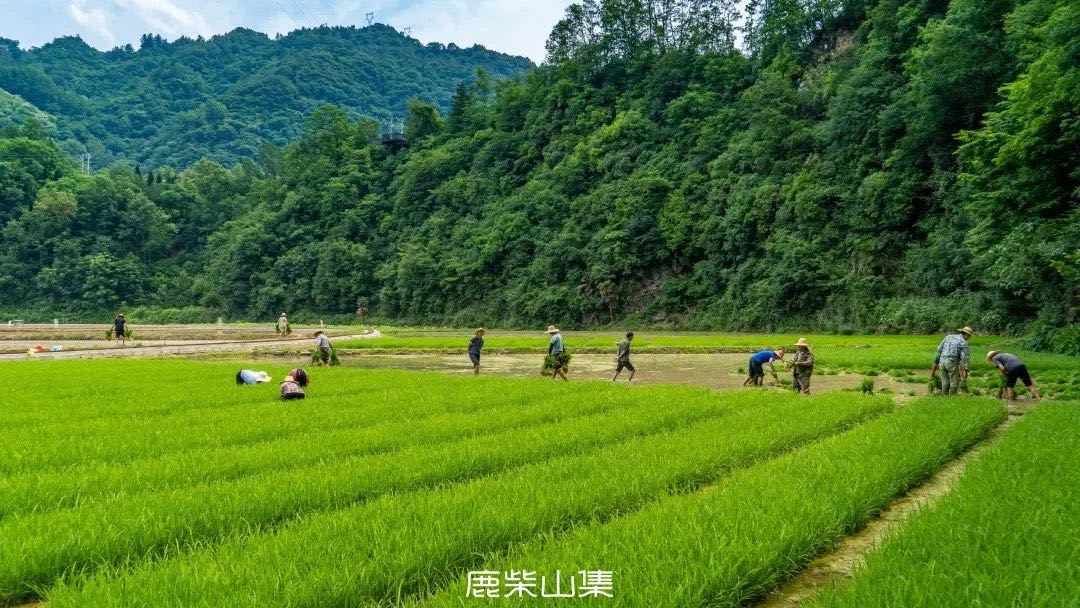
渔湾村に残る、トキの生息地の豊かな自然環境
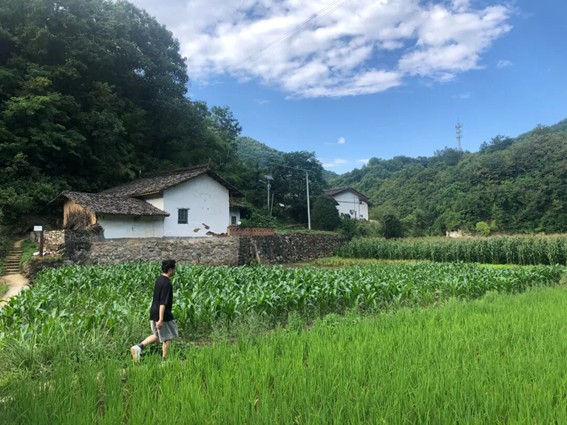
敷地周囲に残る、既存住宅と石積みの擁壁

集落全体配置図 ©kooo architects
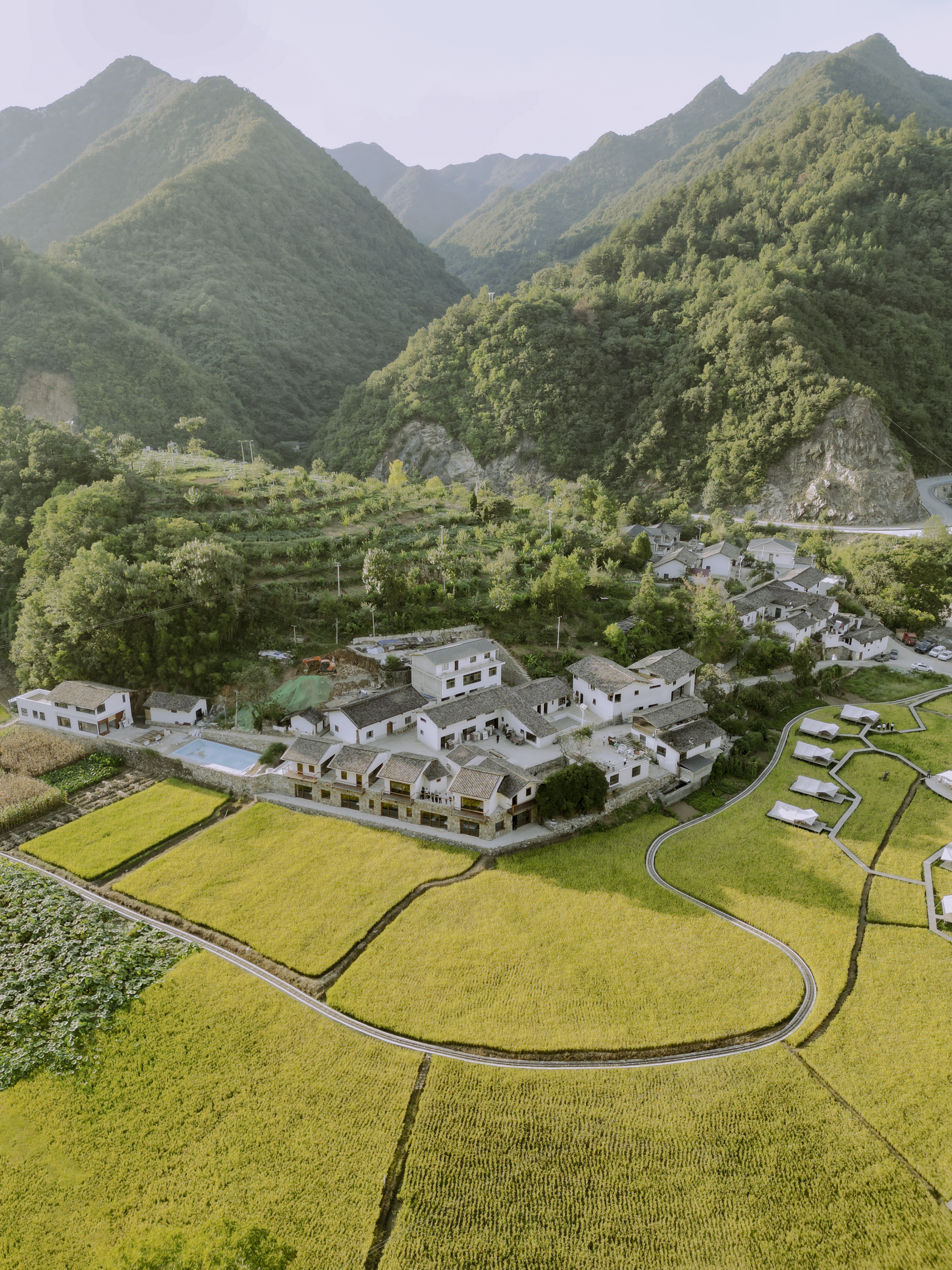
全体鳥瞰
本計画では、民宿を村落に溶け込ませ、生態系への影響を最小限に抑えることを重視しました。周辺環境と一体化するデザインを目指し、新築建築が環境に与える負荷を軽減するとともに、段階的な開発手法を採用しています。
また、設計コンセプトとして、できる限り地域の建築材料を使用し、地元の伝統的な工法を建設プロセスに取り入れることで、建築が土地固有の風景と調和することを目指しました。
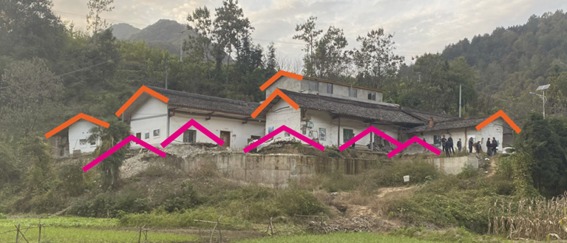
現地でのコンセプトスケッチ ©kooo architects
設計上の主な方針
- 建築ボリュームを抑え、従来案の過度な圧迫感を解消
- 切妻屋根を採用し、地域の建築や周辺環境との調和を図る
- 白壁・灰色瓦・部分的な石材など、地域の素材を選定
- 周辺既存建築のスケールやボリューム感と整合させる
高低差のあるL字型敷地に対し、開放的な農地に面した連続する2階建ての建築を計画しました。

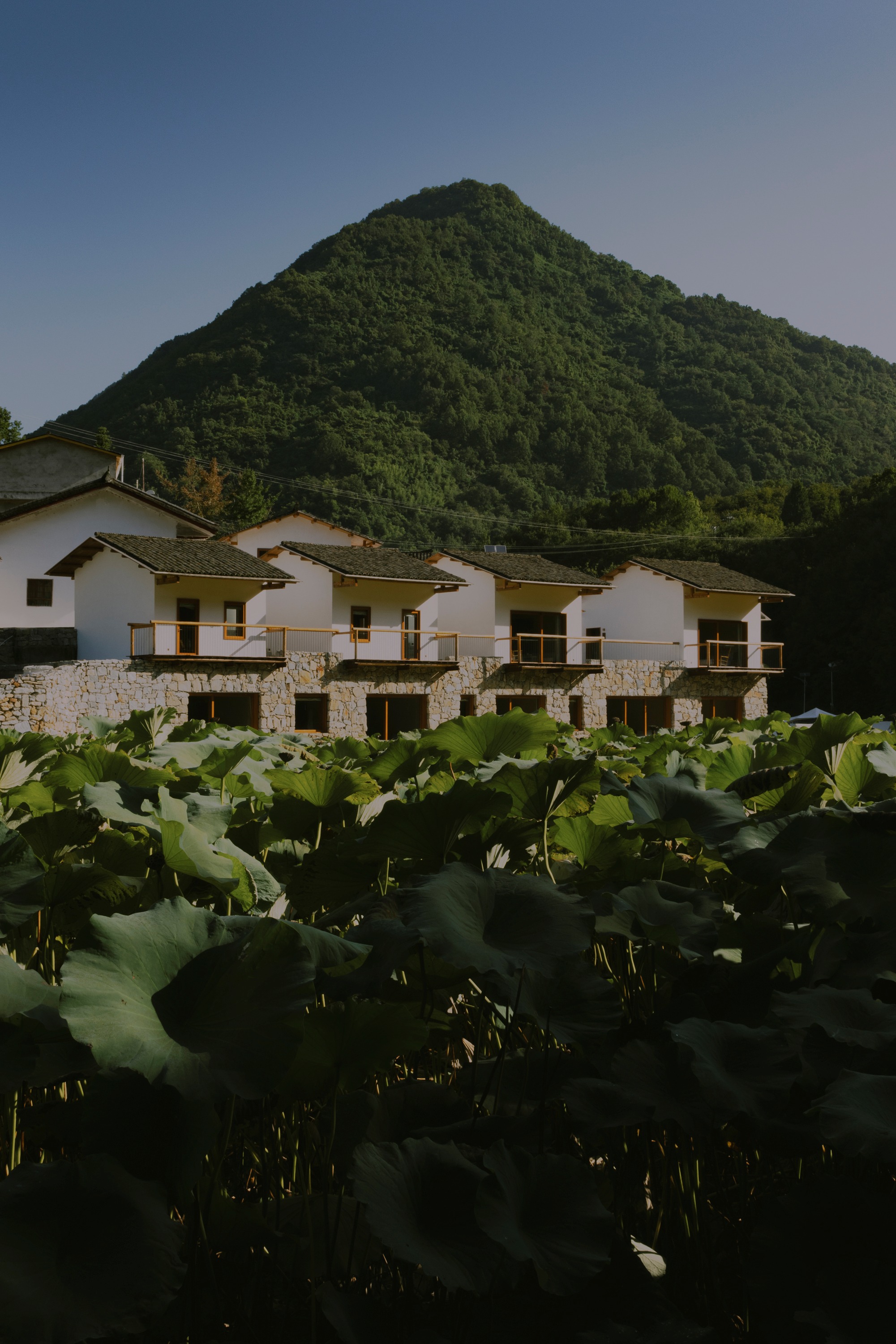
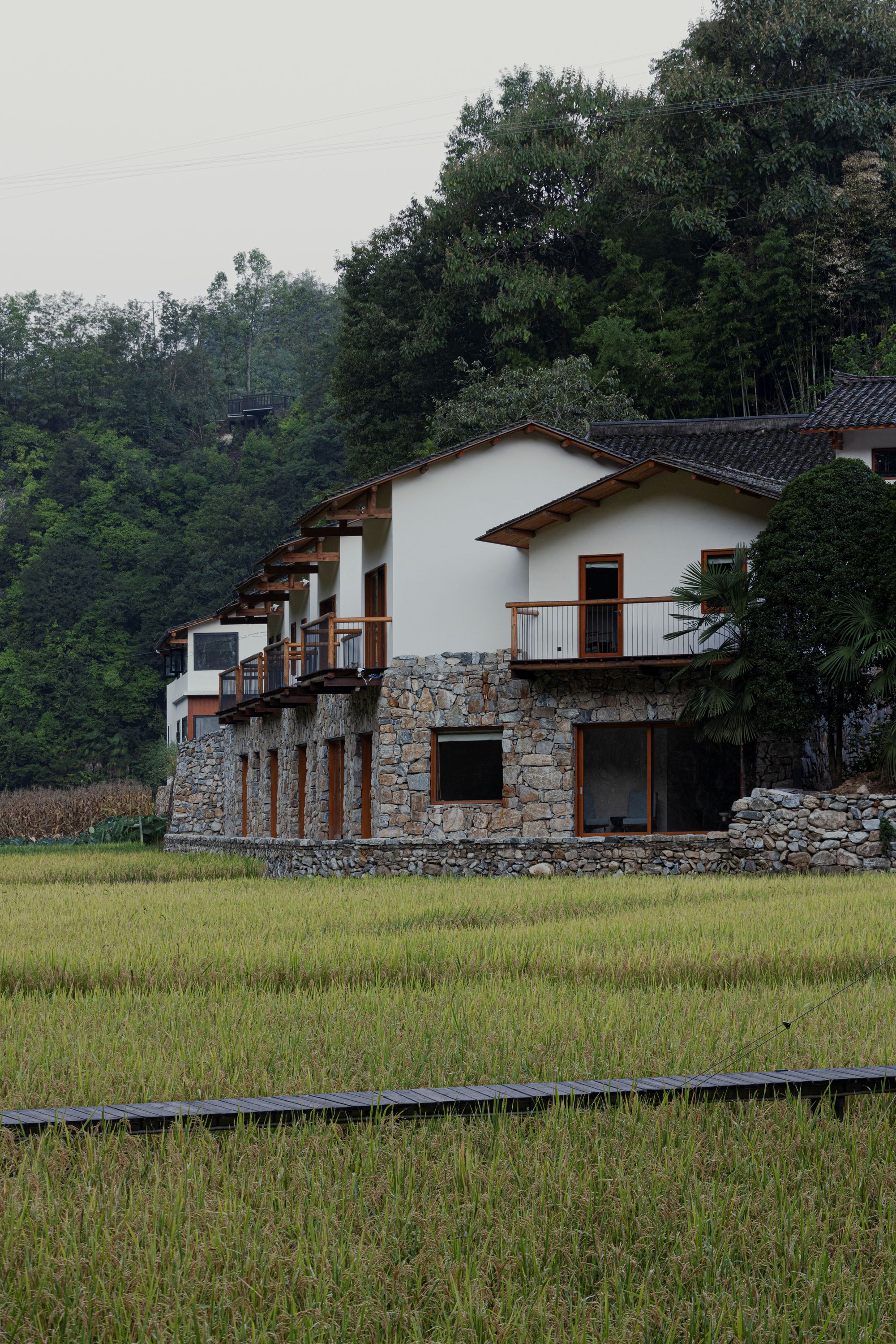
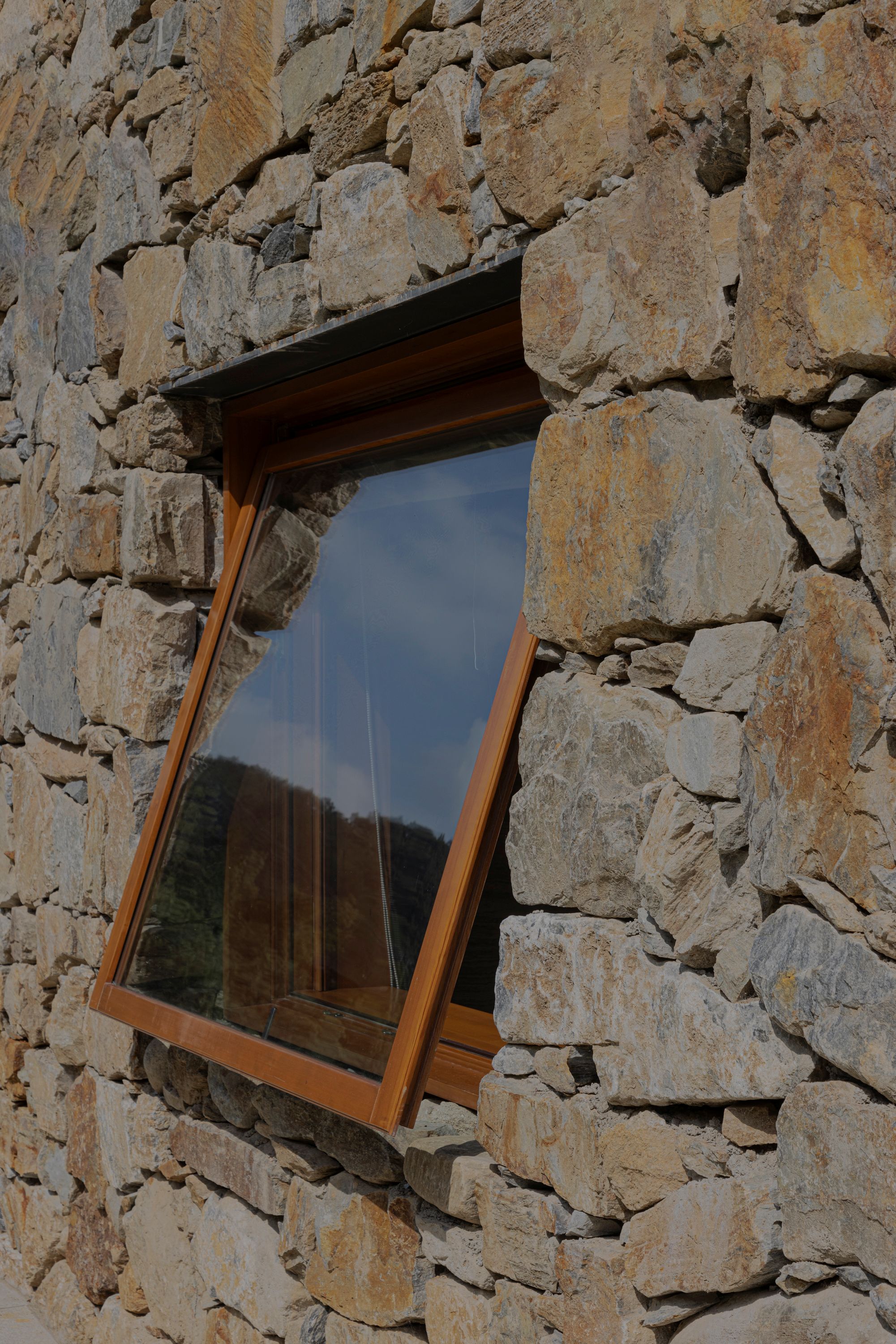
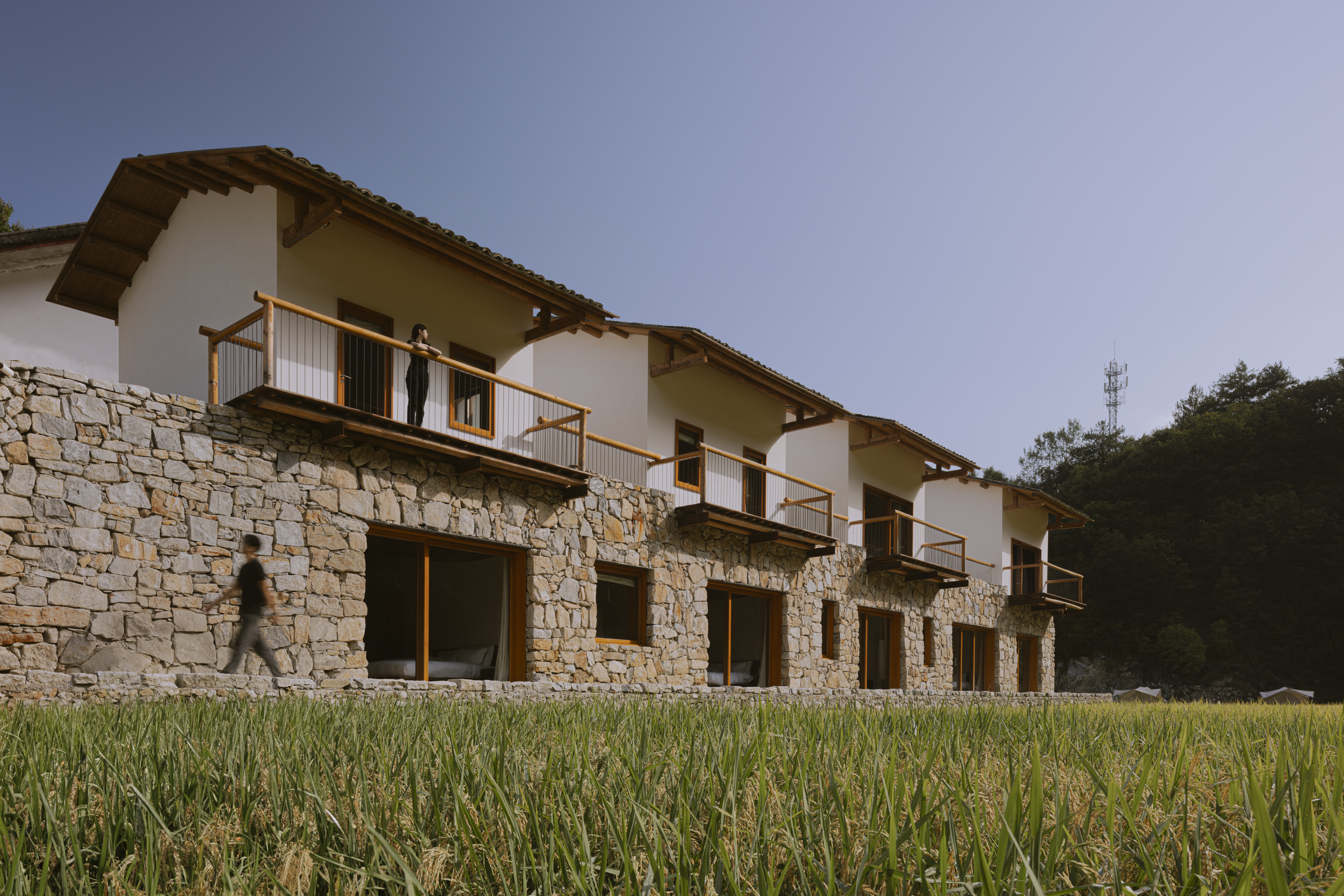
1階の床レベルは田畑と同じ高さに設定し、視線が正面に広がる田園風景と水平につながるよう配慮しています。外壁には敷地周辺に見られる玉石積みの擁壁を用い、既存の石積みと呼応することで、風景の一部として建築を成立させています。
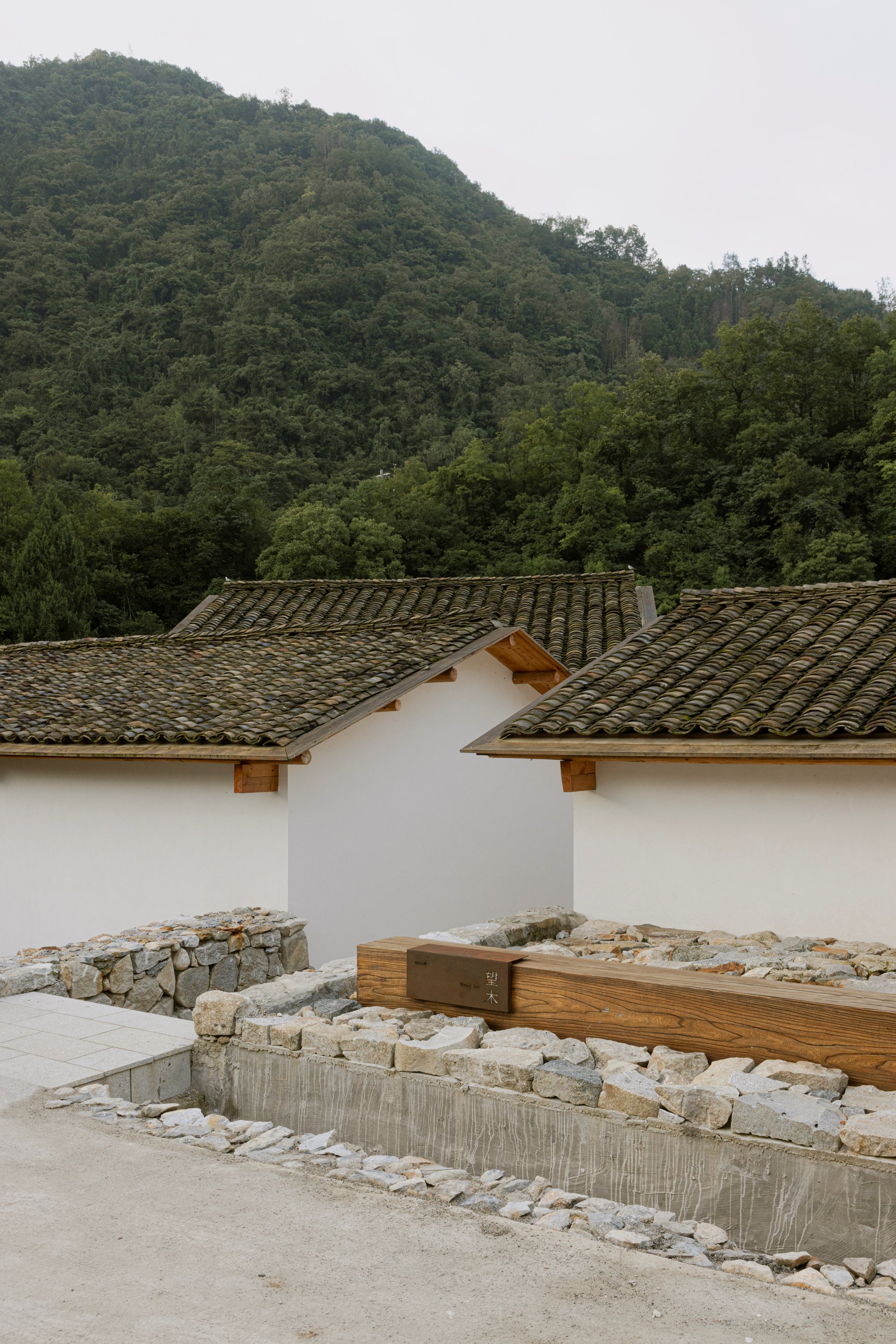
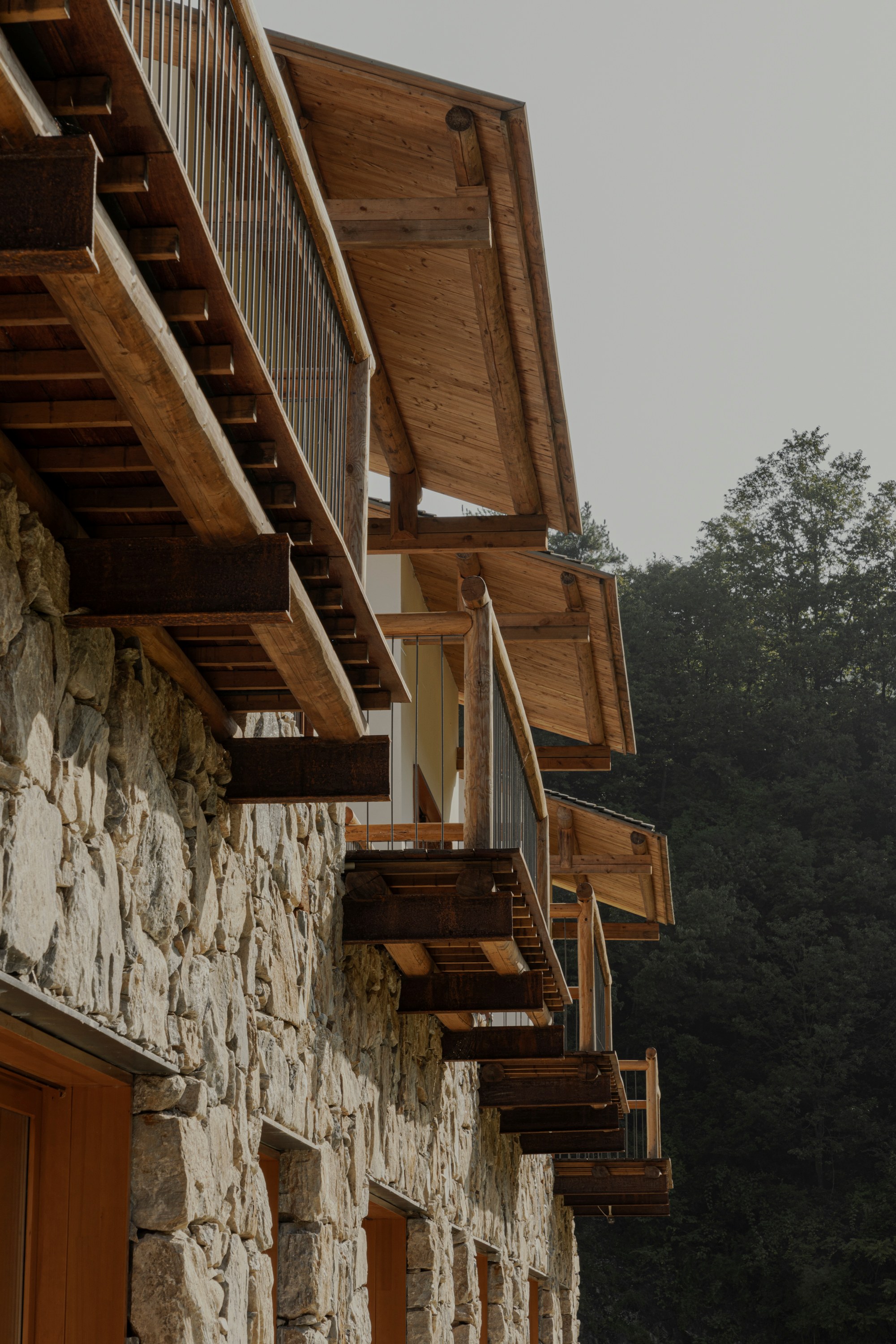
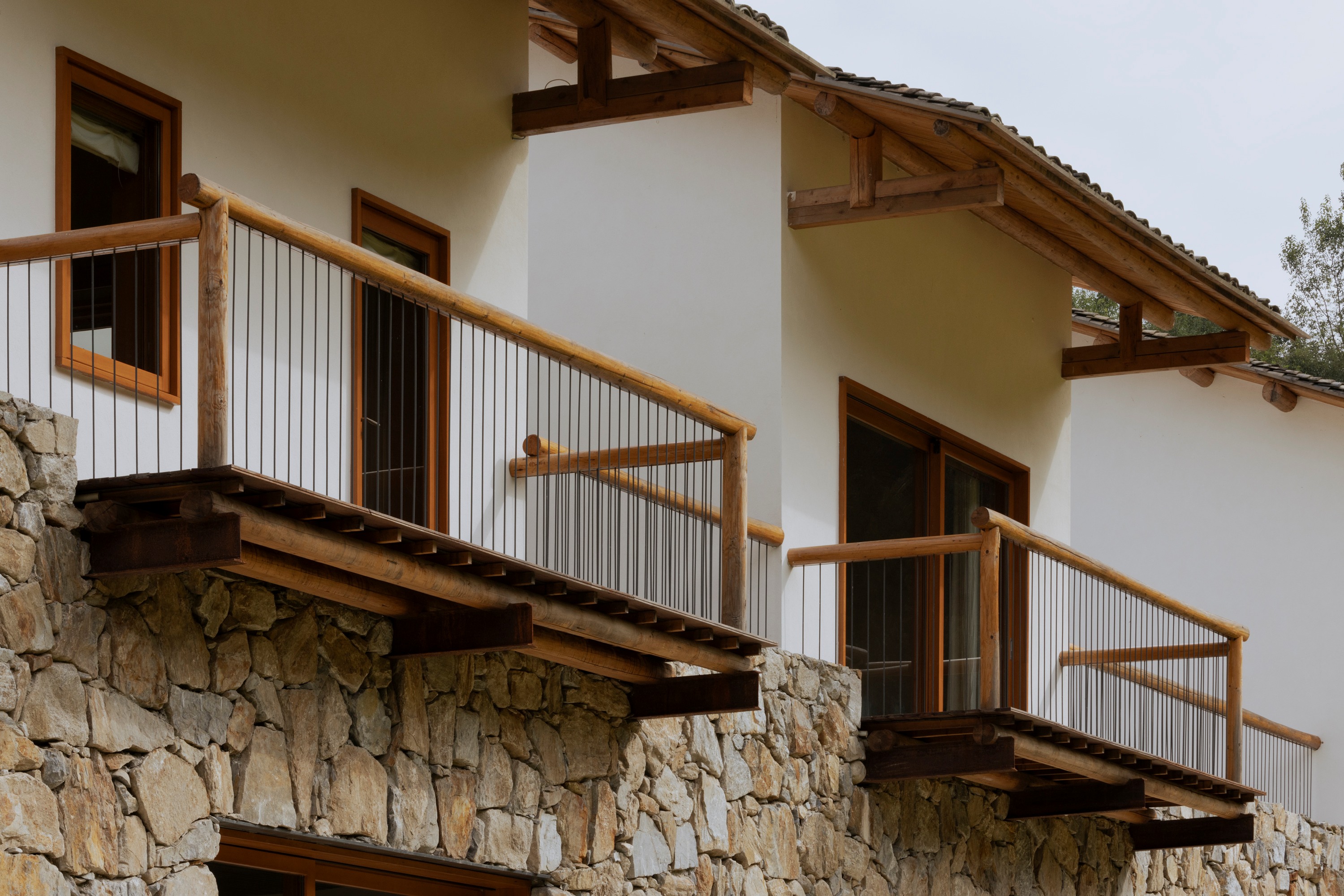
2階のテラスや屋根架構には、地域建築と同様に垂木として無垢材を使用し、新築でありながらも、もともと村にあったかのような佇まいを生み出しています。
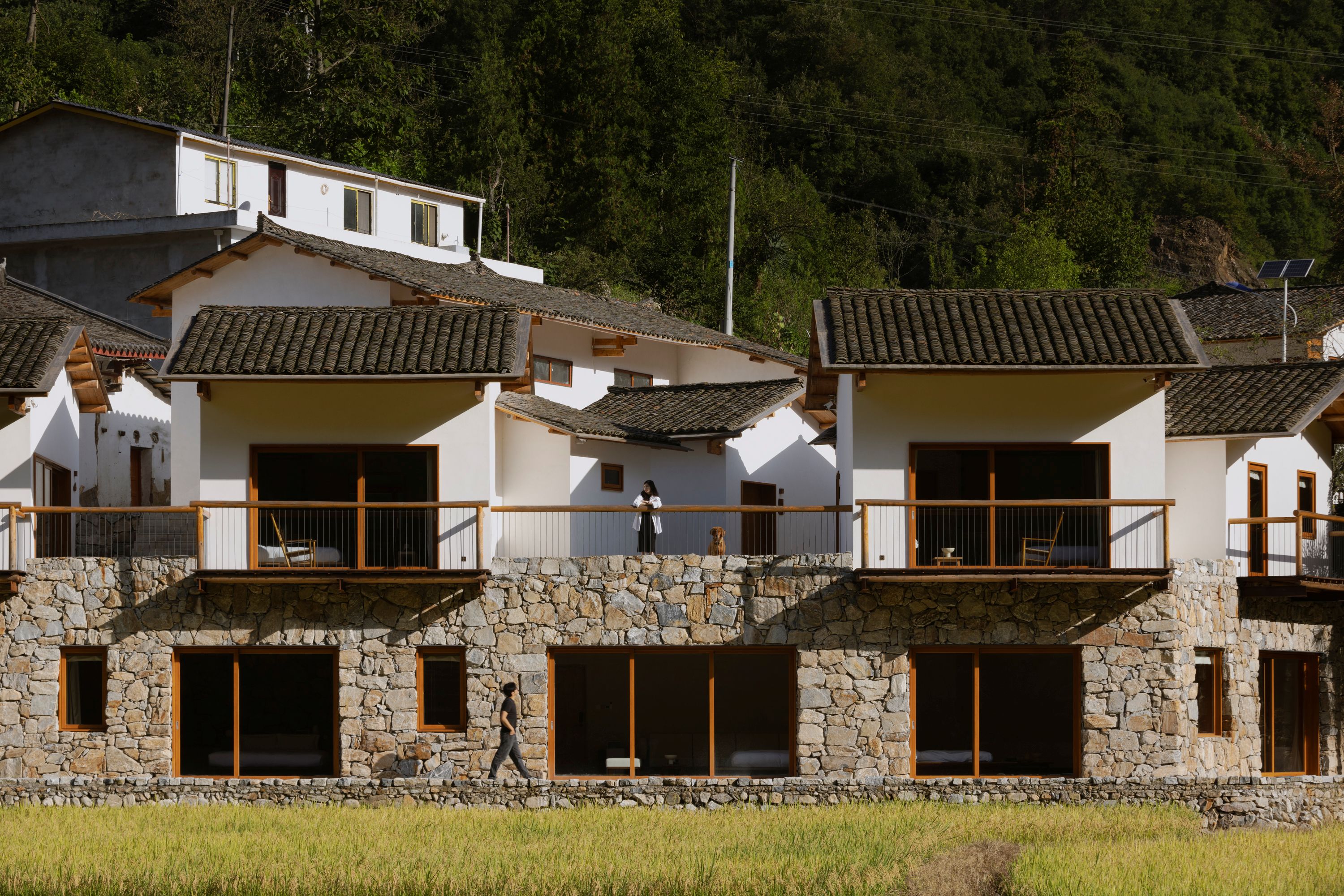
計画の全体像

蓮池から見る本計画地
地元の職人は地域素材の扱いに精通しており、石材は敷地近くの川から採取したものを使用しています。村落は高低差の大きい地形で、周囲には玉石積みの擁壁が数多く見られます。こうした手法を継承することで、建築を周辺環境の延長として位置づけ、敷地に自然に溶け込ませています。
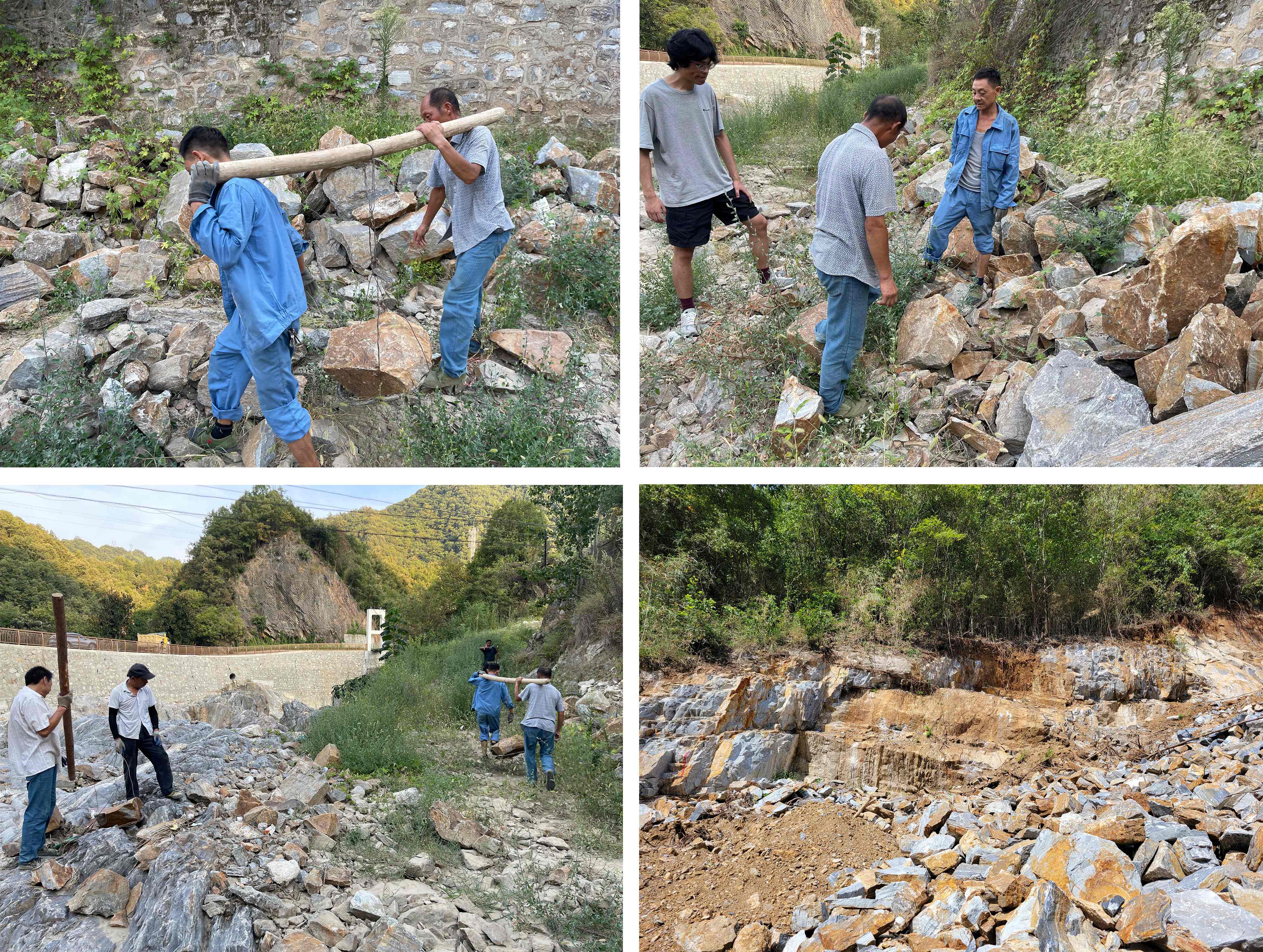
職人とともに地元の石を選び、運び出す様子
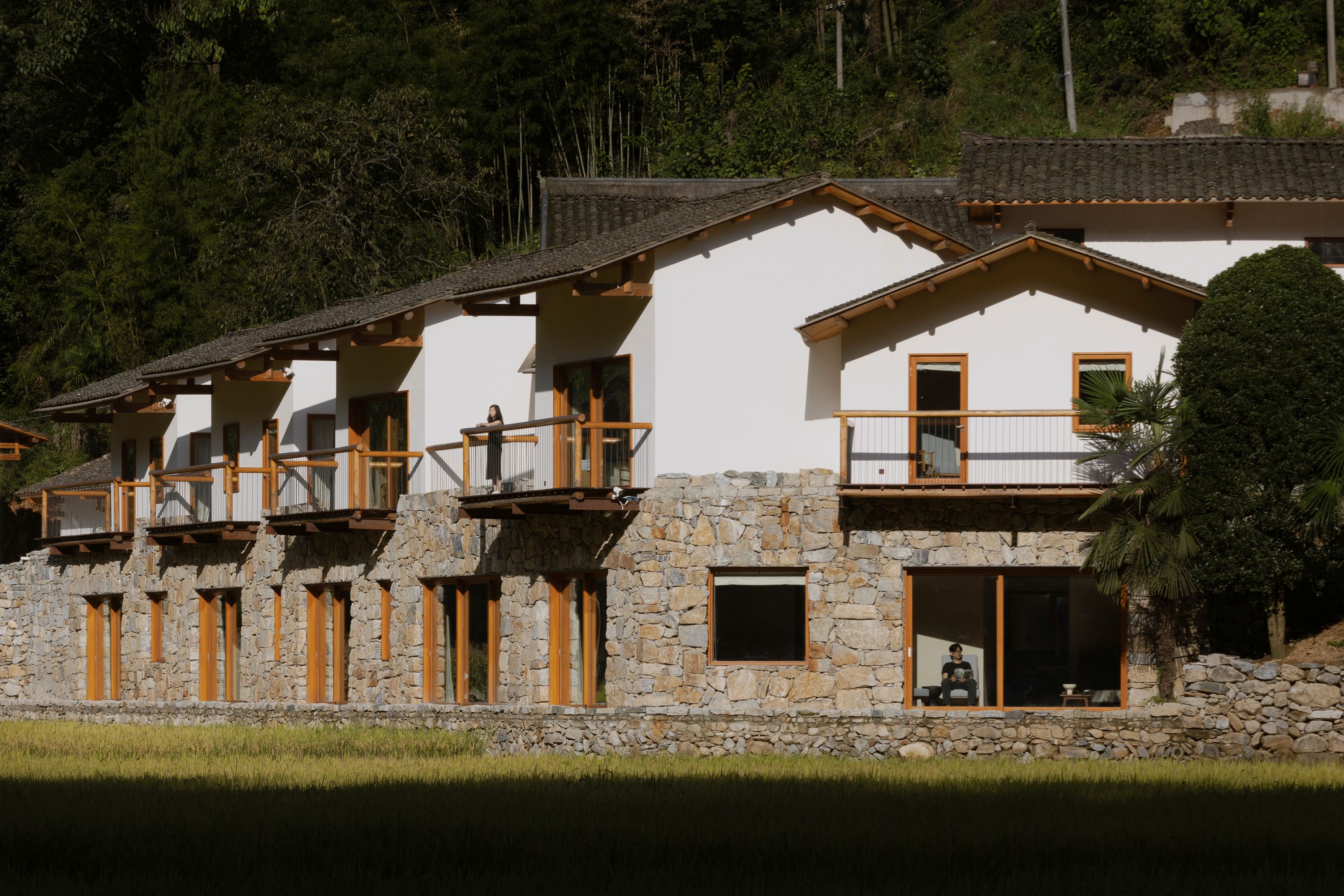
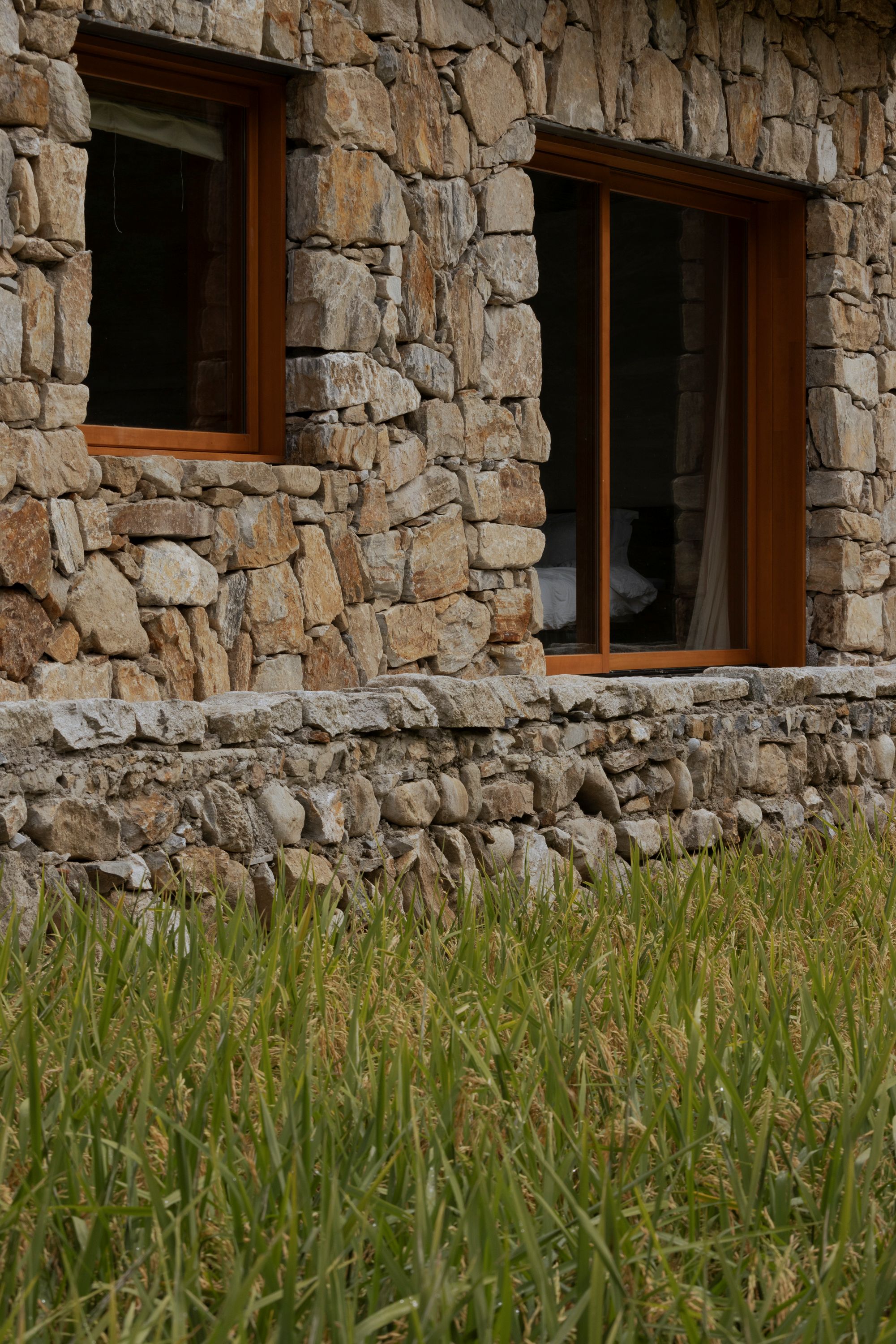
石と木枠の取り合いは丁寧に設計され、石が積層される質感を強調しています。建築同士の間に設けた「隙間」によって視線が抜け、小さなスケールのボリュームとすることで、背後のテラスからの眺望を遮らない構成としました。
屋根やバルコニーには、伝統的な木構法を踏襲し、古材を用いることで、素朴で落ち着いた建築表現を保っています。
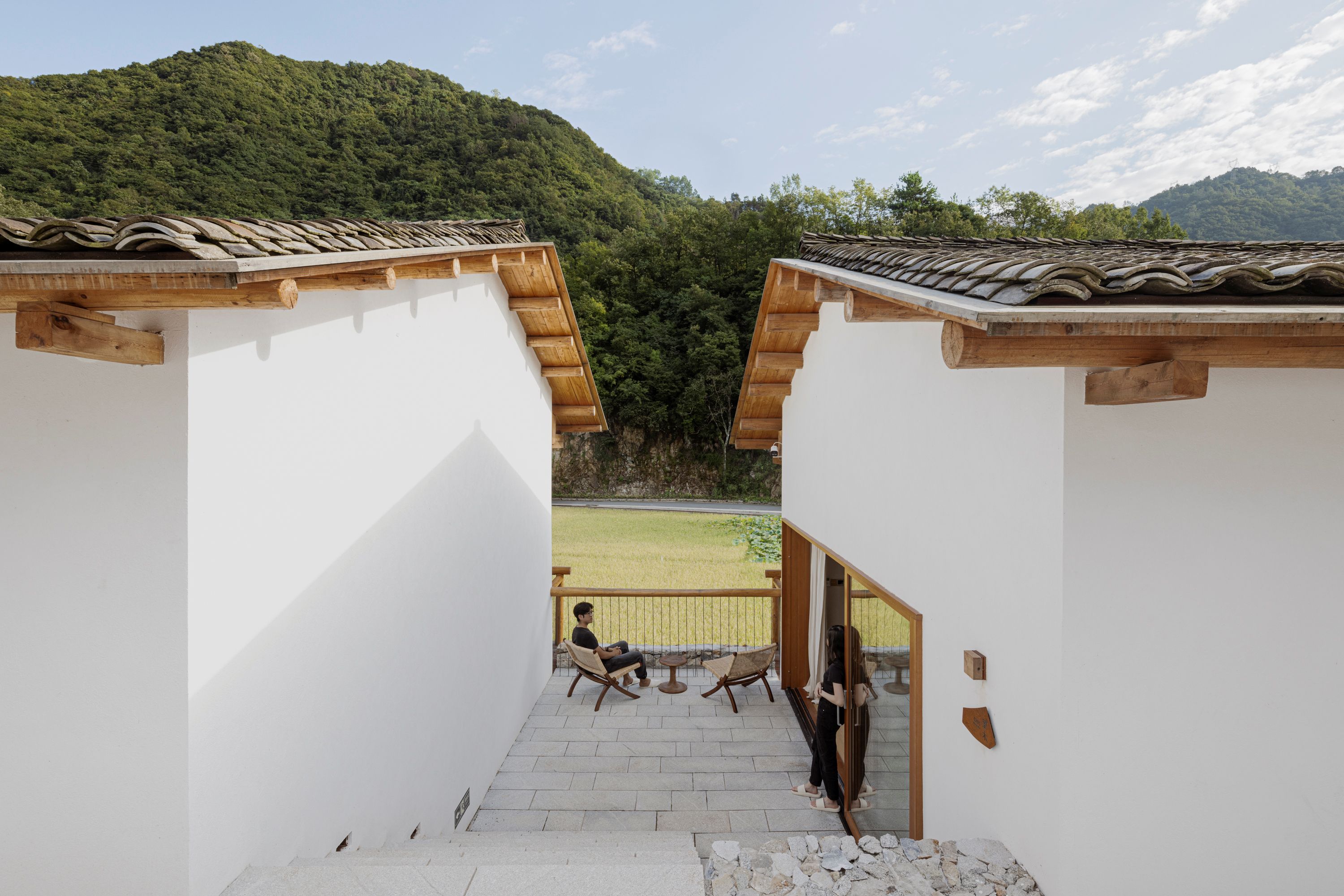
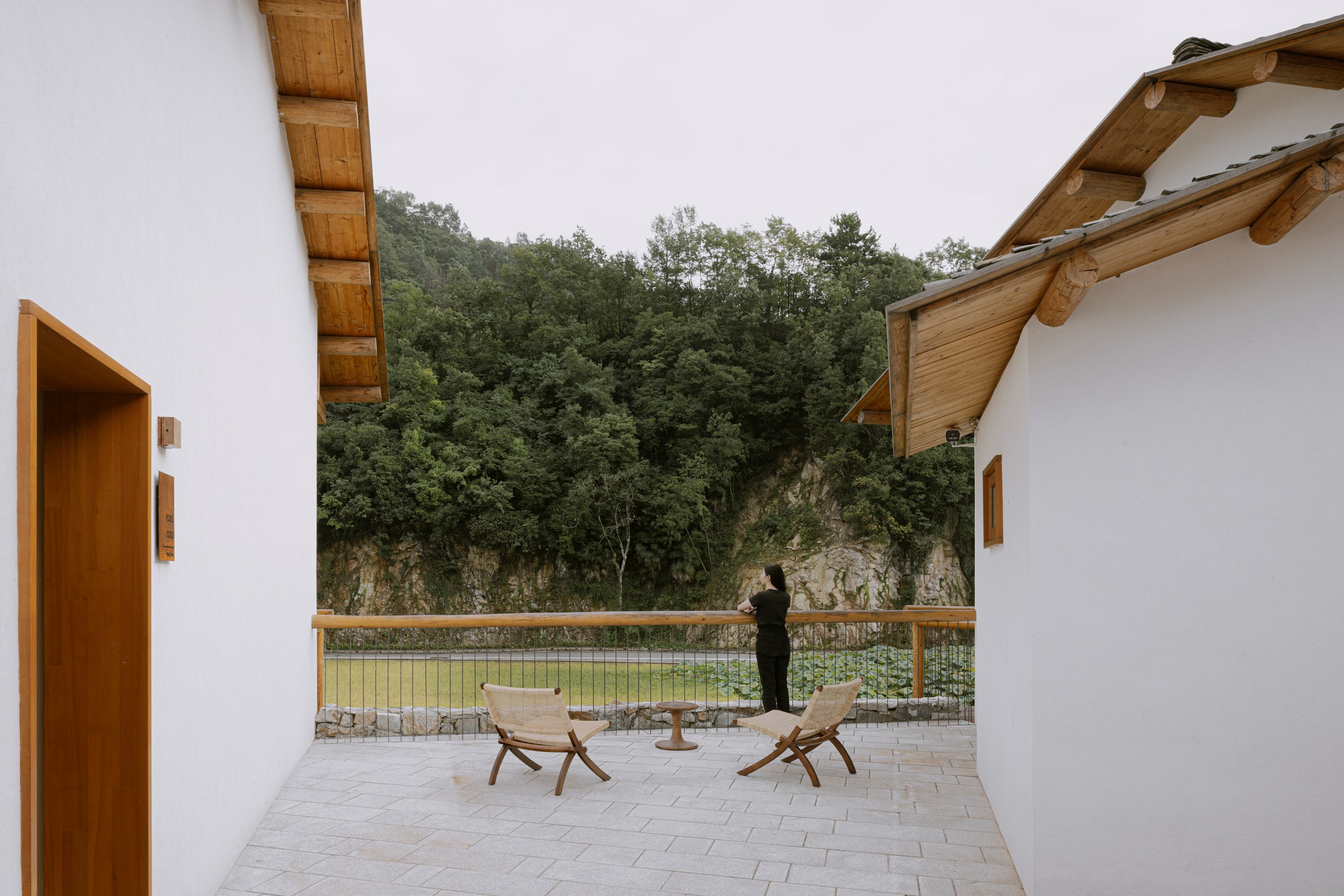
客室のあいだに“隙間”を設け、エントランスとすることで、客室間に中庭空間を生み出している
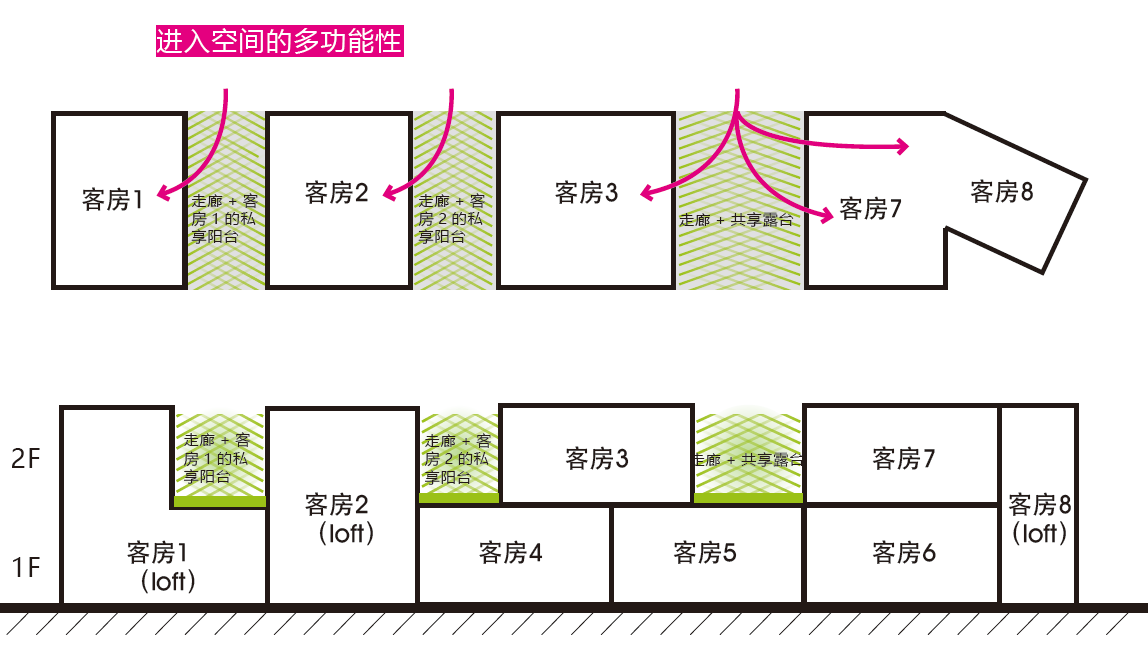
“隙間”コンセプトスケッチ ©kooo architects
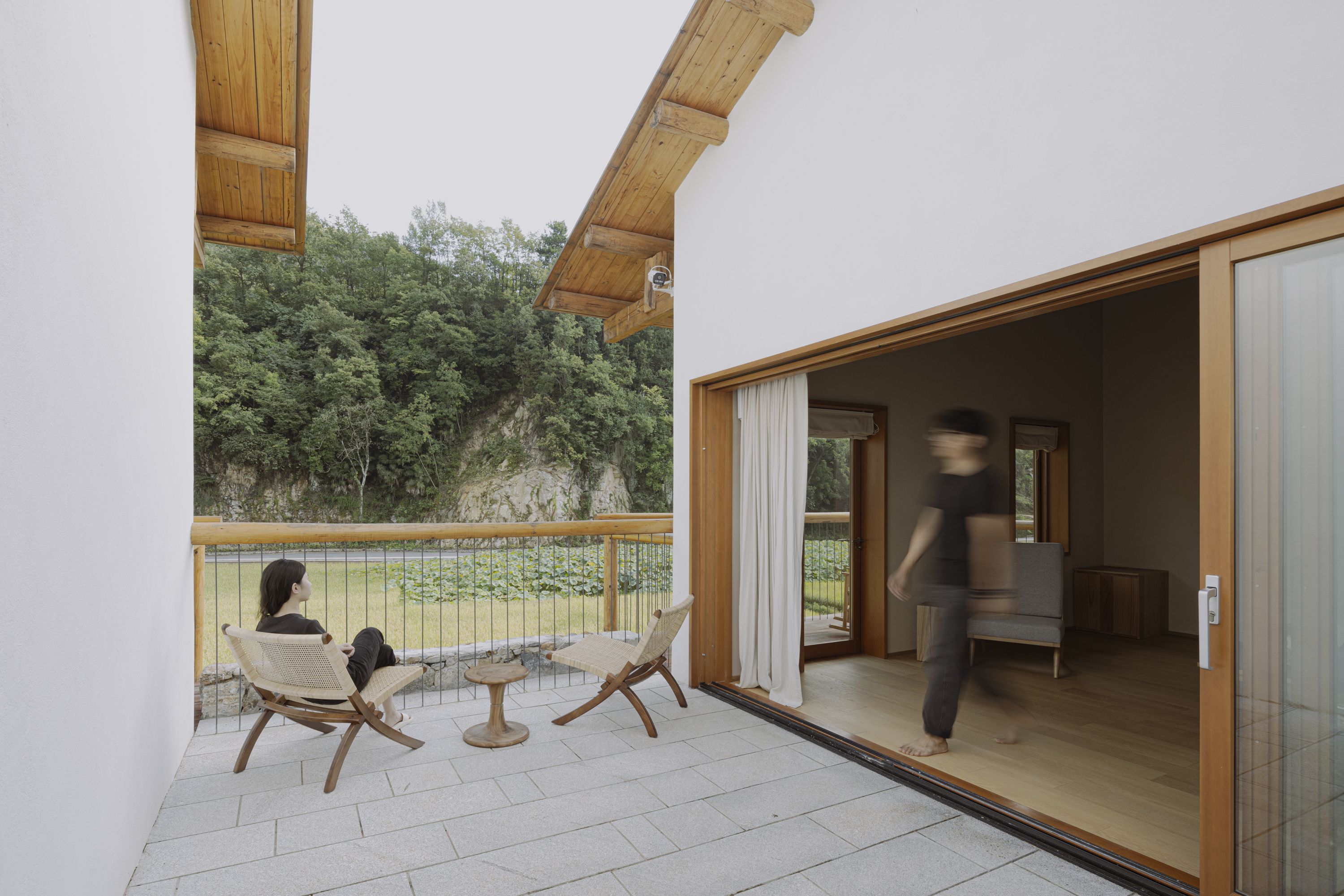
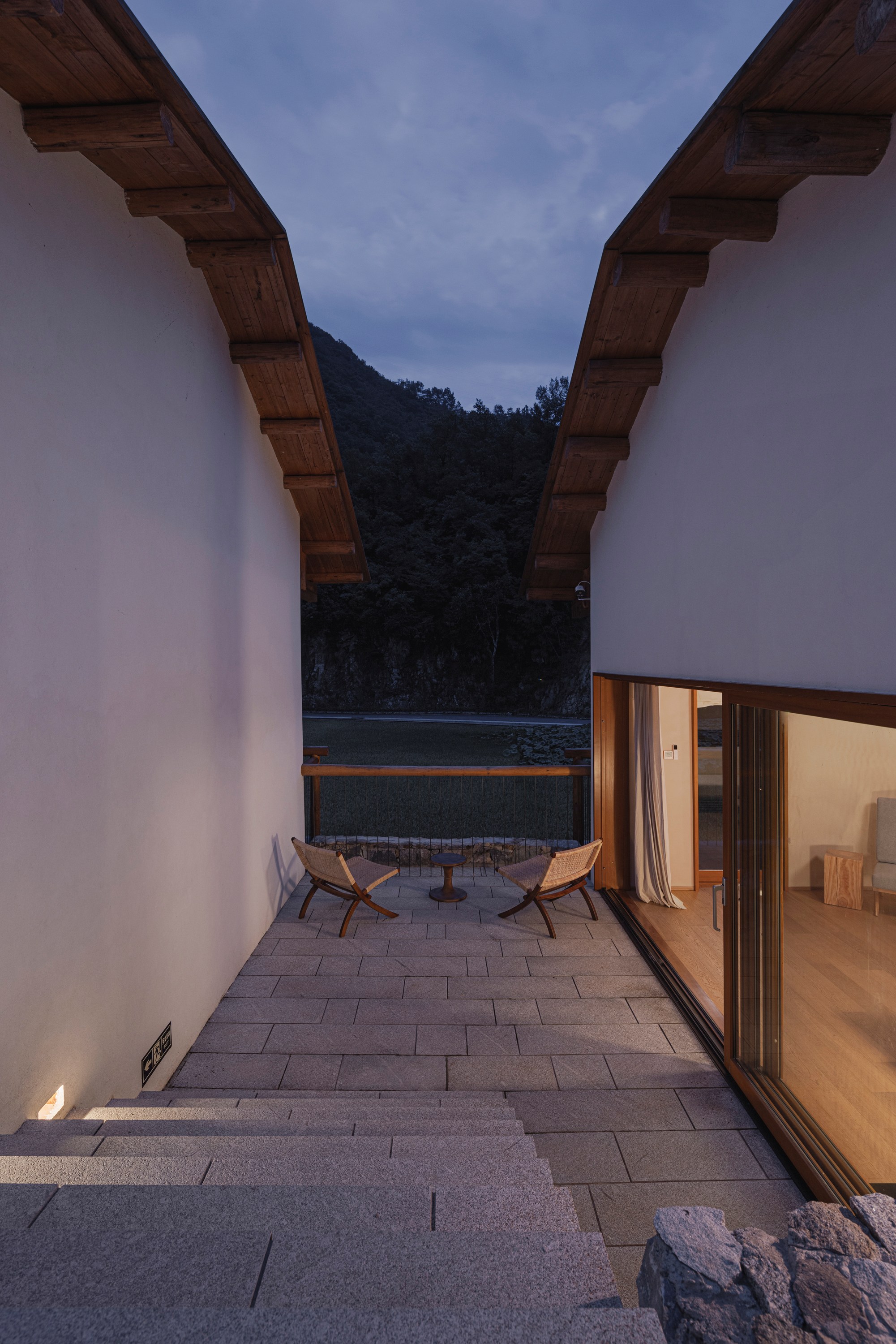
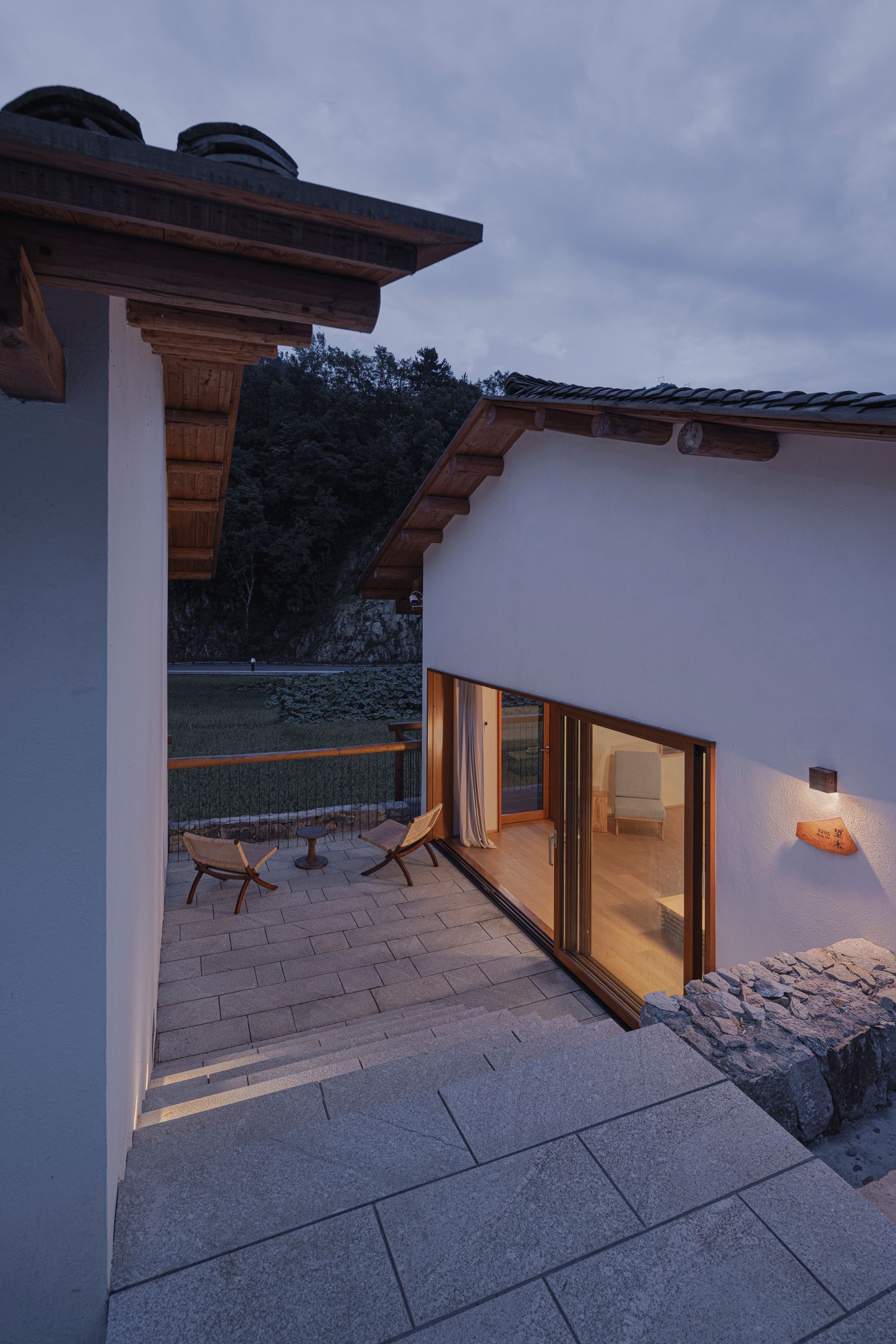
“隙間”を介して、室内とテラスを接続している
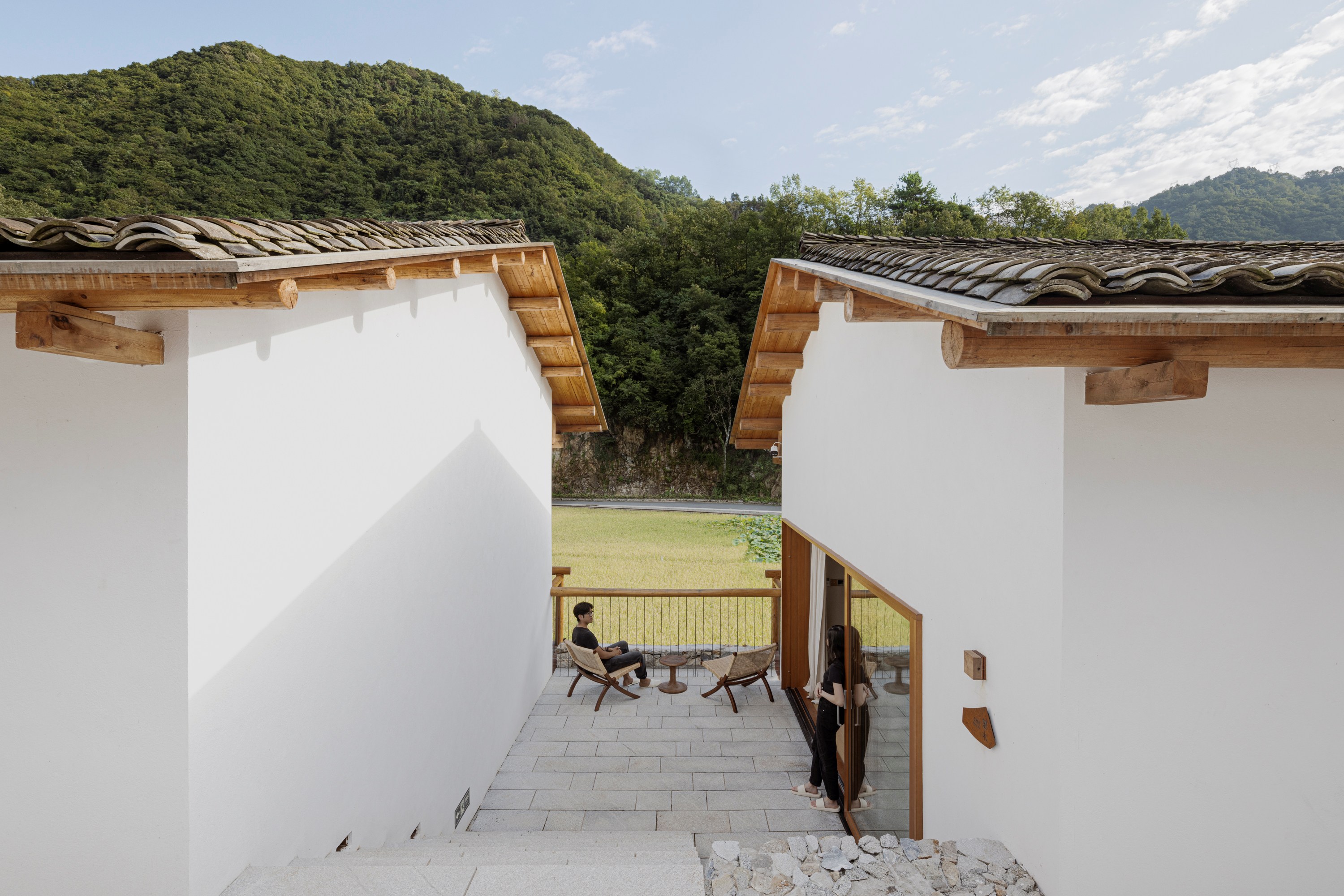
全体計画では、客室の間に「間隙」となる空間を挿入し、ここをエントランスとして計画しました。この空間は客室専用の屋外庭として機能すると同時に、建築ボリュームを分節し、周辺住宅のスケールや風貌と調和させる役割を担っています。
宿泊客がレセプションから各客室へ向かう際、2階の「間隙」空間を通ることで、外に広がる田園風景を楽しむことができます。滞在中、宿泊客は周囲の自然風景をより深く体験し、都市型ホテルとはまったく異なる滞在体験を味わうことができます。「間隙」空間は単なる廊下ではなく、客室へのアプローチであり、同時に専有庭として機能します。
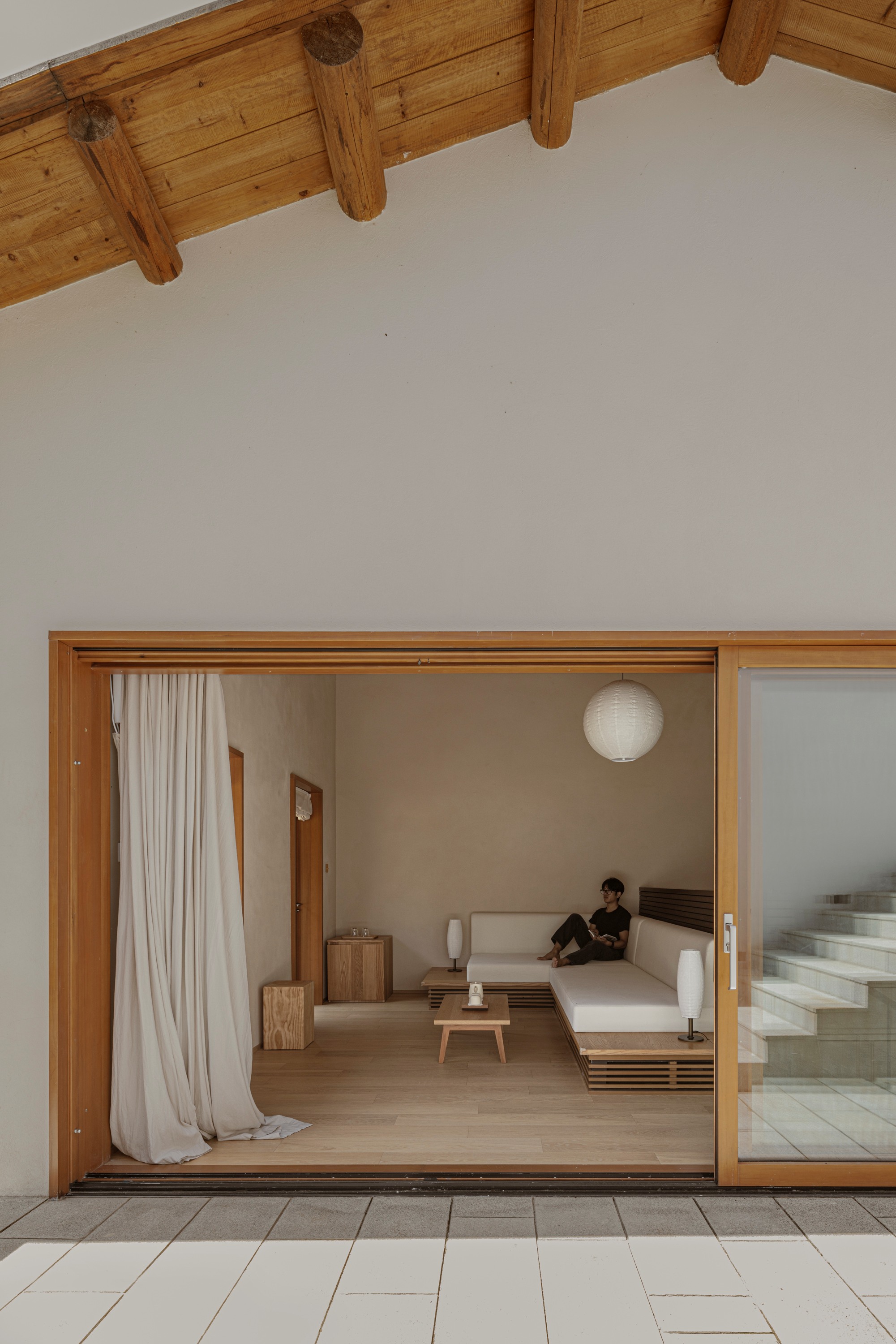
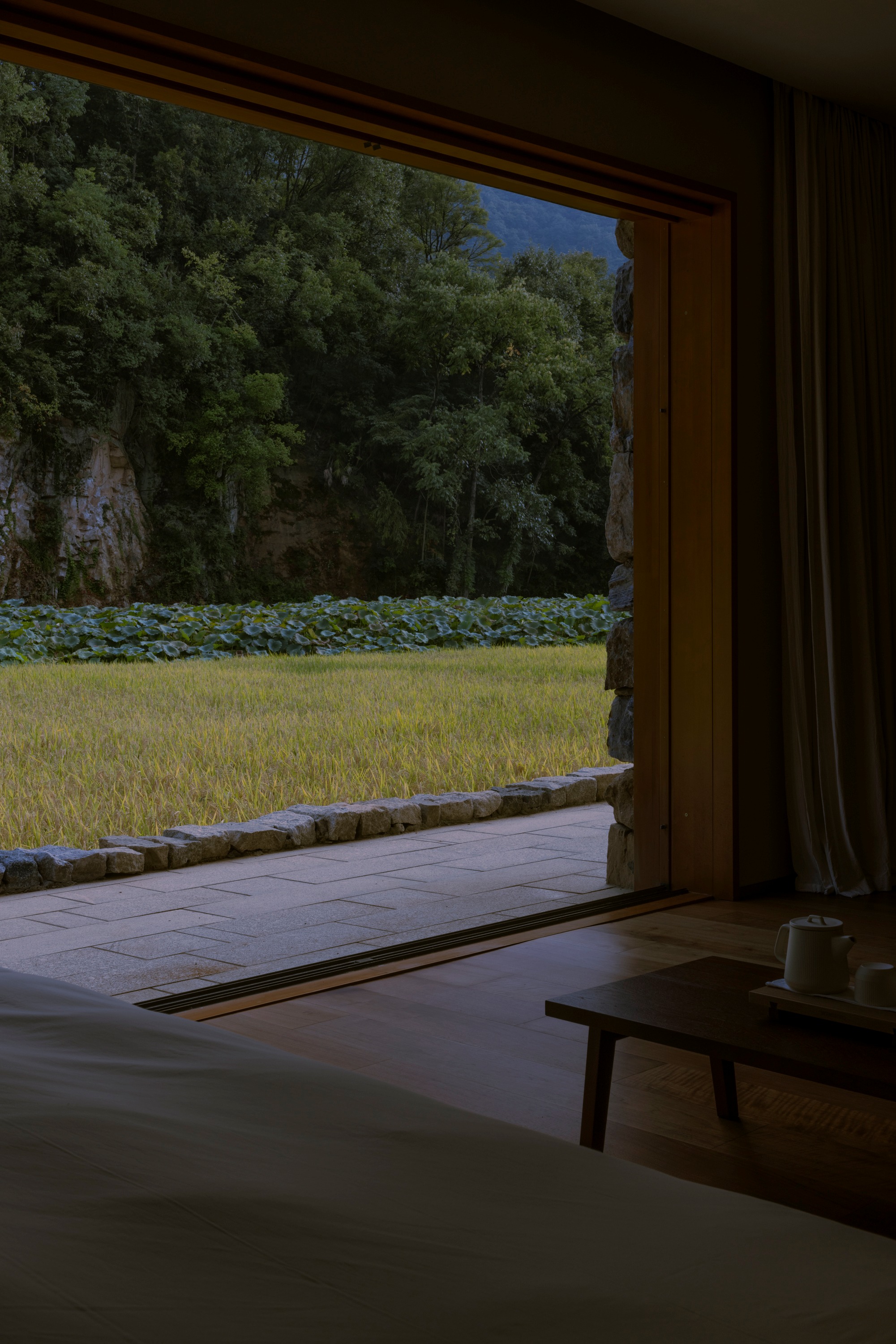
客室入口の大開口ガラス引き戸を全面開放することで、室内と屋外庭が一体となり、より開放的な空間が生まれます。

村の風景と重なる木架構と瓦屋根
建築間の「隙間」による視線の抜けと、小スケールな構成により、背後のプラットフォームからの眺望を確保しています。屋根やバルコニーには、地域の伝統的な木構法を用い、古材を使用することで、素朴で飾らない建築の表情を維持しています。
民宿は2階建てで、8種類の異なる客室タイプから構成されています。多様な客室プランは、再訪の動機を生み、それぞれ異なる空間体験を提供します。
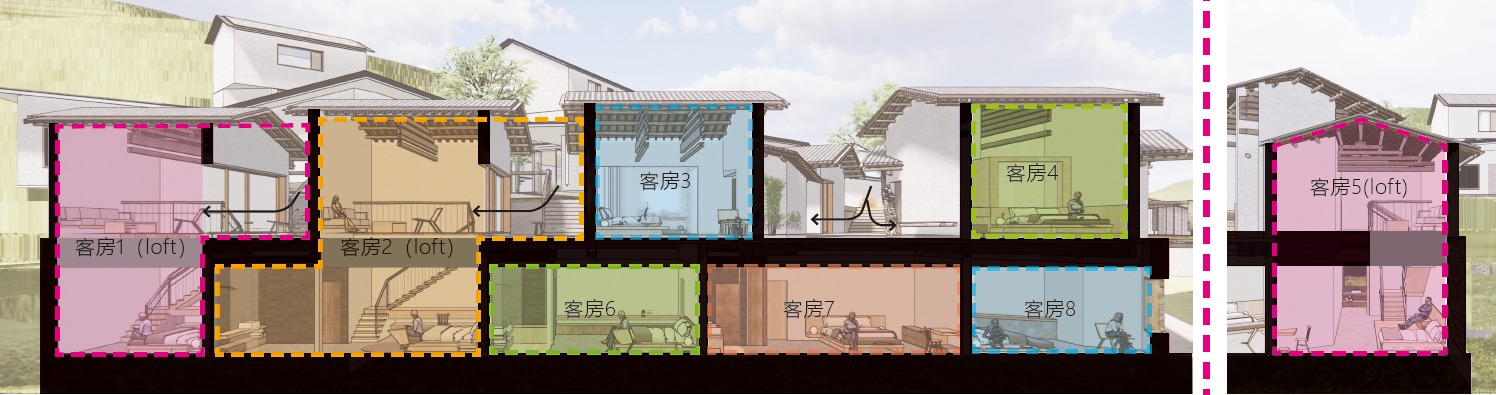
2階建て・8種類の異なる客室タイプ section diagram ©kooo architects
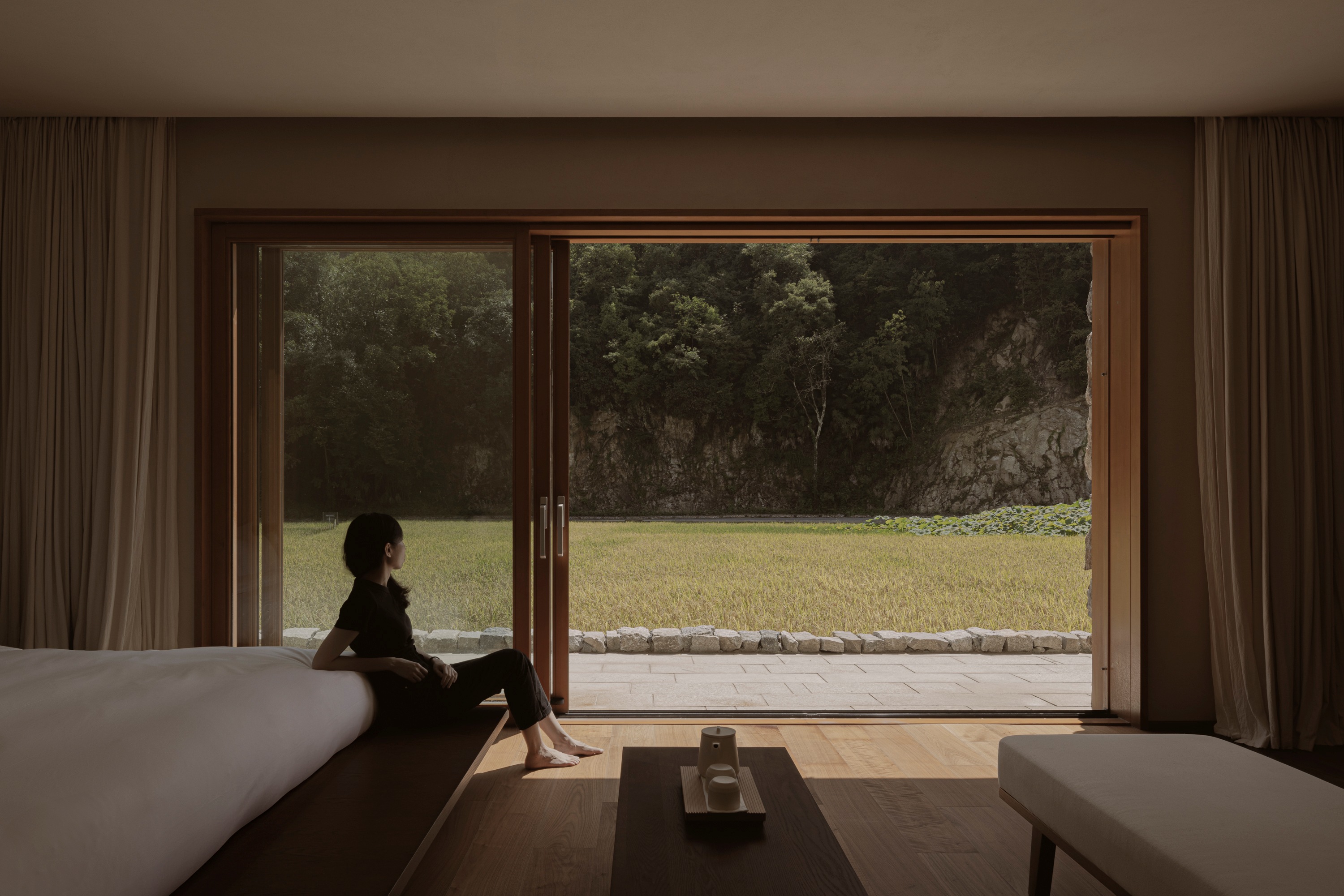
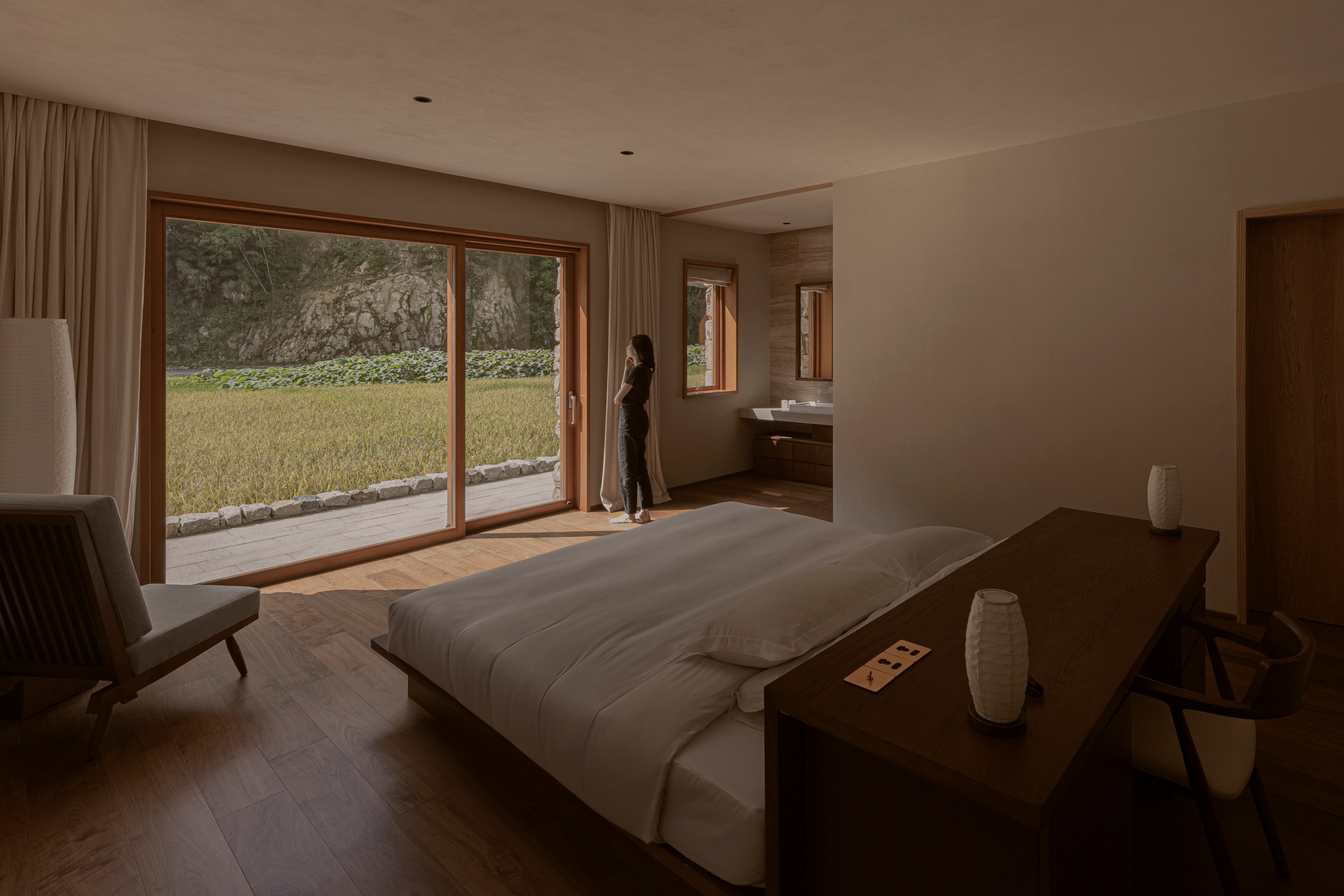
寝室など、より高いプライバシーが求められる空間は、石壁に囲まれた1階に配置しました。田園風景に面することで、快適な滞在とともに、豊かな屋外景観を楽しむことができます。
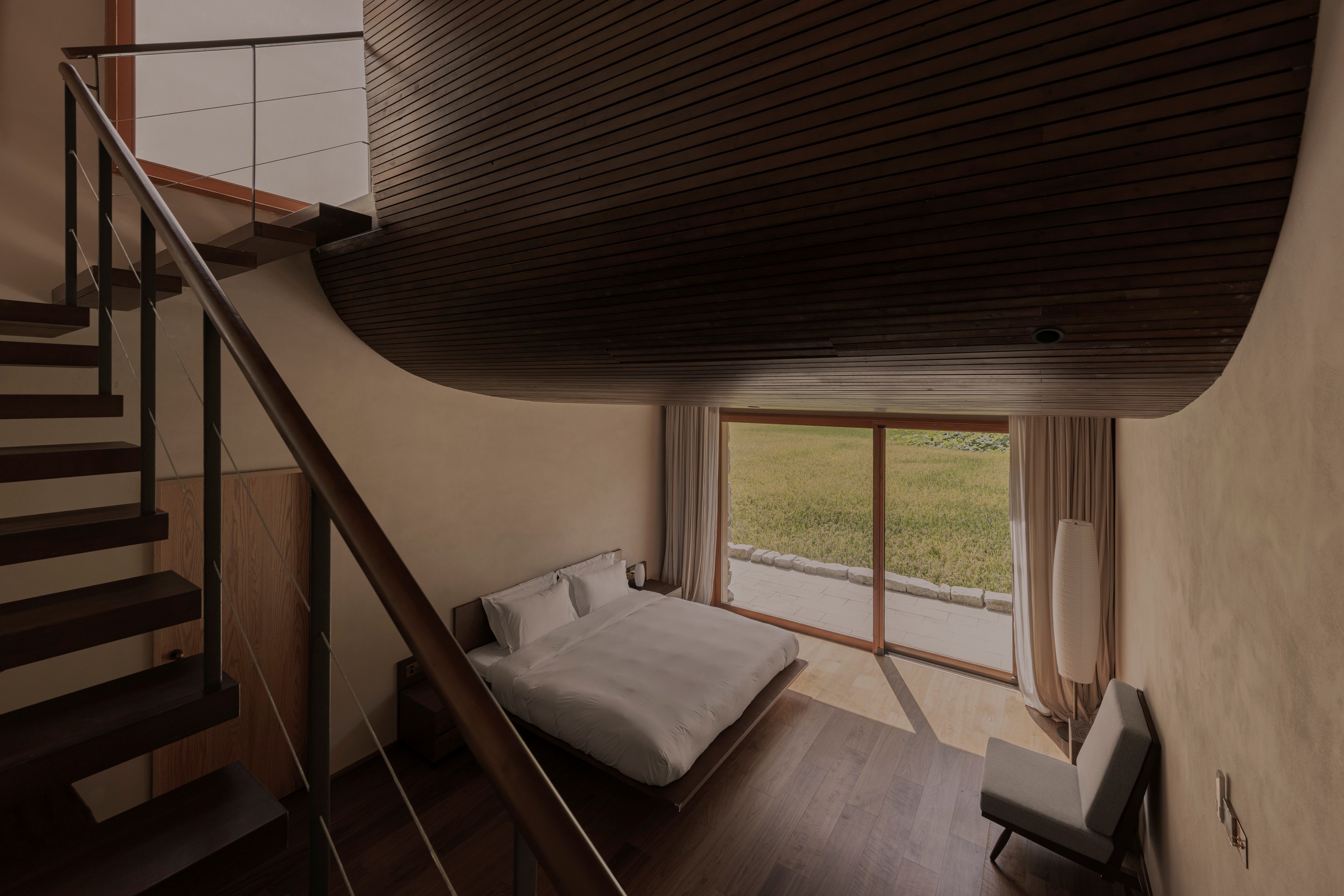
客室01(loft)内部
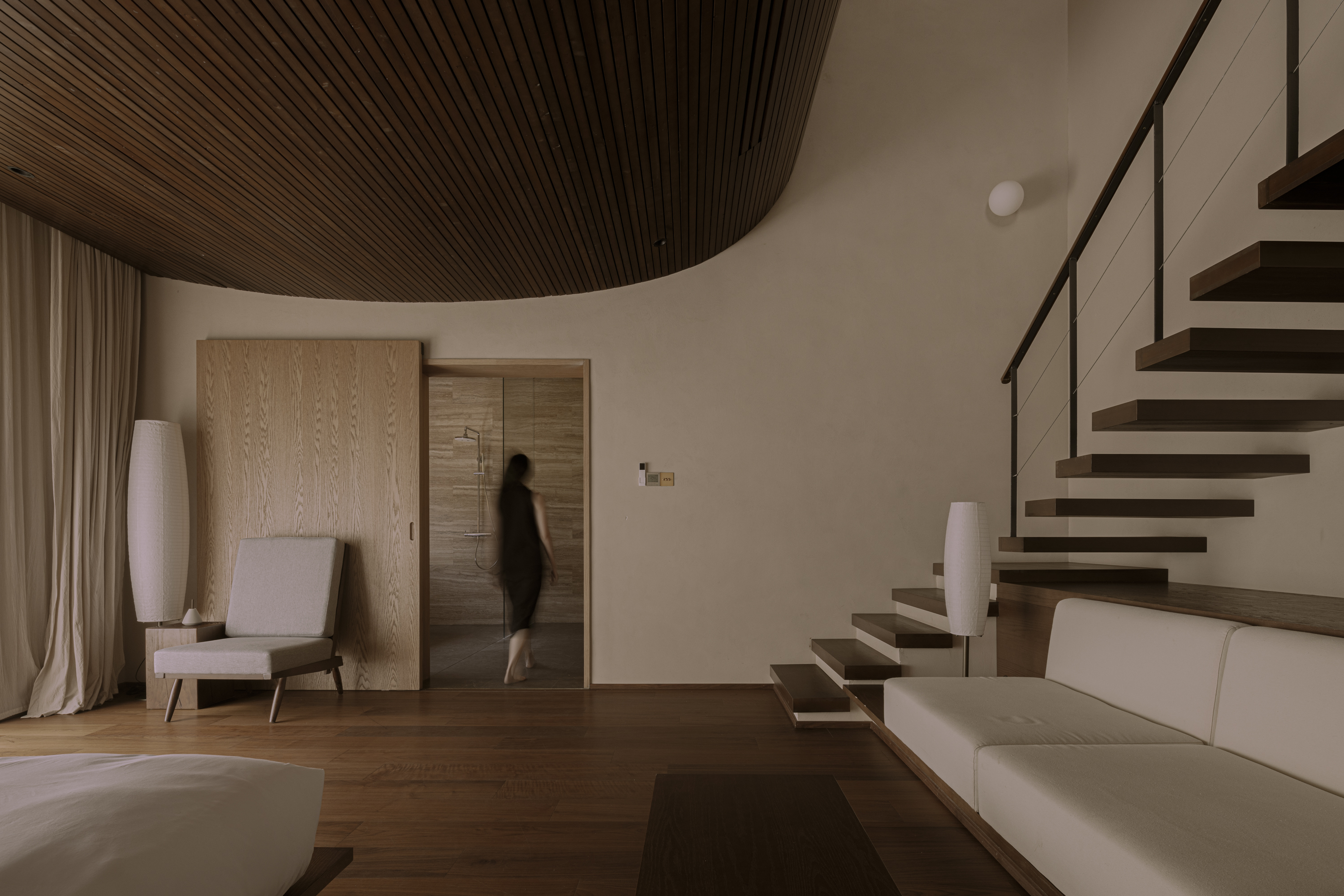
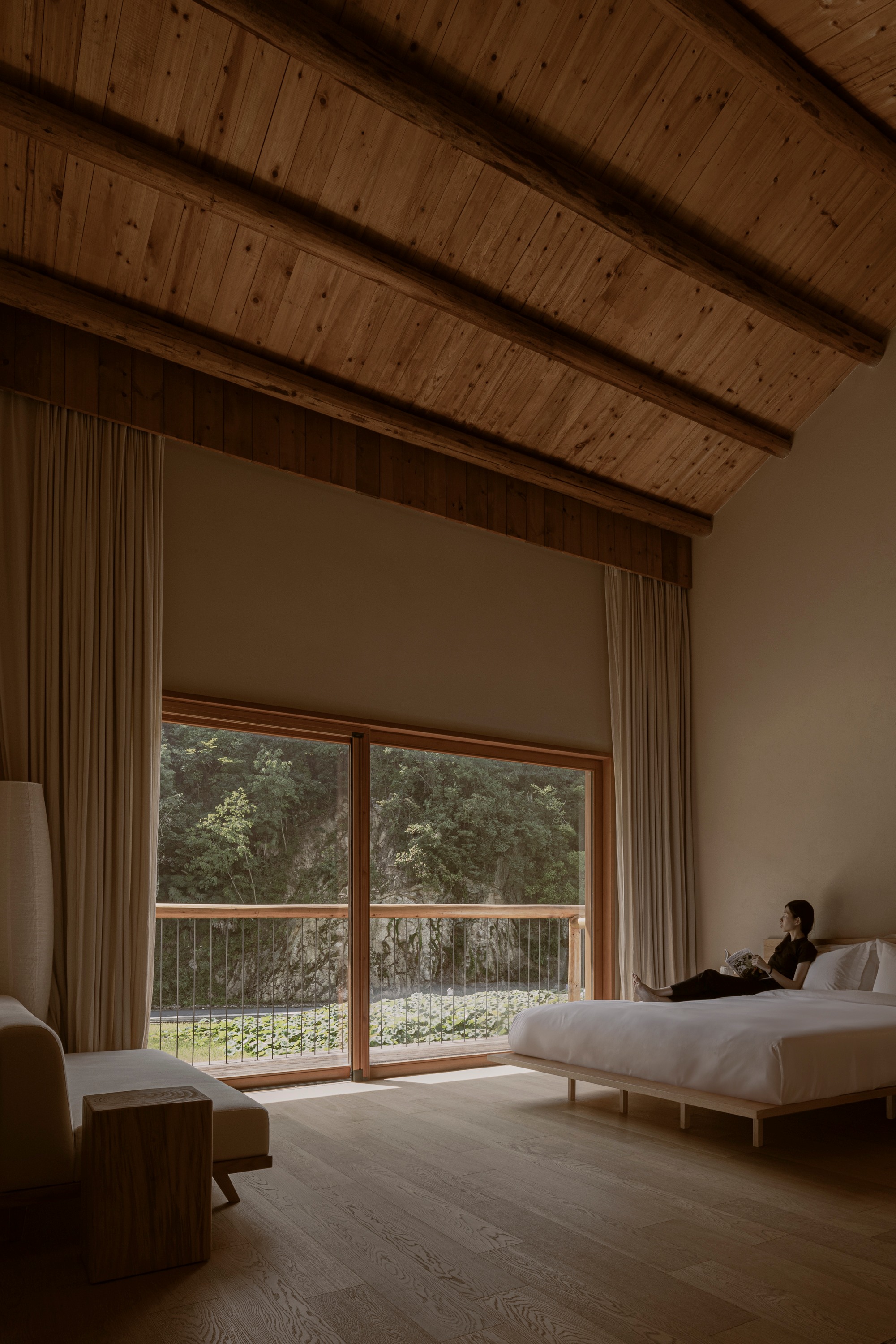
ロフトタイプの客室では、1階の曲面天井を2階まで連続させ、包み込まれるような柔らかな空間を形成しています。この曲面は、室内光と自然光の境界を曖昧にし、外光の変化に応じて、室内にも多様な雰囲気をもたらします。
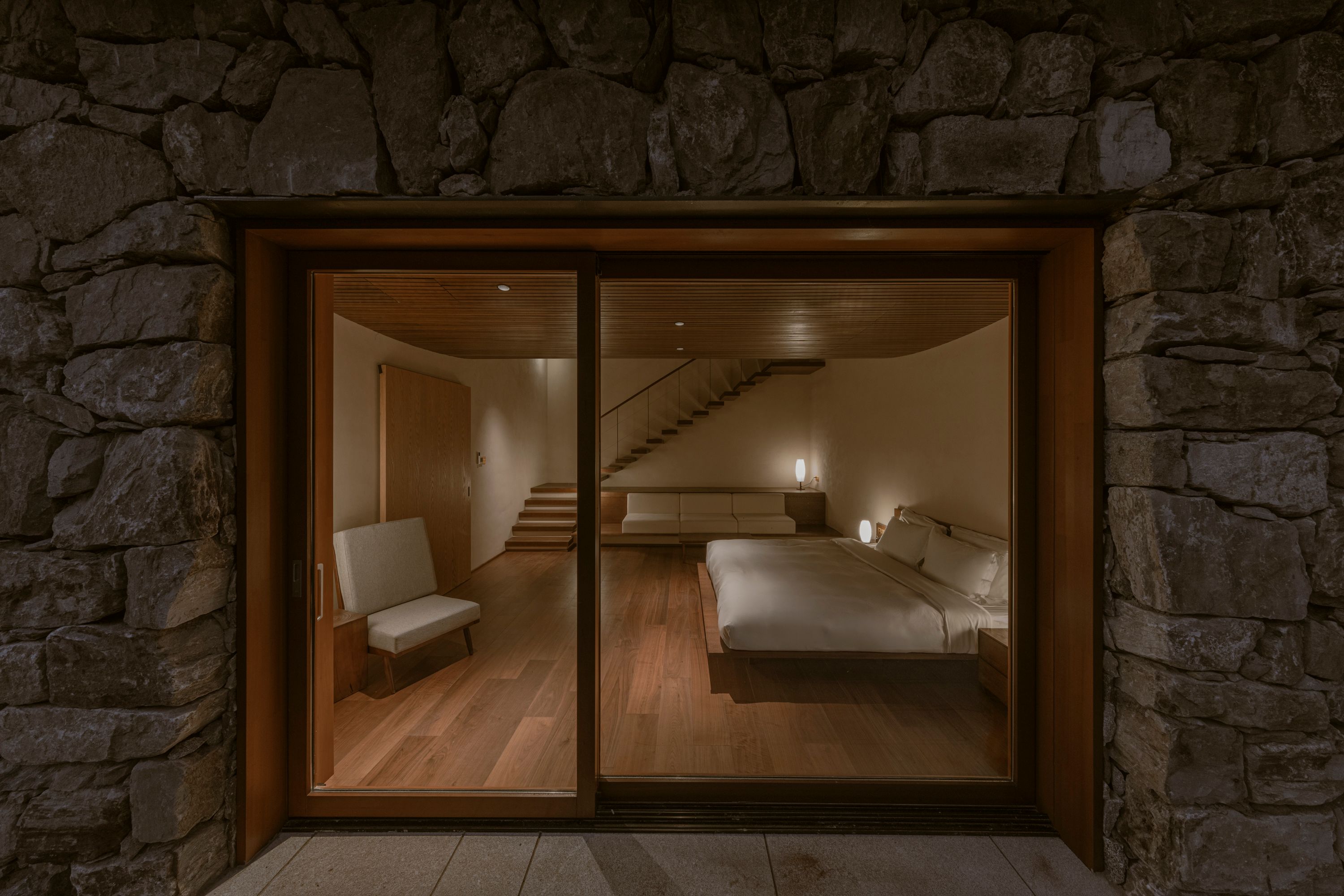

客室02(loft)内部
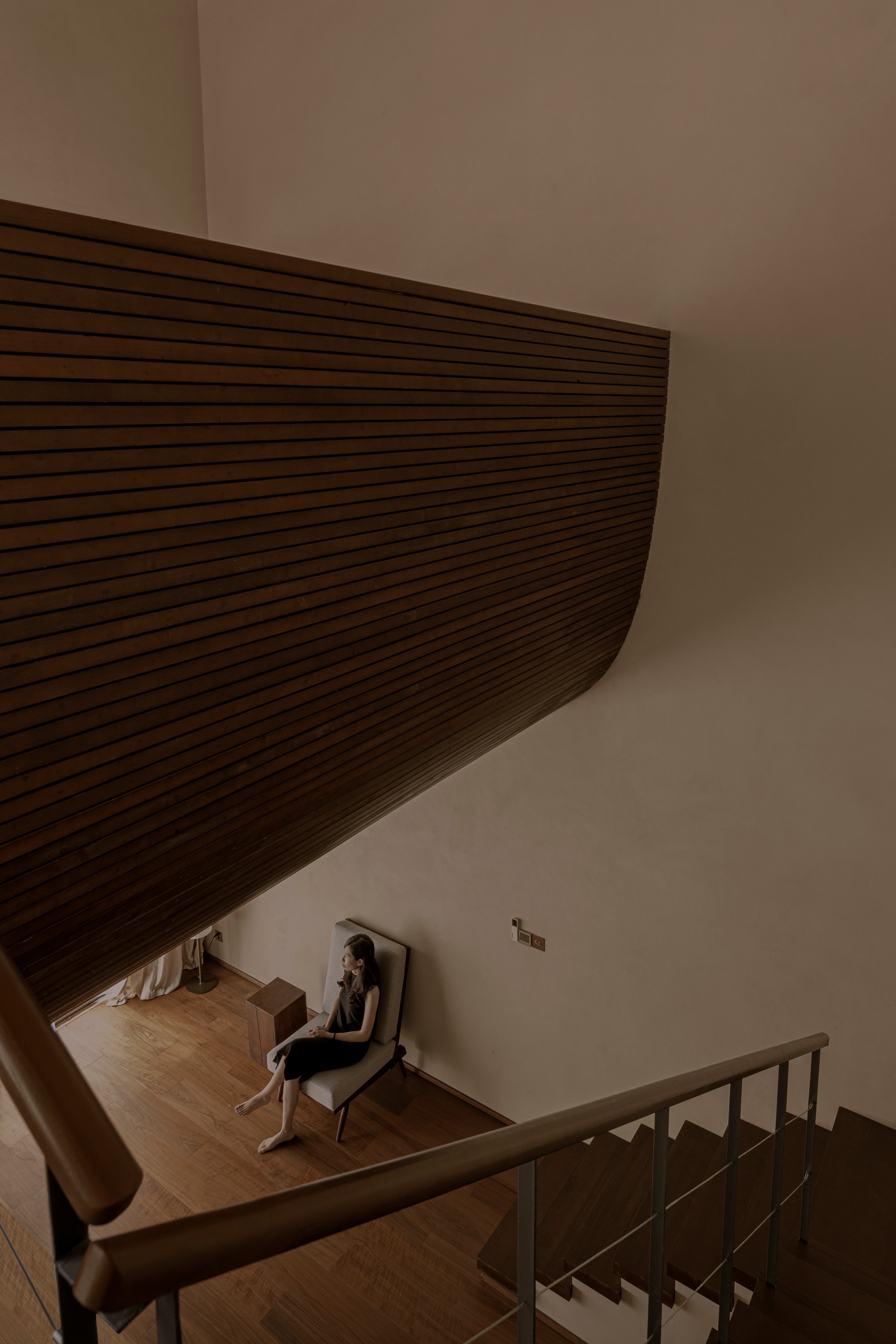
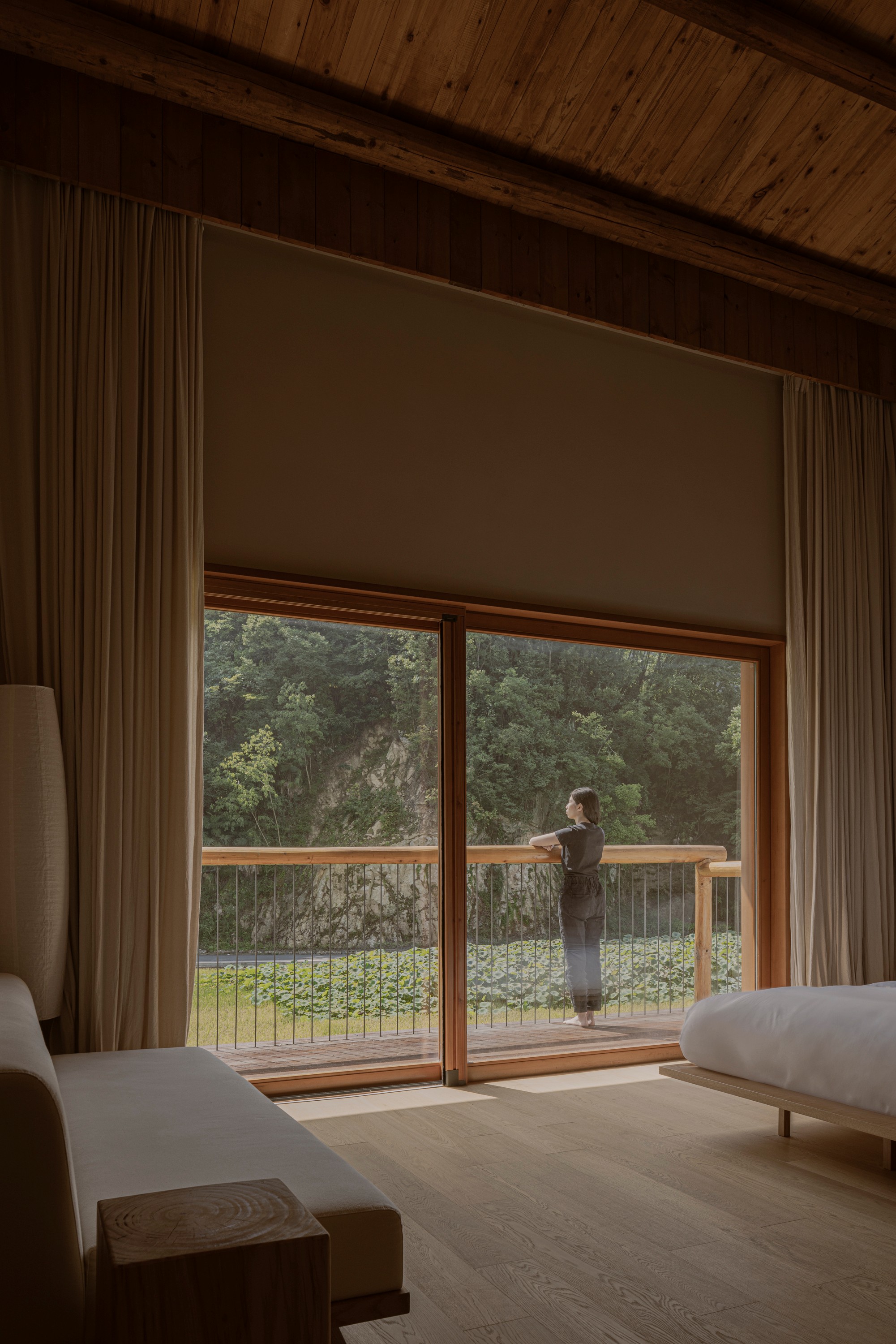
室内では、異なる素材の使い分けにより、1階と2階で異なる空間体験を生み出しています。木製天井のリビングと、石壁に囲まれた田園との間に、開放性とプライバシーを両立させた二重的な関係性を構築しました。
2階のバルコニーからは開放的な眺望が広がり、1階の大開口窓からは直接田園へと出ることができます。素材選定は慎重に行われ、空間全体に一体感をもたらすと同時に、屋外の豊かな自然環境と対比させながら、自然を室内へと引き込む設計としています。
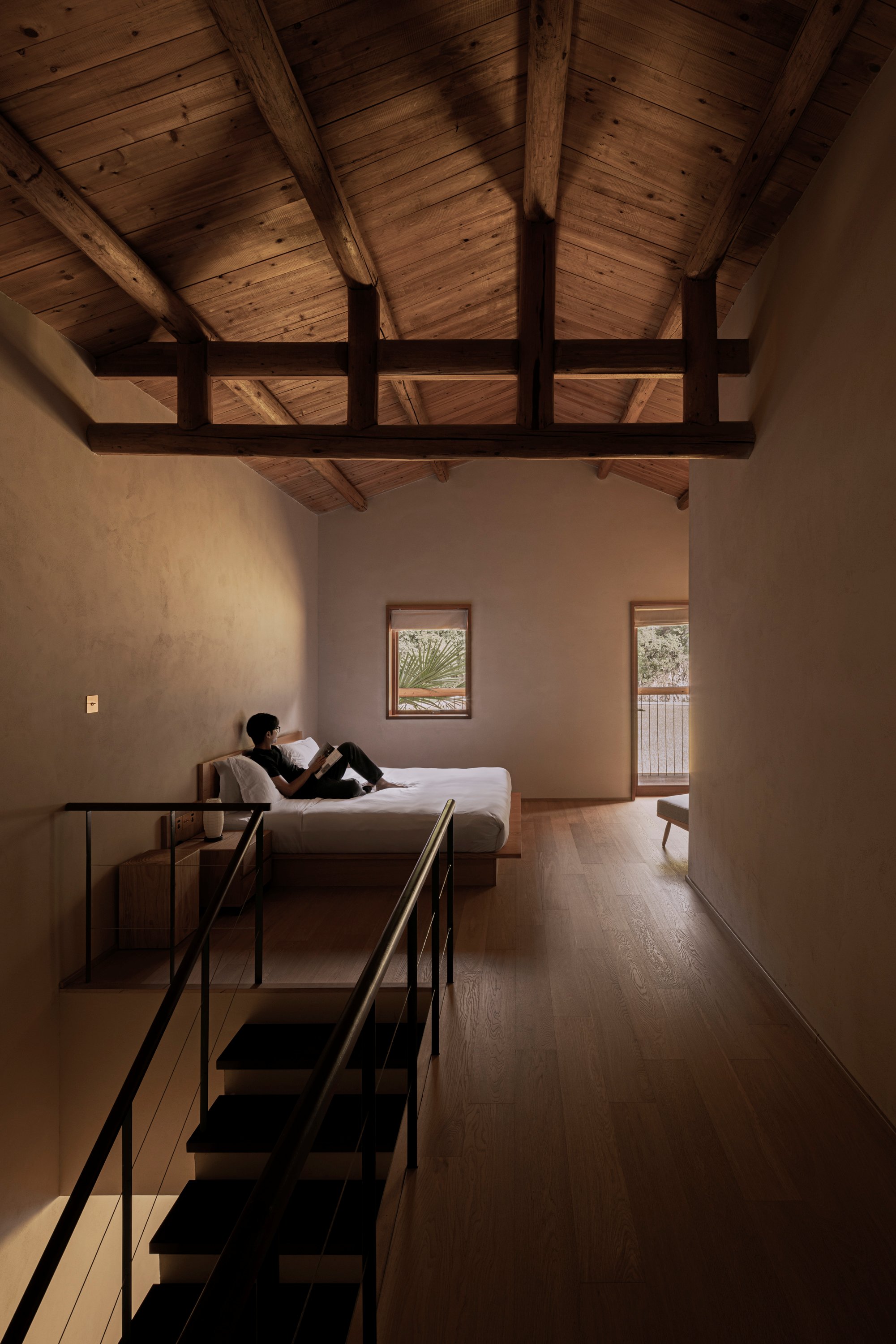
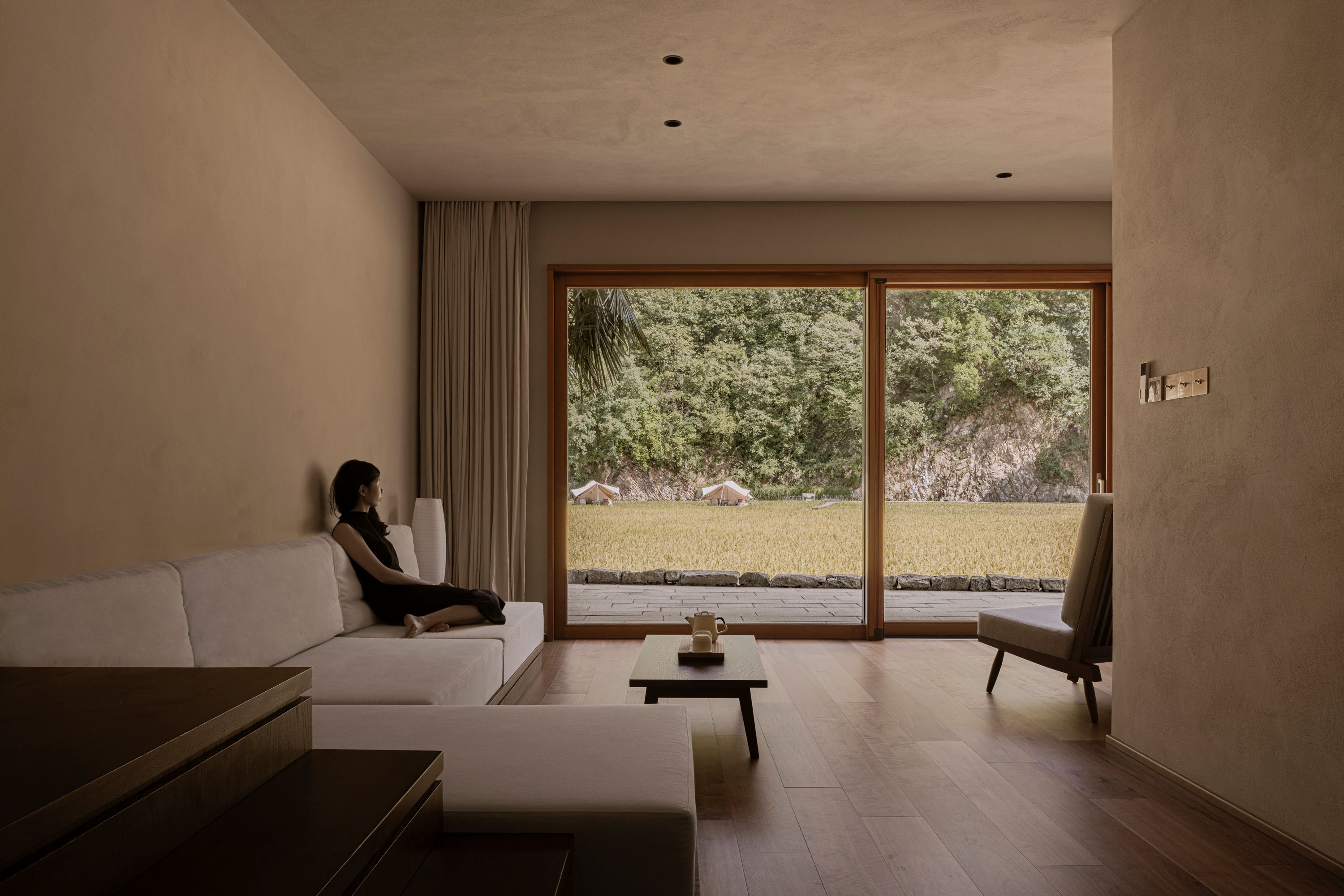
客室05(loft)内部
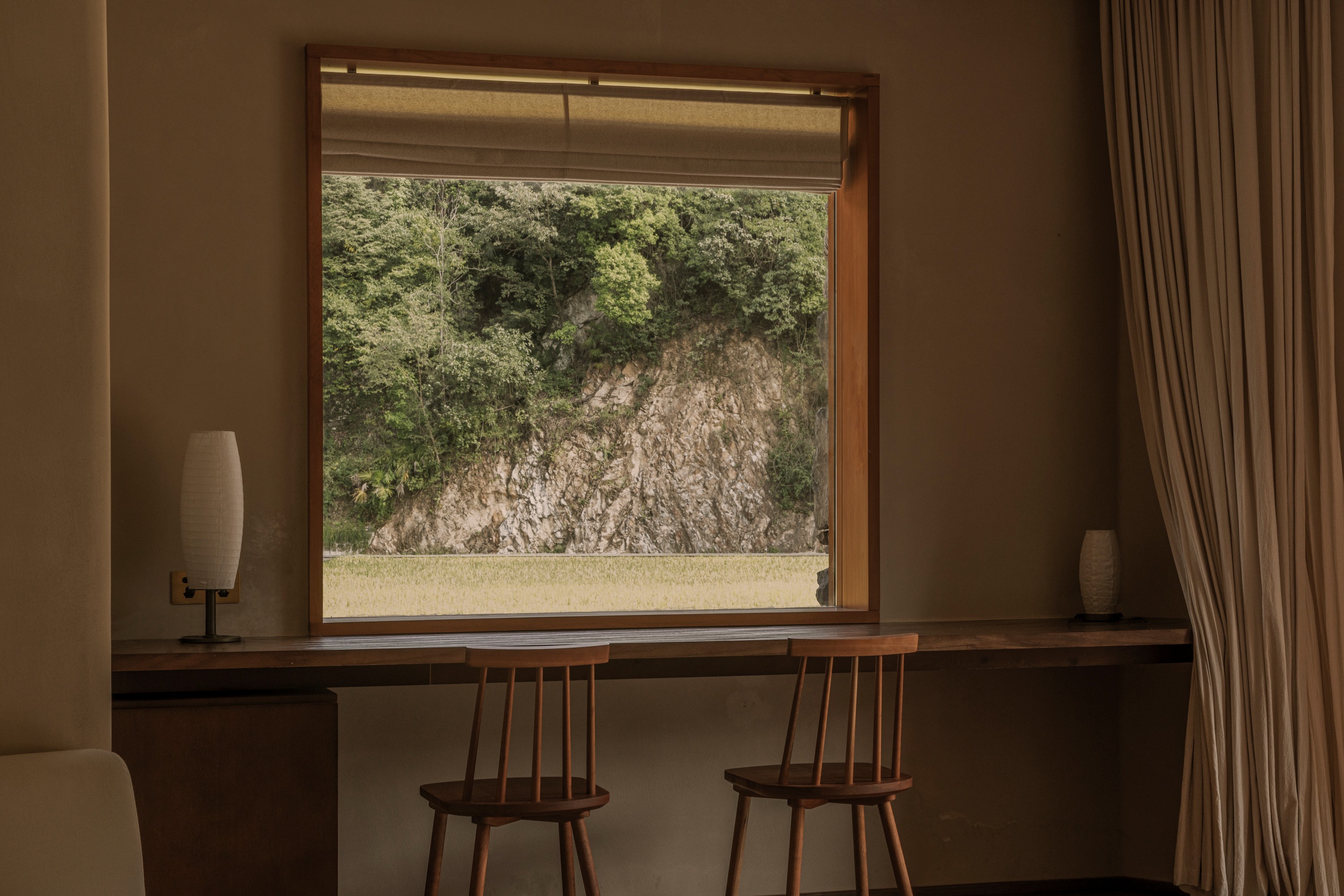
ミニマルな空間構成の中で、壁や床にはシンプルな素材を用い、屋根特有の木構架を際立たせています。
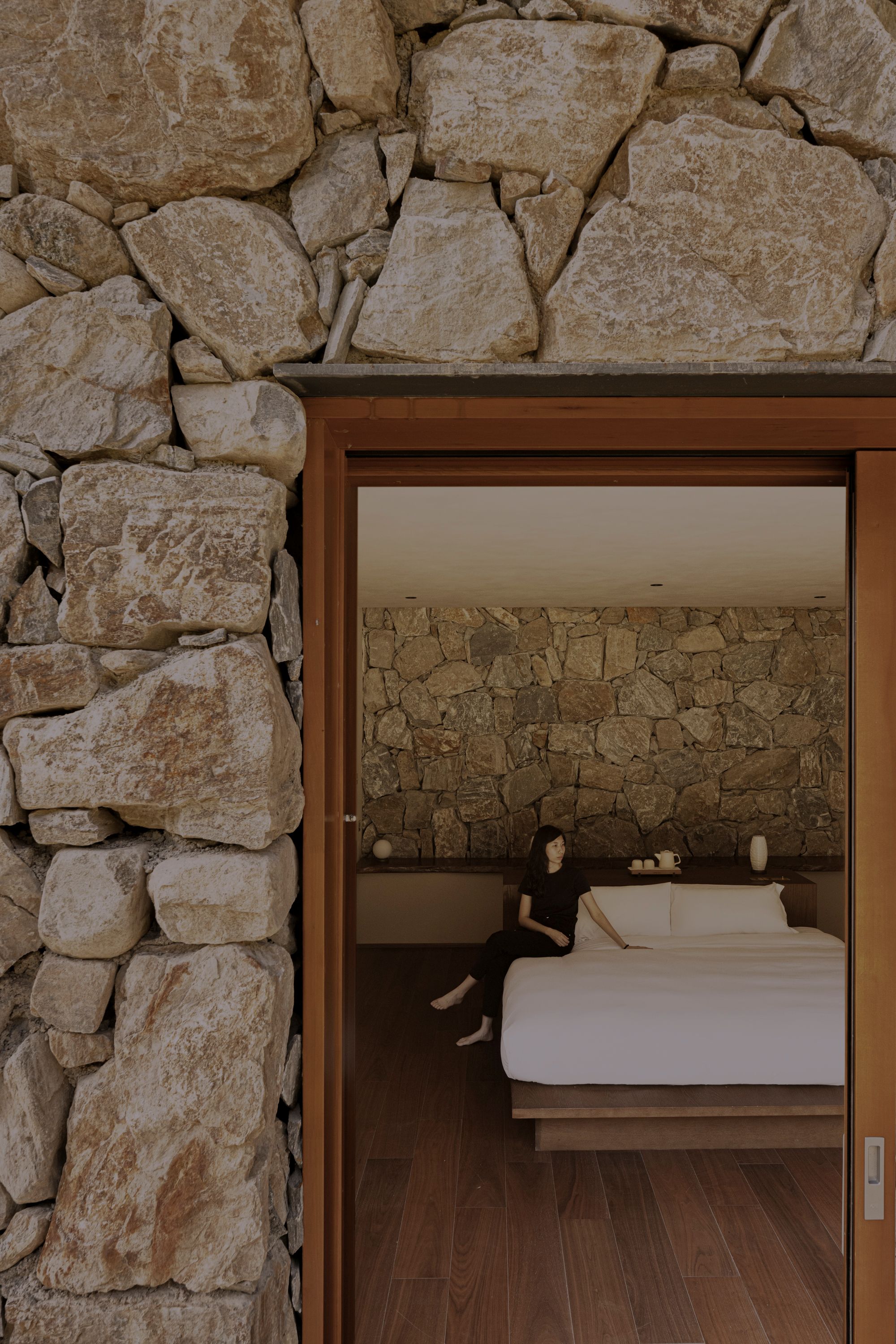

客室06内部
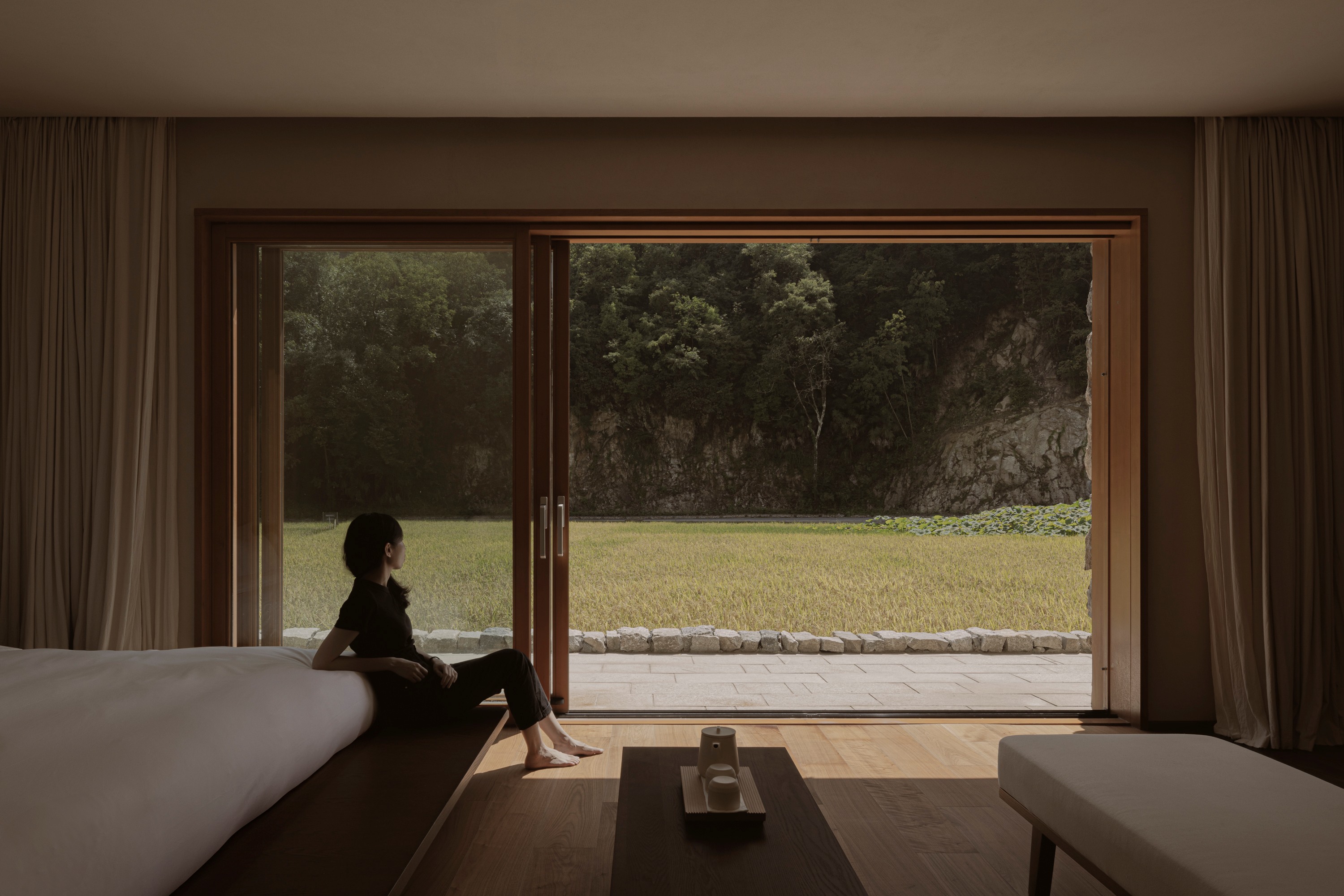
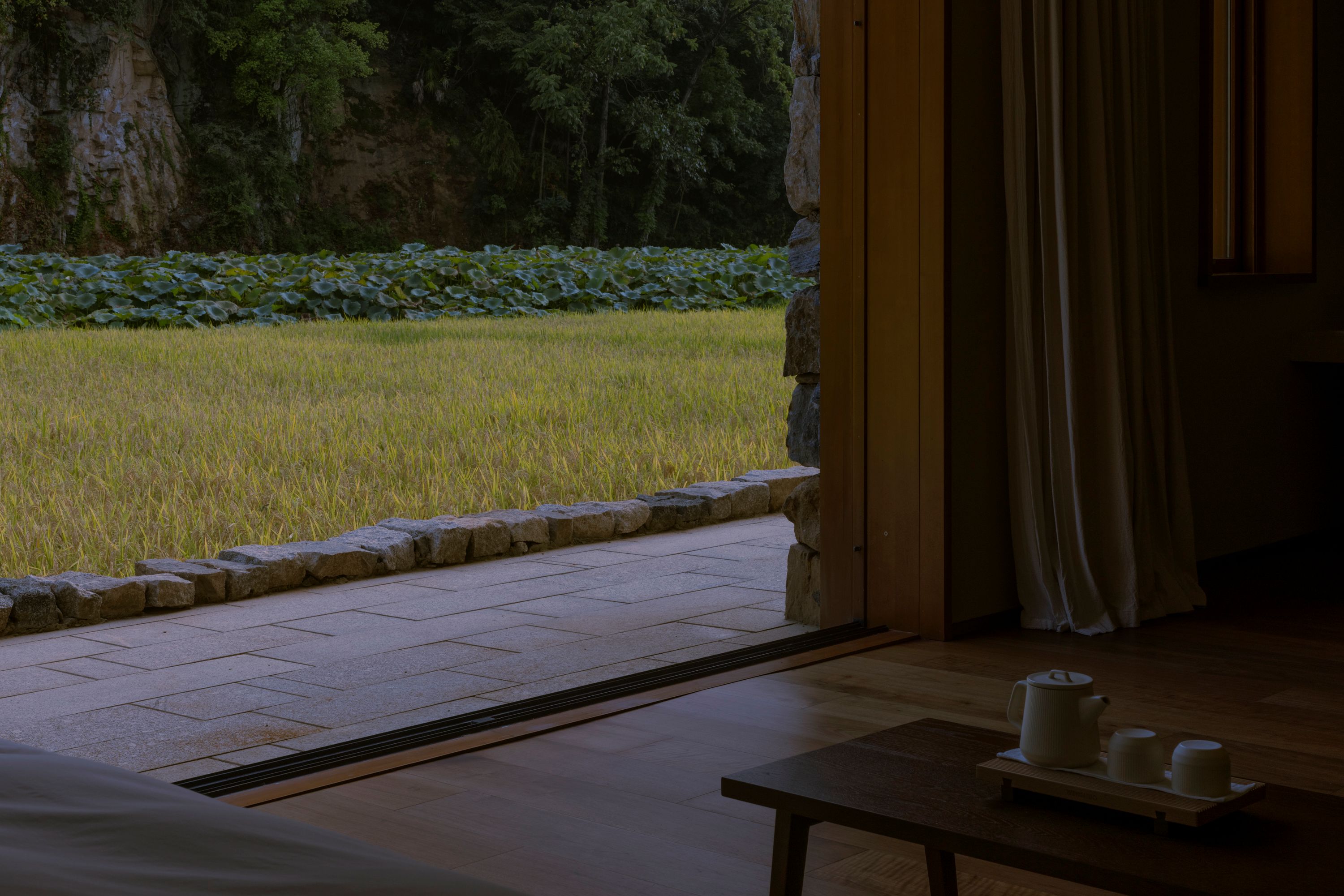
客室07内部
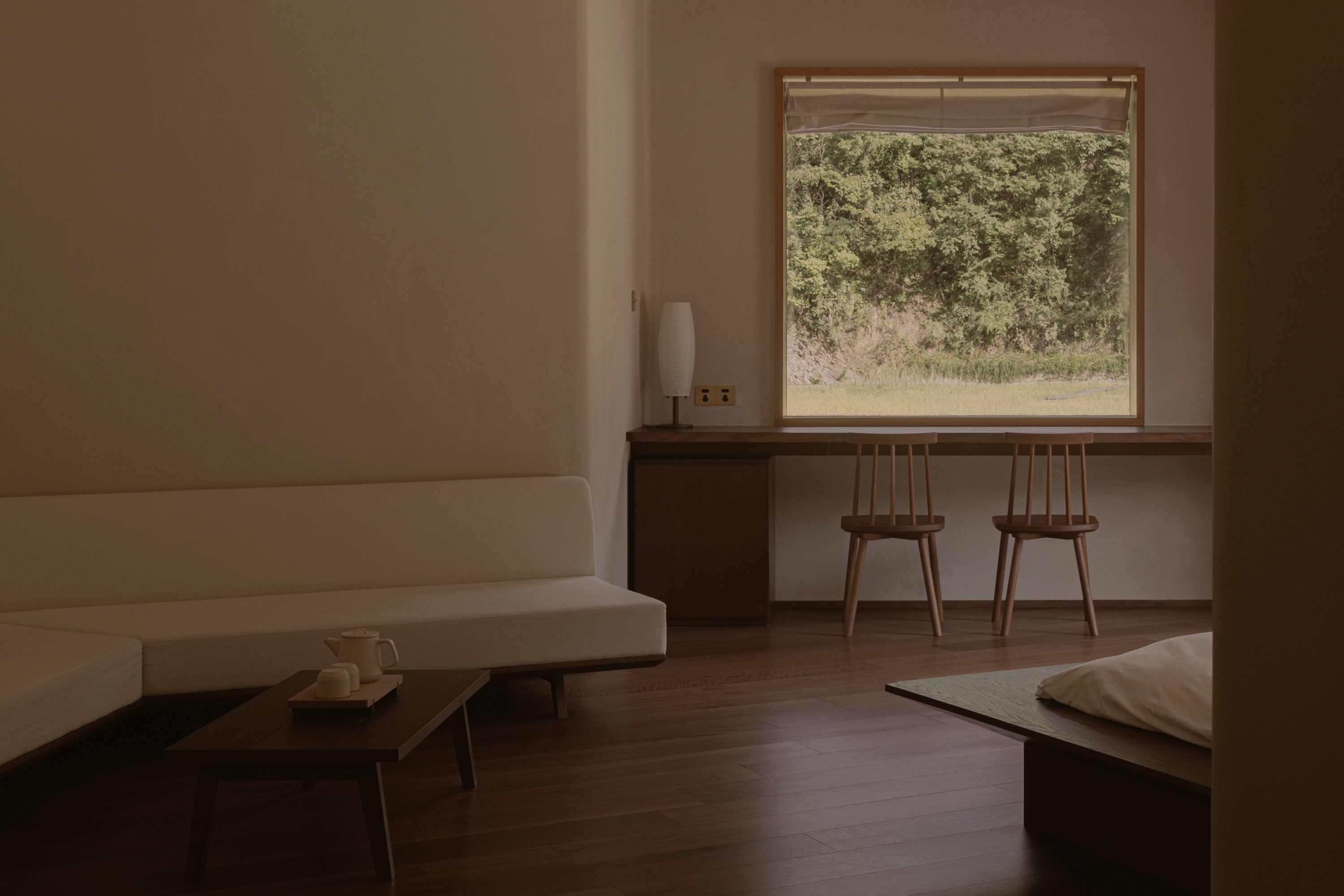

客室08内部
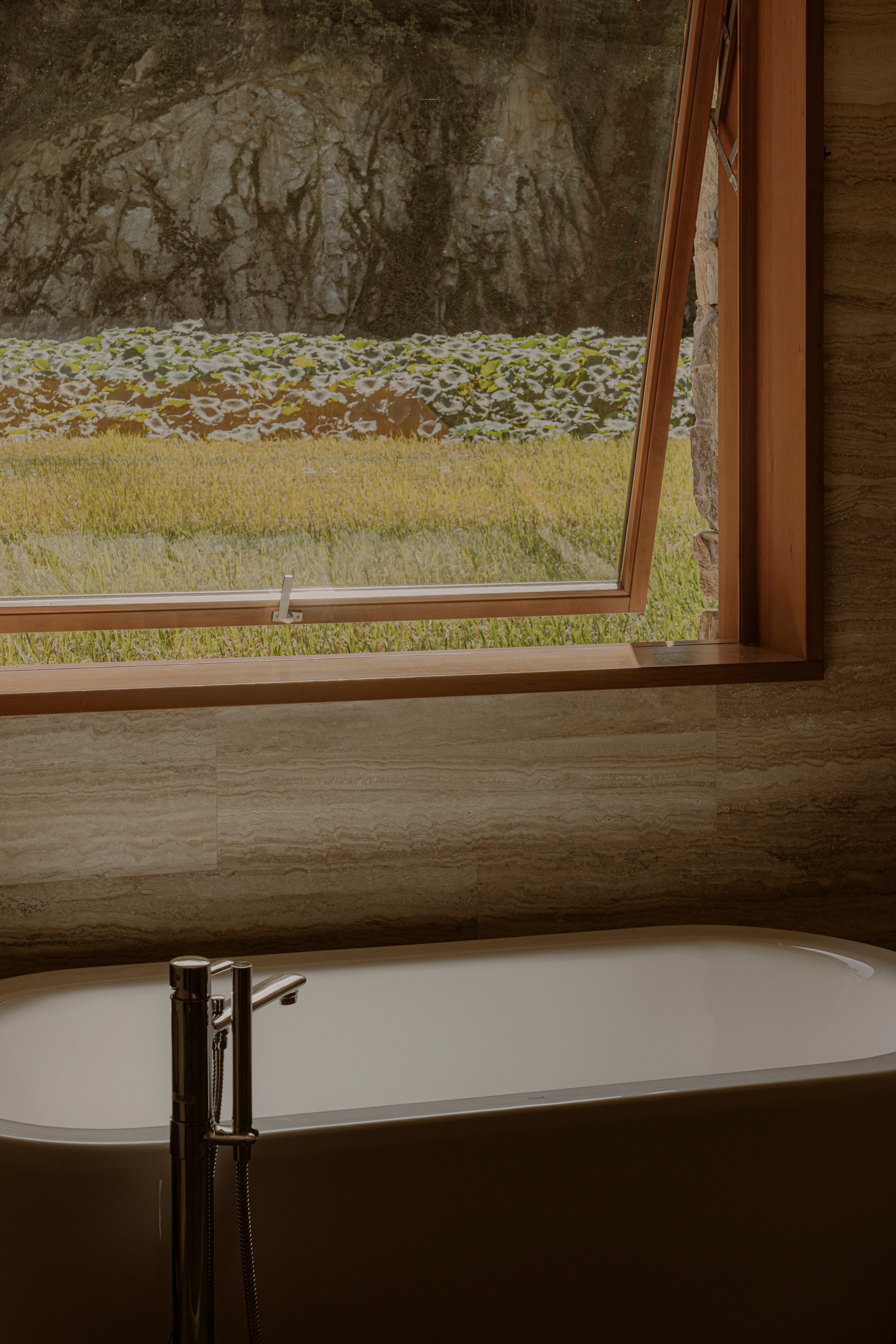
外壁に地域特有の豊富な石材を使用するだけでなく、現代的なデザイン手法によって、石を景観壁として室内にも取り込み、宿泊客が室内にいながら土地固有の風景を感じられるようにしています。
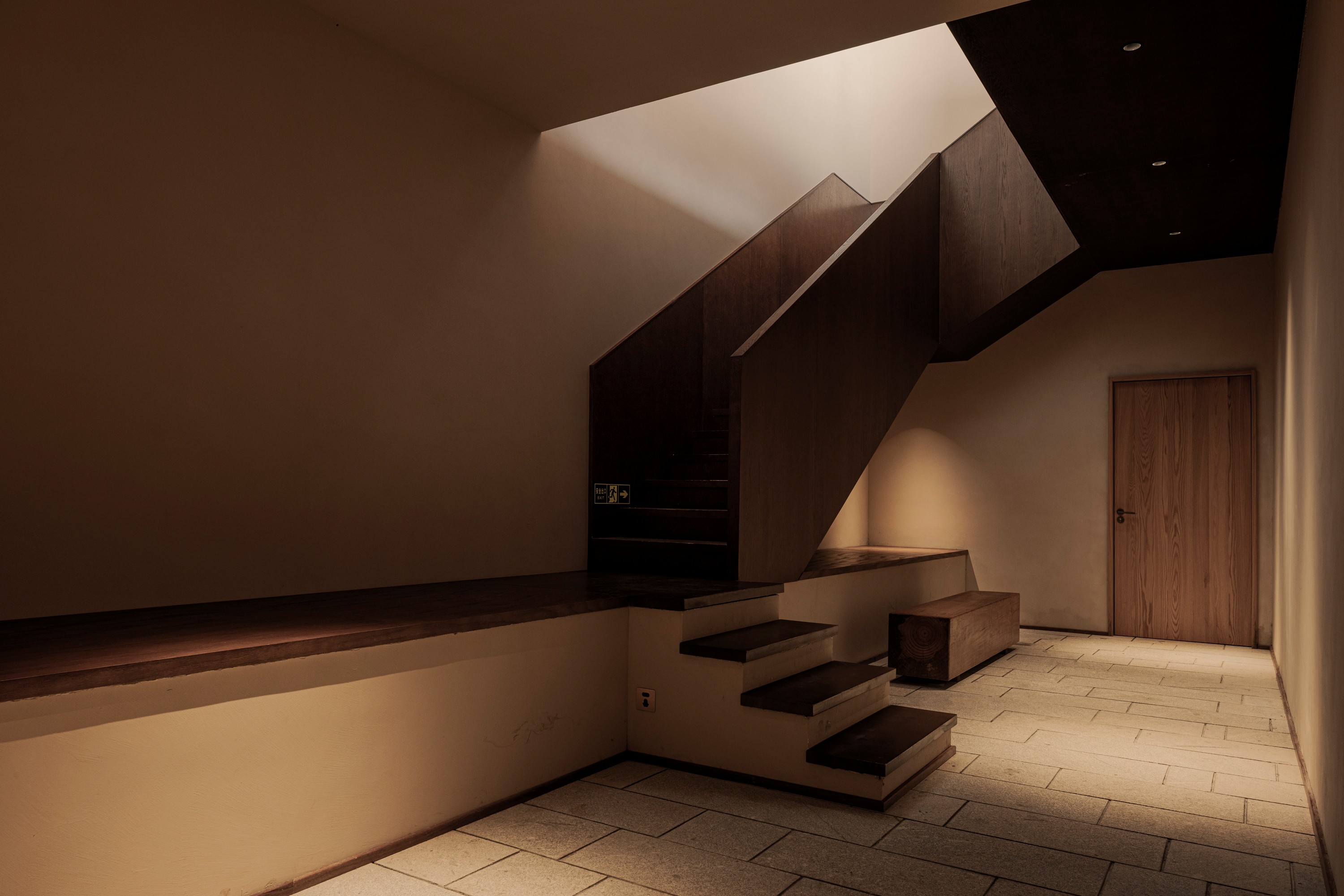
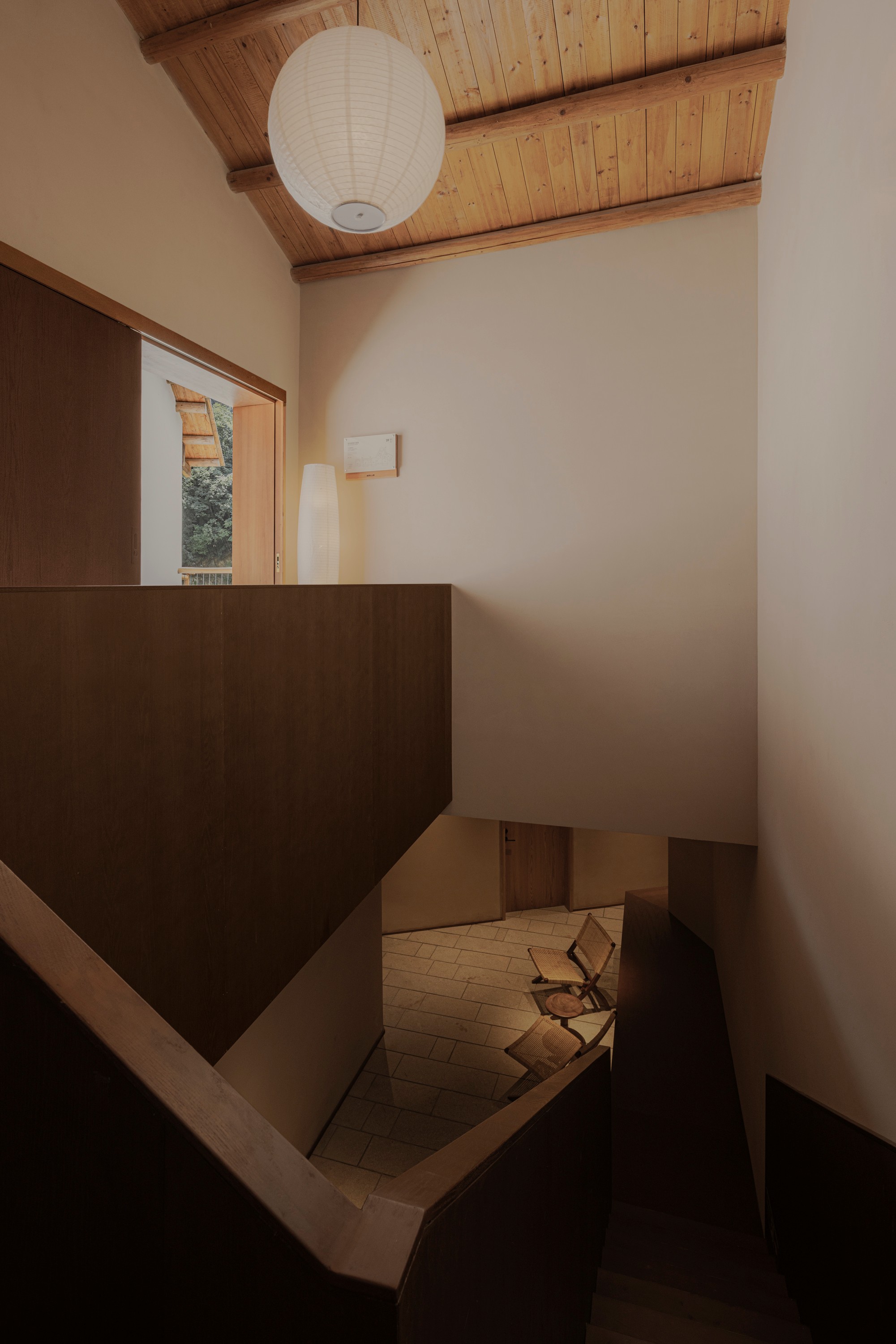
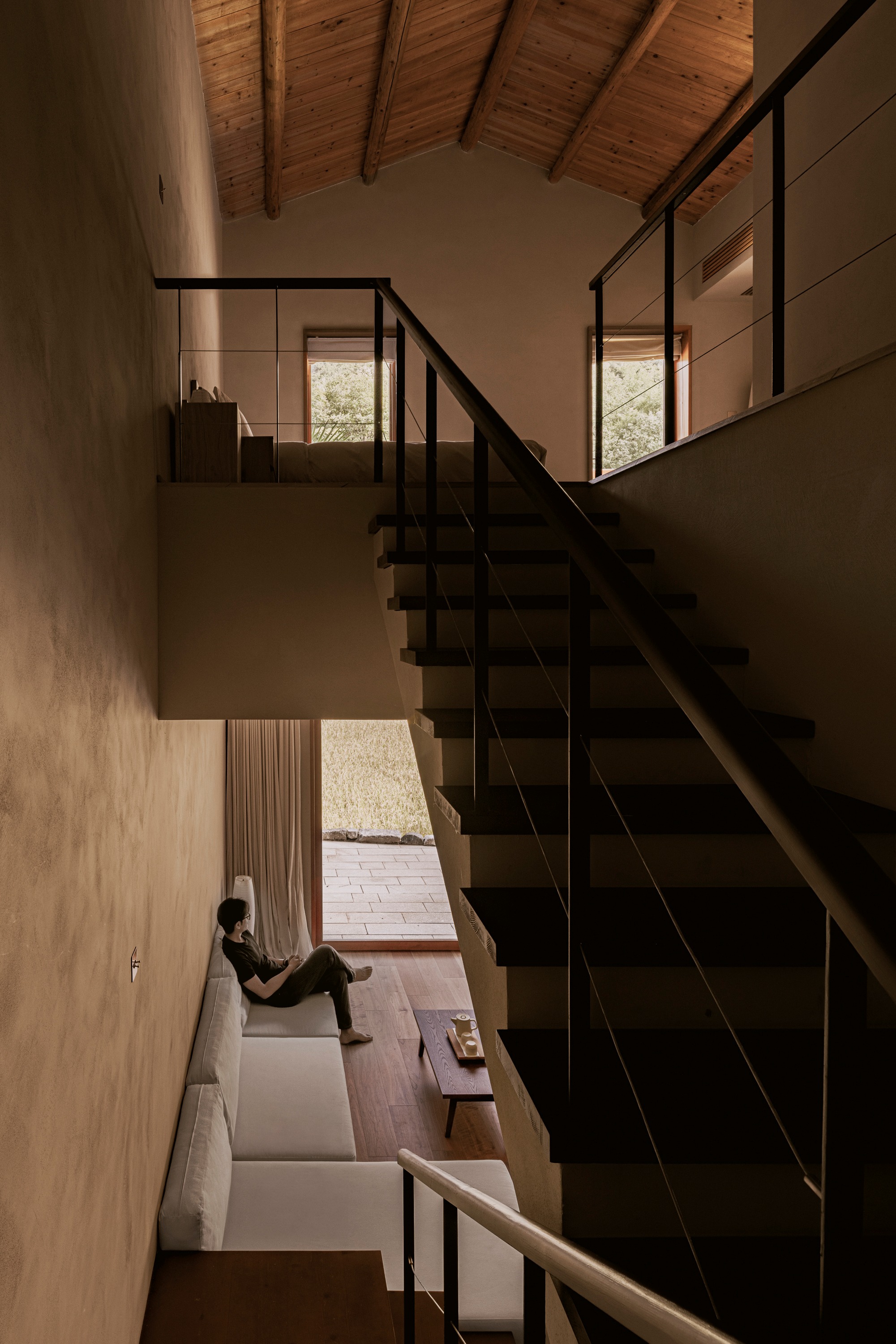
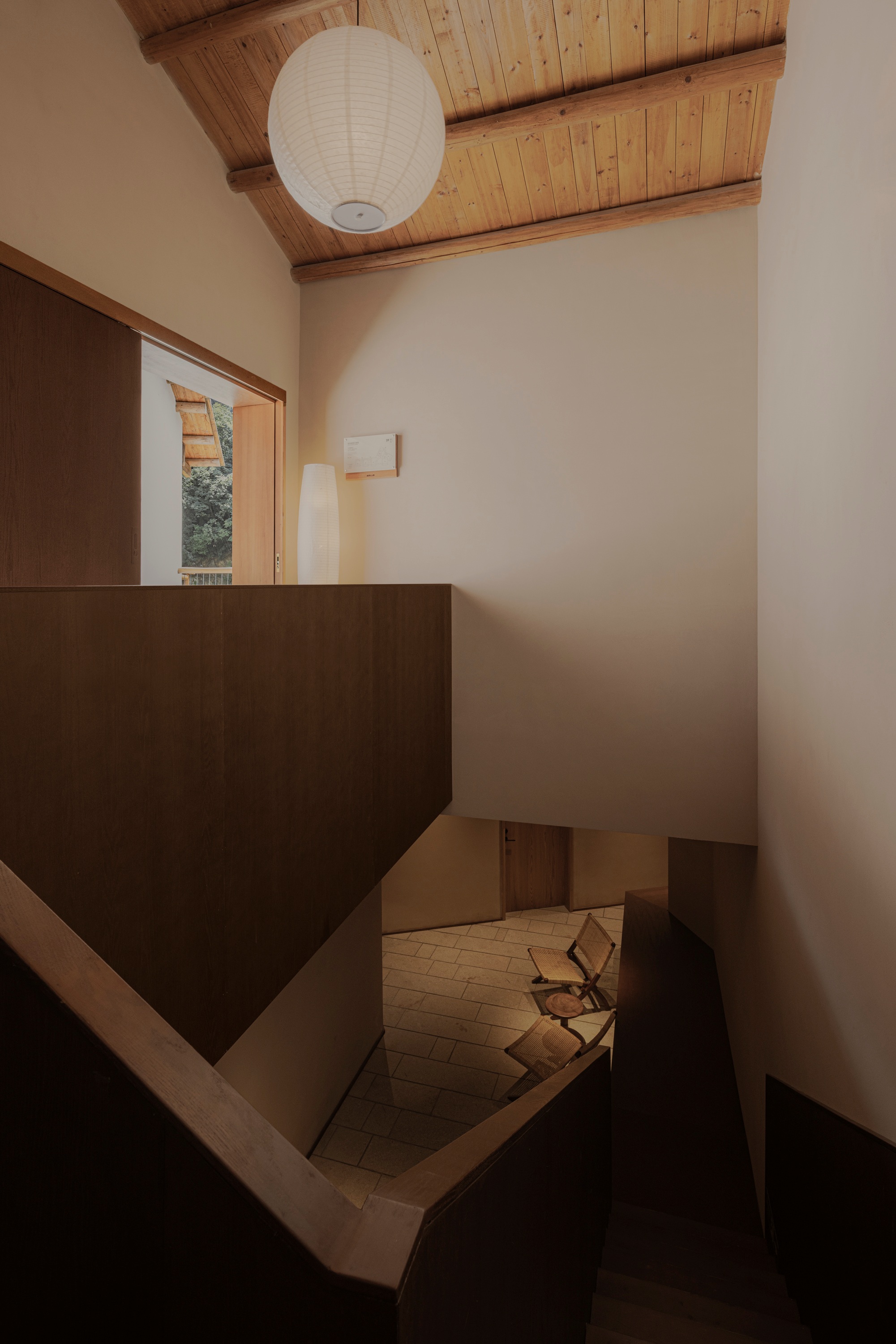
1階 共用階段と室内廊下
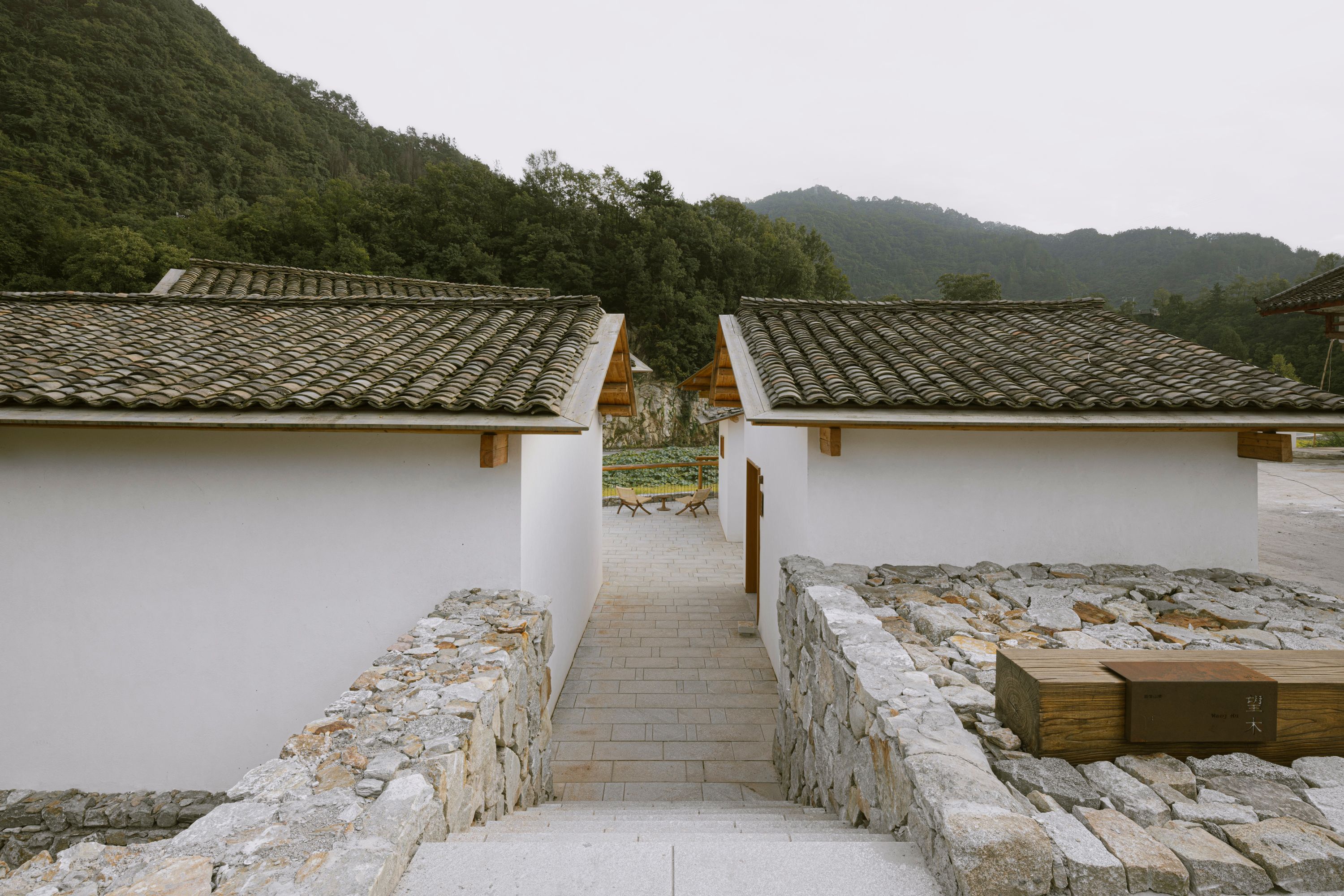
2階 屋外の共用廊下

既存村落の景観と呼応し、建築と自然環境との視覚的なバランスを整え、開放感のある空間を生み出すため、連続する建築の2階部分を分節しました。これにより、民宿は周辺建築と調和したスケール感を獲得しています。
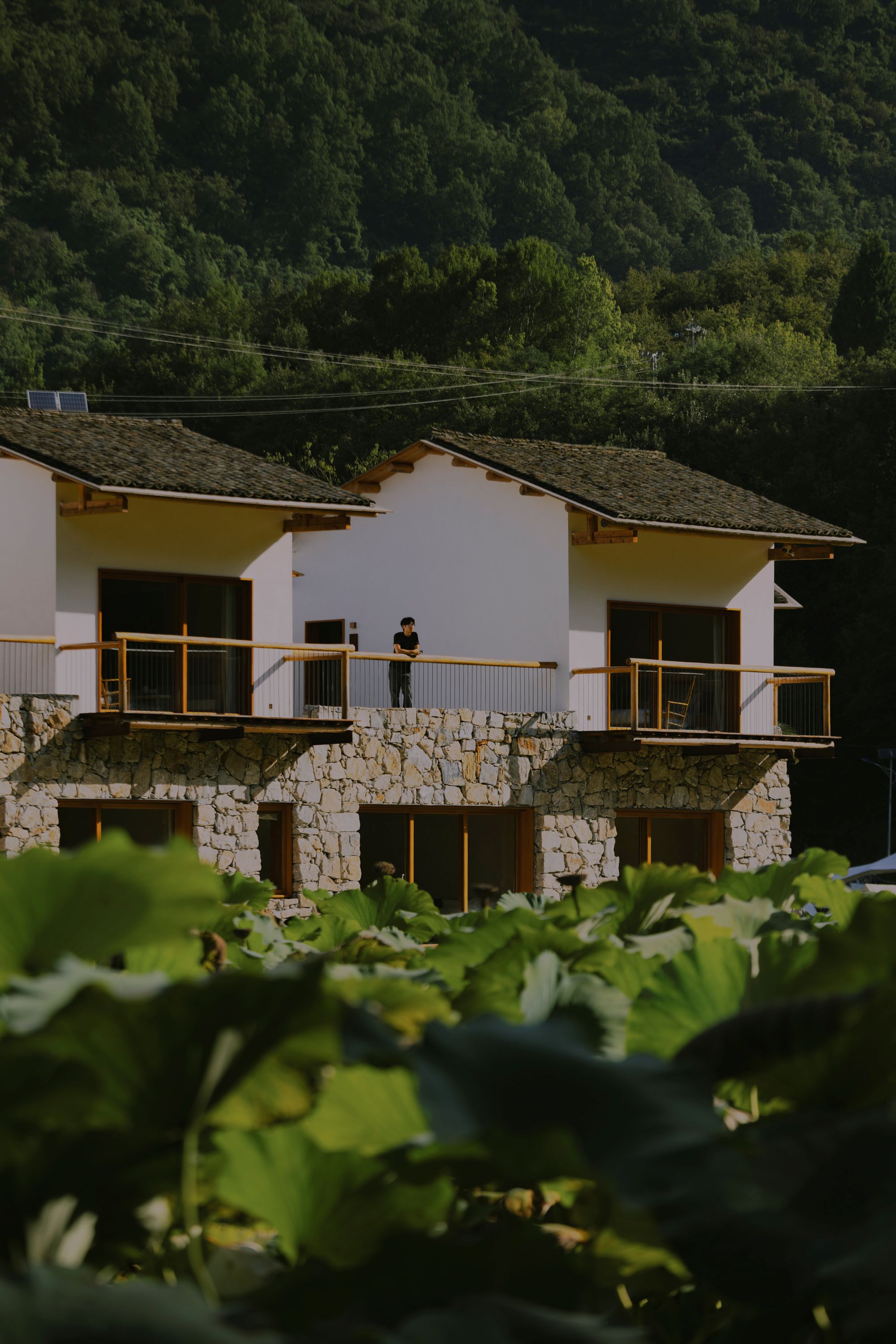
自然の肌理は連なり、まるで重厚で悠久の時を刻んできた壁体の内側から、新たな生命が芽吹くかのようです。
川から採取した玉石は、彫刻を施すことのない純粋な自然素材であり、素朴でありながら力強い気配をまとっています。それらを積み重ねることで堅牢な擁壁を形成し、太古から続く時間の厚みを際立たせています。
空間体験に豊かさをもたらすと同時に、各空間をつなぐ動線を効果的に結び、重なり合うような空間のレイヤーを織り成しています。
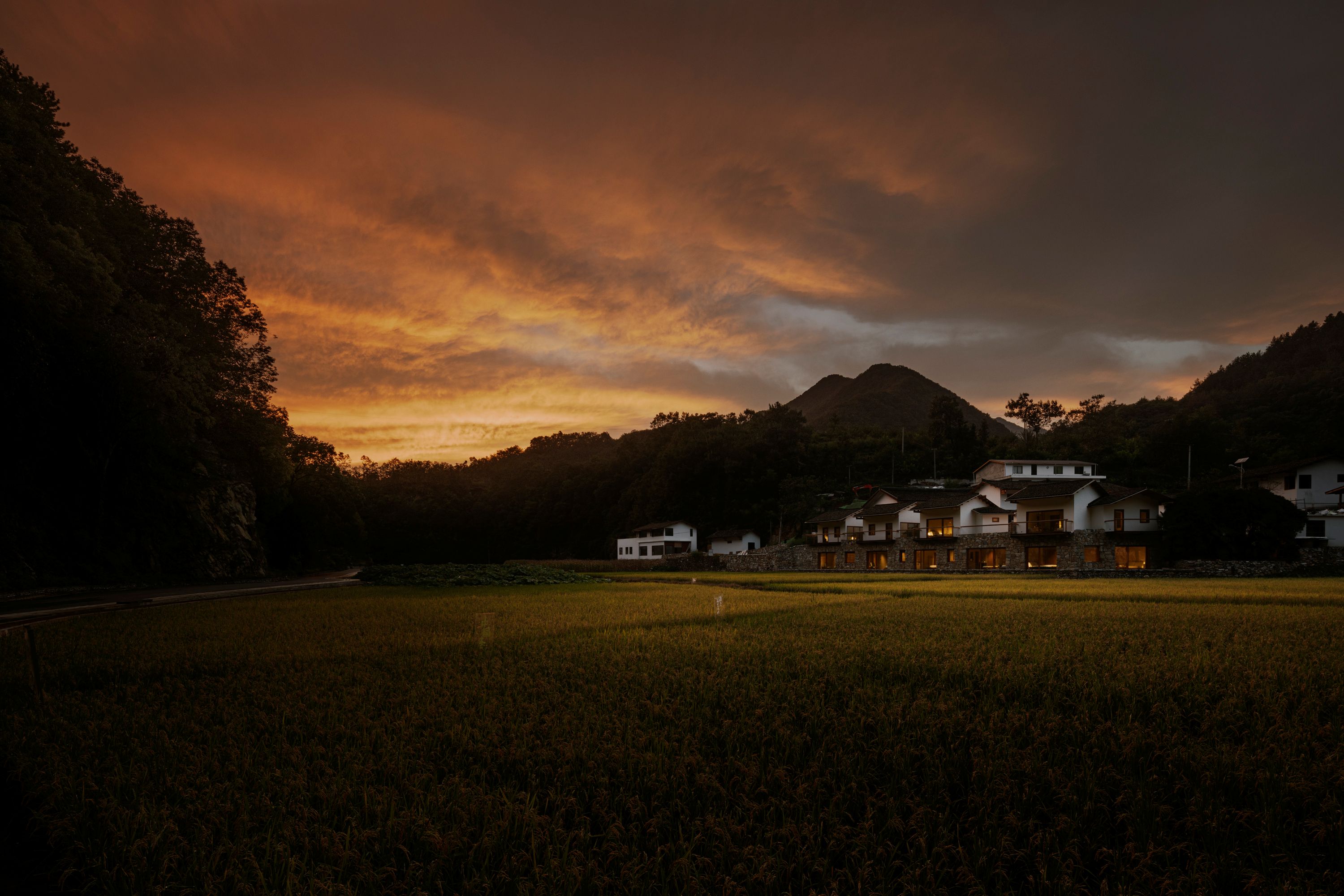
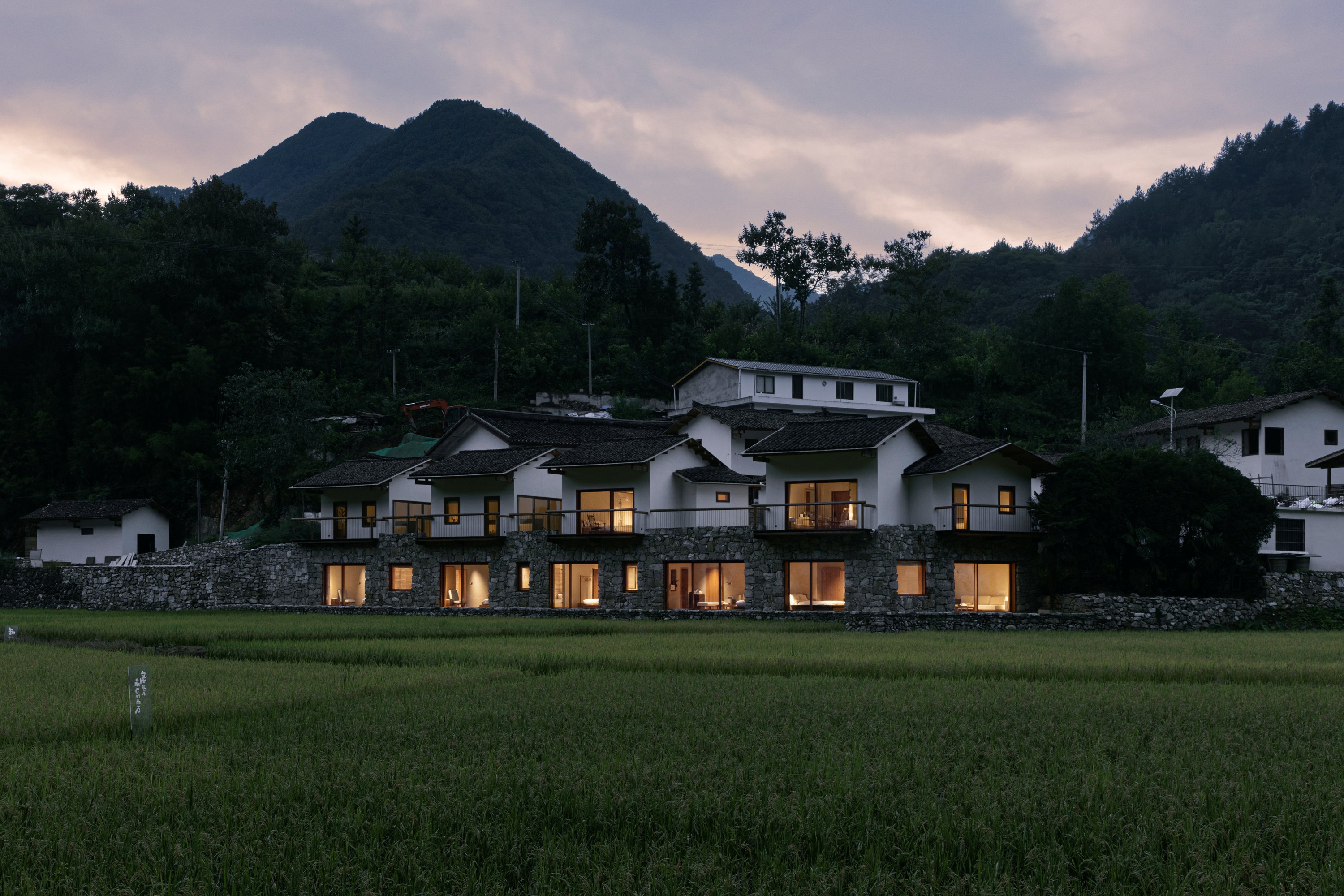
稲田の上に浮かぶような佇まいで、稲の色や質感を取り込み、周辺の山・田園・樹木と呼応する建築
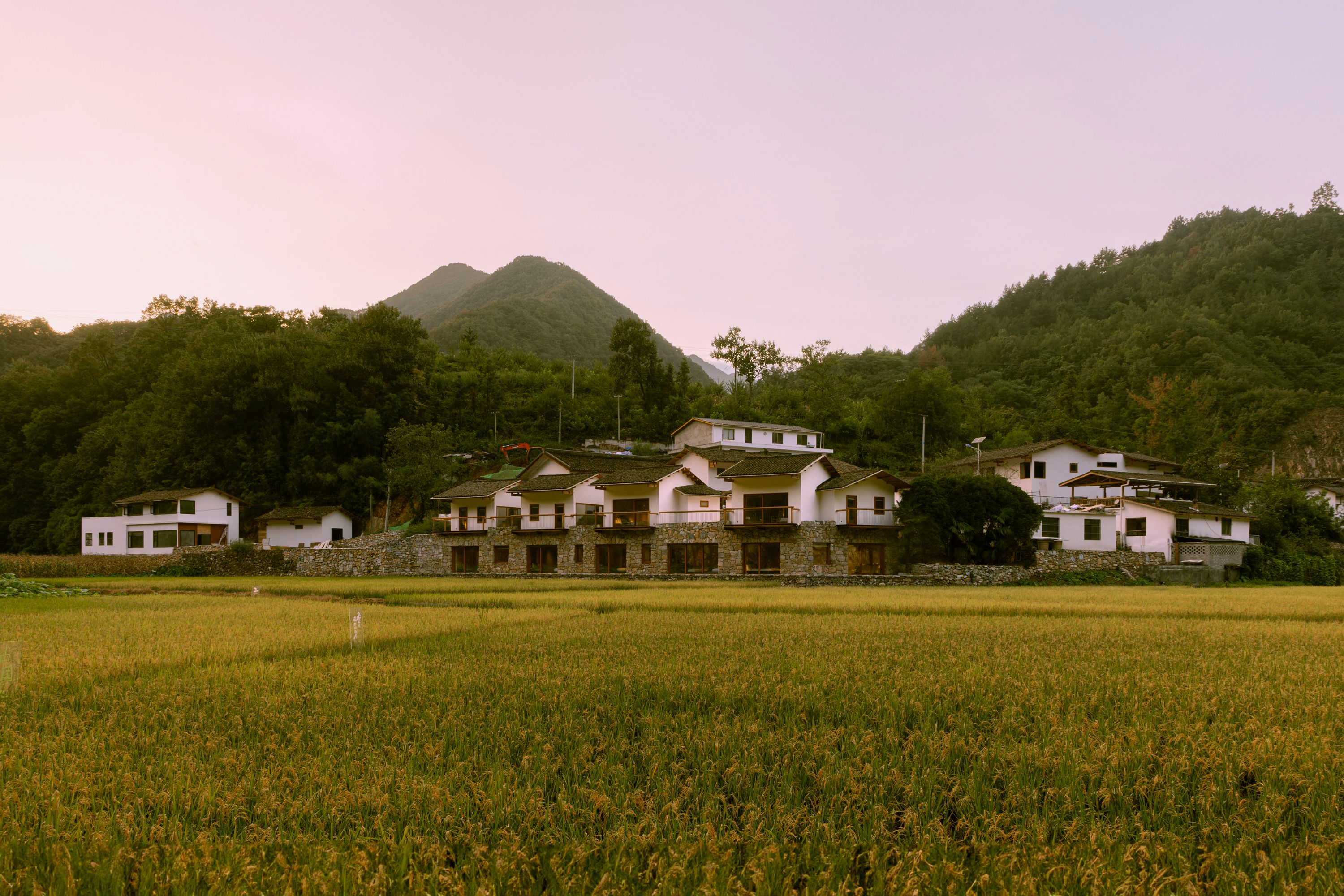 Open countryside stretching out in front of the site
This project is located in Yuwan Village, Ningshan County, Ankang City, Shaanxi Province, China, and was planned to integrate harmoniously with the existing village fabric.
The site is blessed with abundant natural resources and a beautiful environment, where pristine nature has been well preserved. It is also a habitat of the crested ibis. The project site lies on a mountainside characterized by terraced fields, encircled by retaining walls made of stacked river stones, and opens toward an expansive agricultural landscape at the front — a setting of striking natural presence.
The rich natural environment of the crested ibis habitat in Yuwan Village
The surrounding existing residences and stone masonry retaining walls
Overall site plan ©kooo architects
Overall aerial view
In this project, we placed strong emphasis on integrating the guesthouse into the existing village context while minimizing its impact on the local ecosystem. The design seeks to merge seamlessly with the surrounding environment, reducing the environmental footprint of new construction through a phased development approach.
As a central design principle, we aimed to use locally sourced materials wherever possible and incorporate traditional construction techniques into the building process. Through these efforts, the architecture aspires to harmonize with the site’s inherent landscape and reflect the unique character of the region.
Concept sketch on site ©kooo architects
Key Design Principles
- Reducing the overall building volume to alleviate the excessive sense of enclosure proposed in the previous scheme
- Adopting a gabled roof form to harmonize with local architecture and the surrounding environment
- Selecting regional materials such as white plaster walls, gray roof tiles, and partially exposed stone
- Ensuring consistency with the scale and massing of the existing neighboring buildings
For the L-shaped site with significant level differences, we proposed a continuous two-story building facing the open agricultural landscape, responding carefully to the site’s topography and context.
The ground-floor level is aligned with the surrounding farmland, allowing the interior to connect visually and horizontally with the expansive rural landscape beyond. For the exterior walls, stacked river stones — commonly found in the retaining walls around the site — were used to resonate with the existing masonry, enabling the architecture to become an integral part of the landscape.
For the second-floor terrace and roof structure, solid timber rafters were employed, reflecting local building traditions. Although newly constructed, the architecture is designed to appear as though it has long been part of the village setting.
Project overview
The project site viewed from the lotus pond
Local craftsmen are highly skilled in working with regional materials, and the stone used in the project was sourced from a nearby river close to the site. The village is characterized by significant changes in elevation, with numerous retaining walls constructed from stacked river stones throughout the area.
By inheriting and continuing these traditional construction methods, the architecture is positioned as an extension of its surroundings, allowing it to blend naturally into the site and its broader landscape.
Selecting and transporting local stone with local craftsmen
The junction between the stonework and the timber frames was carefully detailed to emphasize the layered texture of the stacked stone. By introducing “gaps” between the building volumes, visual permeability is maintained, and the overall mass is broken down into smaller-scale forms that do not obstruct the views from the terraces behind.
Traditional timber construction methods were adopted for the roof and balconies, and reclaimed wood was incorporated to preserve a modest and tranquil architectural expression.
Architectural voids are carved out between the guest rooms, serving as entrances and generating intimate courtyard spaces
“Void” concept sketch ©kooo architects
The interior and the terrace are connected through the “void”
In the overall planning, interstitial “void” spaces were inserted between the guest rooms and designated as entrances. These spaces function as private outdoor gardens for each room while simultaneously articulating the building mass, allowing it to harmonize with the scale and character of the surrounding houses.
As guests move from the reception to their rooms, they pass through the second-floor “void” spaces, where they can enjoy views of the expansive rural landscape beyond. Throughout their stay, guests are able to engage more deeply with the surrounding natural scenery, experiencing a form of hospitality entirely distinct from that of an urban hotel. The “void” is not merely a corridor, but an approach to each room that also serves as a semi-private garden.
By fully opening the large sliding glass doors at the guest room entrance, the interior merges seamlessly with the outdoor garden, creating a more open and fluid spatial experience.
Timber structure and tiled roof overlapping with the village landscape
The “voids” between the building volumes create visual permeability and, together with the smaller-scaled composition, secure unobstructed views from the platform behind.
Traditional local timber construction methods were adopted for the roof and balconies, and reclaimed wood was used to maintain a simple and unadorned architectural expression.
The guesthouse is a two-story structure composed of eight distinct room types. This variety of layouts encourages repeat visits, offering guests a different spatial experience with each stay.
Two stories / Eight guest room types section diagram ©kooo architects
Spaces requiring a higher level of privacy, such as the bedrooms, are located on the ground floor and enclosed by stone walls. Facing the rural landscape, these rooms provide a comfortable stay while allowing guests to enjoy the expansive views of the surrounding countryside.
Guest room 01 (loft) – Interior
In the loft-type guest rooms, the curved ceiling of the ground floor extends continuously to the second level, forming a soft, enveloping spatial experience. This curved surface blurs the boundary between interior lighting and natural light, allowing subtle changes in daylight to generate a range of atmospheres within the room.
Guest room 02 (loft) – Interior
Within the interior, different materials are carefully articulated to create distinct spatial experiences on the first and second floors. A layered relationship is established between the timber-ceilinged living space above and the stone-enclosed ground floor facing the rural landscape, balancing openness and privacy.
From the second-floor balcony, expansive views unfold across the countryside, while large openings on the ground floor allow direct access to the fields. The selection of materials was undertaken with great care, ensuring a cohesive spatial atmosphere while simultaneously contrasting with the richness of the surrounding natural environment — drawing the landscape inward and integrating it into the interior experience.
Guest room 05 (loft) – Interior
Within the minimal spatial composition, simple materials are applied to the walls and floors, allowing the distinctive timber roof structure to stand out.
Guest room 06 (loft) – Interior
Guest room 07 (loft) – Interior
Guest room 08 (loft) – Interior
In addition to using the region’s abundant local stone for the exterior walls, contemporary design strategies have been employed to incorporate the stone as an interior feature wall. This allows guests to experience the site-specific landscape from within the building itself.
Ground floor – Shared staircase and interior corridor
Second floor – Outdoor shared corridor
To respond to the visual character of the existing village and balance the architecture with its natural surroundings while creating a sense of openness, the continuous second-floor volumes of the building were segmented. This allows the guesthouse to achieve a scale that harmonizes with the neighboring structures.
The textures of nature unfold continuously, as if from within the walls that have weathered the passage of time, new life begins to emerge. River stones, sourced directly from the nearby stream, are pure natural materials left uncarved, conveying both simplicity and a quiet strength. Stacking these stones forms robust retaining walls, emphasizing the profound depth of time that has flowed through this landscape.
These design strategies not only enrich the spatial experience but also effectively connect circulation paths, weaving overlapping layers of space that guide movement and frame views throughout the architecture.
Floating above the rice fields, the building reflects the colors and textures of the crops and the surrounding landscape
村落整体与场地前面有开敞的稻田
项目位于中国陕西省安康市宁陕县渔湾村,与村庄聚落融为一体。
场地自然资源丰富,环境优美,原生态保护良好,是朱鹮的栖息地。项目选址在梯田层叠的山坡上,山坡外围环绕着毛石堆砌的挡墙,面向开敞的农田景象,令人印象深刻。
渔湾村的朱鹮栖息地自然环境
场地周围村里的原有的房子与石头挡墙
整体村子布置图 ©kooo architects
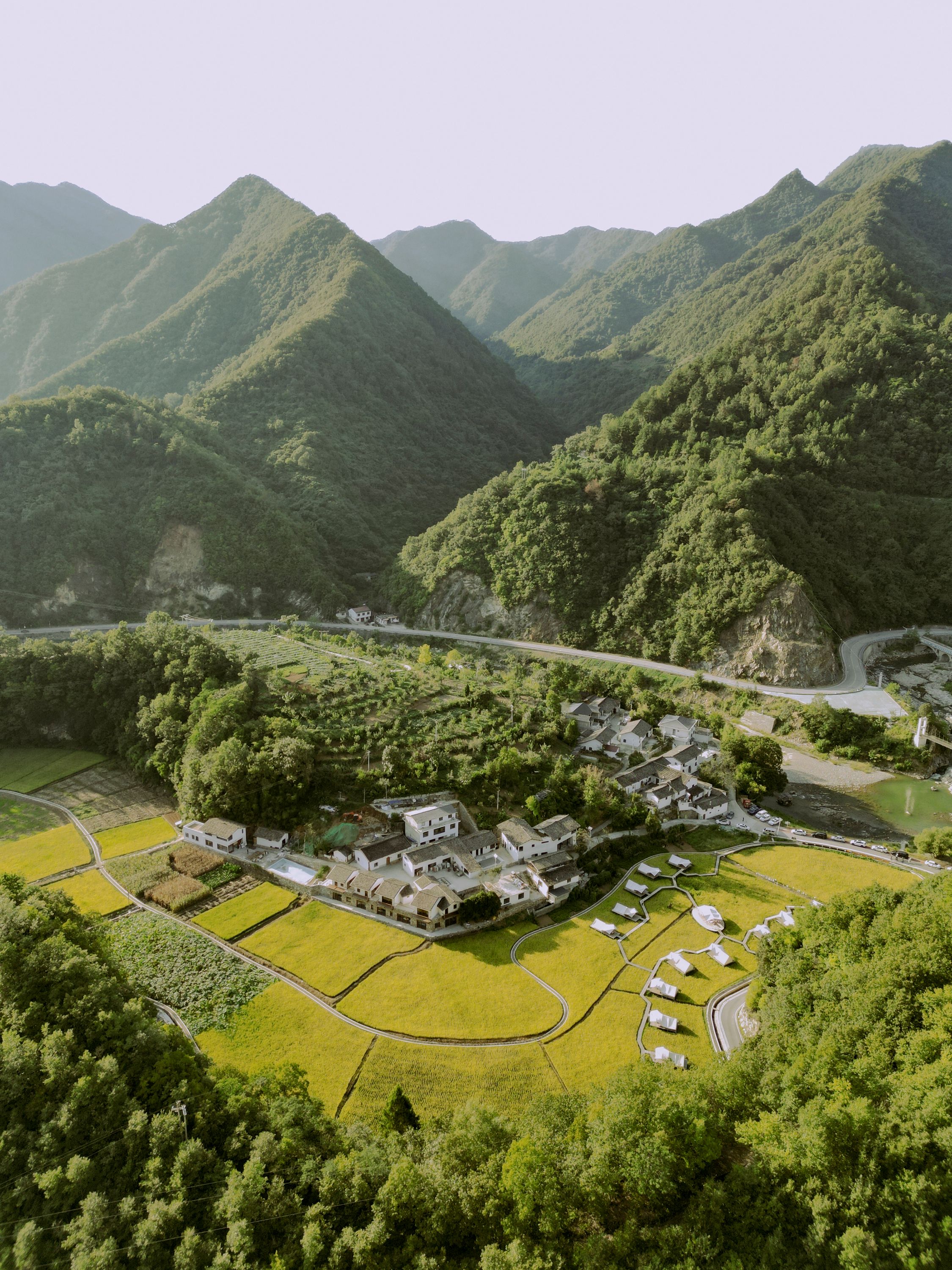
整体鸟瞰视角
在这个项目中,为了让民宿融入到村庄,减少对生态系统的破坏,我们努力创造一种与周边环境融为一体的设计,以减轻新建建筑对环境的负担,并采取项目分阶段开发的策略。同时,我们在设计概念中,提出尽可能多地使用当地的建筑材料,并将当地的传统工艺引入到建造过程中,以此让建筑与当地的风貌相协调。
现场概念草图 ©kooo architects
- 减小建筑体量,消除原有设计过大体量带来的压迫感。
- 采用坡屋顶形式,与当地建筑及环境协调。
- 选择当地的材料,白墙灰瓦及局部石材。
- 与周边既有建筑的尺度体量相协调。
在有高差的L形场地上,我们规划了一座连续的两层建筑,面向开敞的农田。
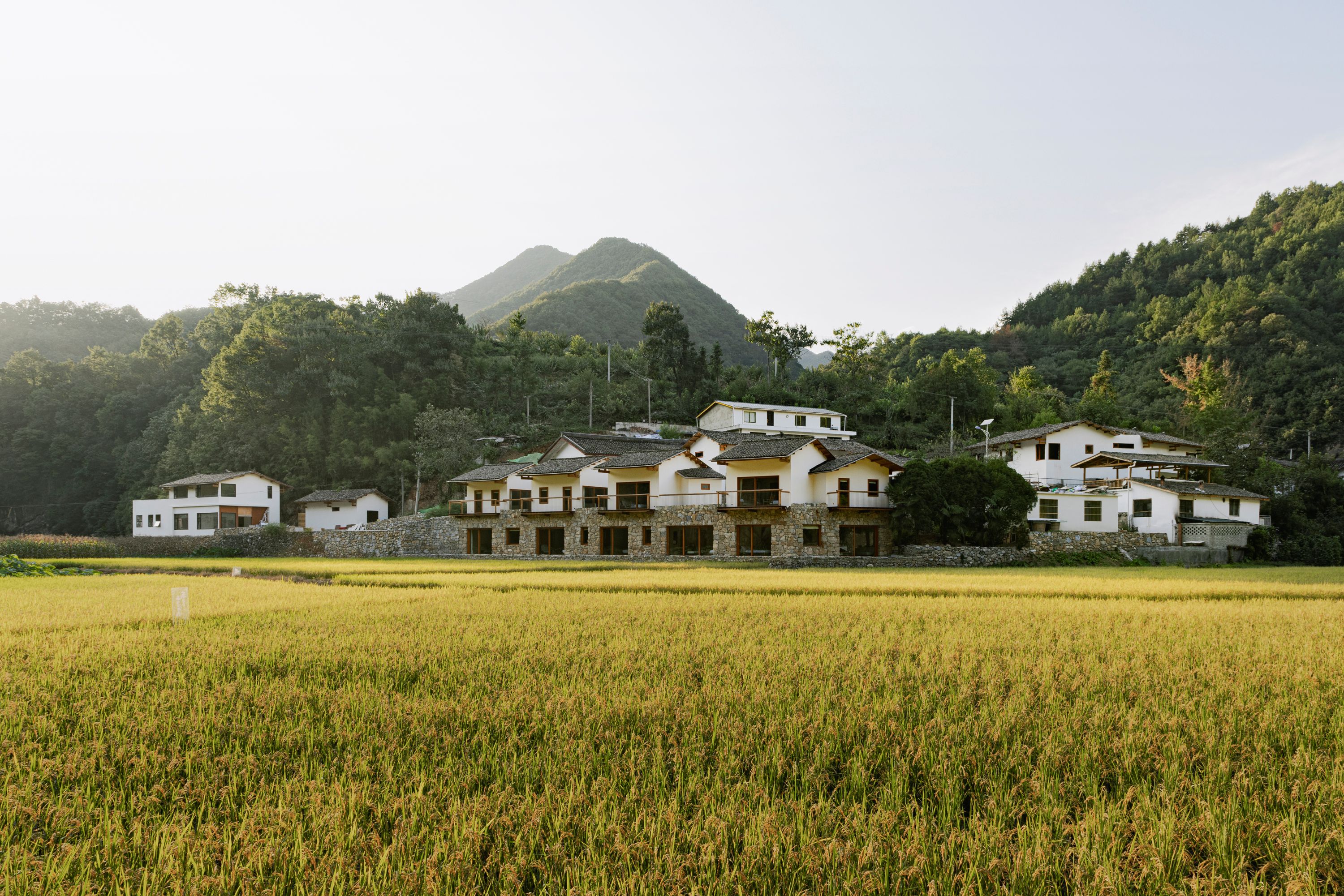
建筑与稻田的视角
建筑一楼的地坪同田野的标高一致,旨在将视线与前面展开的田野保持齐平。外墙采用了在地的毛石挡墙,与既有石墙呼应,成为一个整体。二楼的露台和屋顶构架,与当地建筑类似,椽子均使用原木,即使是一座新建筑,也能让其融入到原有的村落中。
整体鸟瞰视角整体鸟瞰视角
建筑与荷花塘视角
当地的工匠对本地材料的使用比较熟悉,因此石材在场地边的河流中就地取材。村庄的地形高差较大,周边有很多毛石堆砌的挡土墙。延用这个方式,让建筑成为周边环境的延续,融入到场地中。
和工匠们一起从场地旁的河里挑选并运输当地的石头
石头和木框的收口节点经过精心设计,强调了石头相互堆叠的感觉
在整体规划中,我们在客房之间插入了一个“间隙”空间作为入口,成为客房户外庭院的同时,可以使建筑的体量分散,以同周边住宅尺度风貌相协调。当客人从接待处前往每间客房,经过二楼的“间隙”空间时,可以欣赏到外面开阔的田野景观。
在客房之间插入了一个“间隙”空间作为入口,形成客房间的户外庭院
“间隙”空间概念草图 ©kooo architects
室内空间和露台通过建筑内的“间隙”空间连接
客人入住时,能更好地体验、融入周边自然风景,感受与城市酒店完全不同的体验。“间隙”空间不只是走廊,是进入客房的入口也是客房独享的庭院。客房入口的大面积玻璃推拉门完全打开后,可以使室内空间与户外庭院结合形成更加开阔的空间。
木框架和瓦屋顶的适合村庄重叠
建筑之间的“缝隙”能让视线穿透。小尺度的体量,减少对建筑后平台视线的遮挡。延续当地传统木构手法,用老木搭建屋顶及阳台,保持建筑朴素的感觉。
民宿是由2层楼,8 种不同户型的客房组成。丰富的客房类型,增加了客人再次入住的理由,体验不同客房特有空间体验。
2层楼的8 种不同户型section diagram ©kooo architects
卧室等私密性要求较高的空间,布置在由石墙包裹的一层。面向田野景观,让客人享受舒适入住的同时,还能体验到丰富的室外景观。
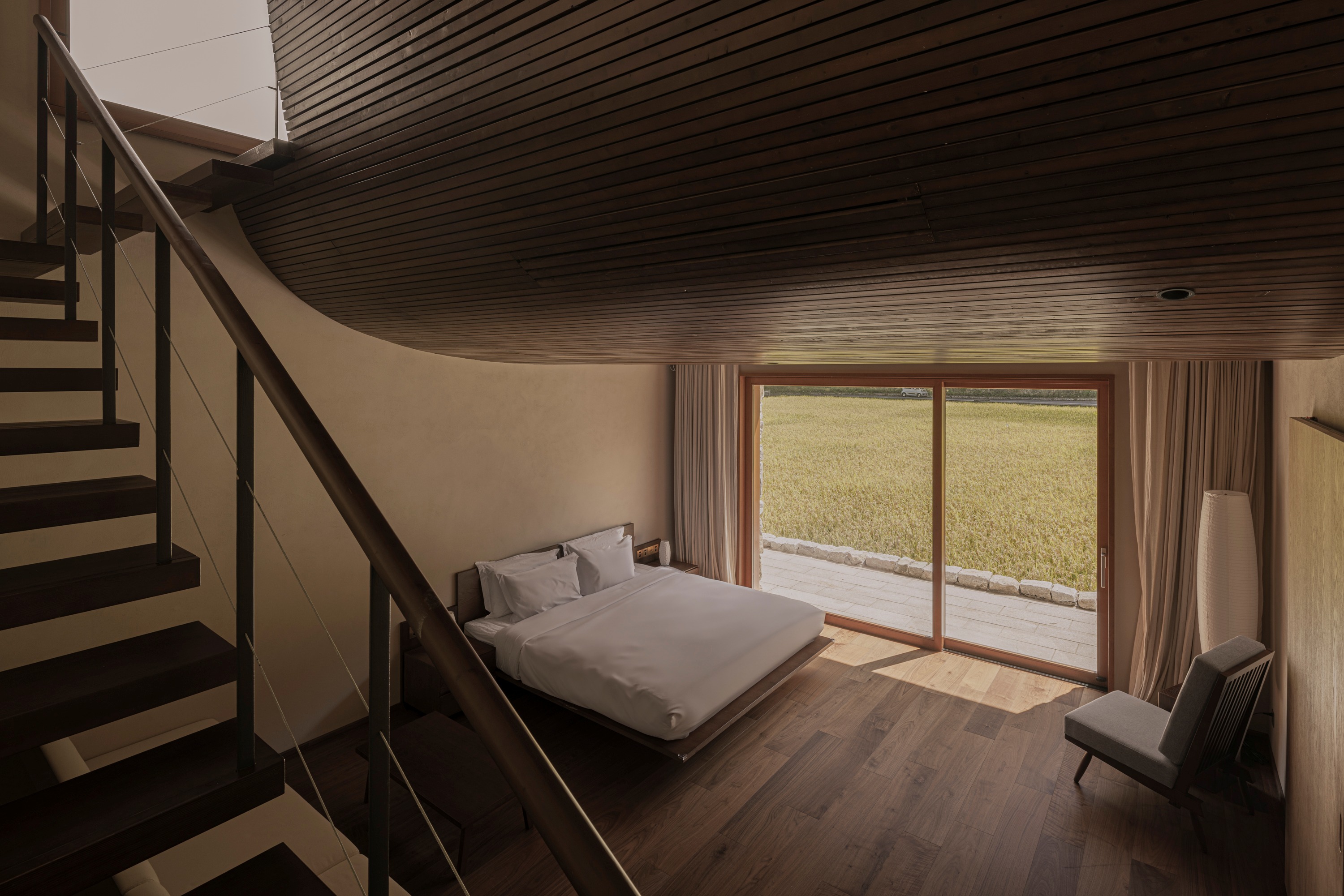
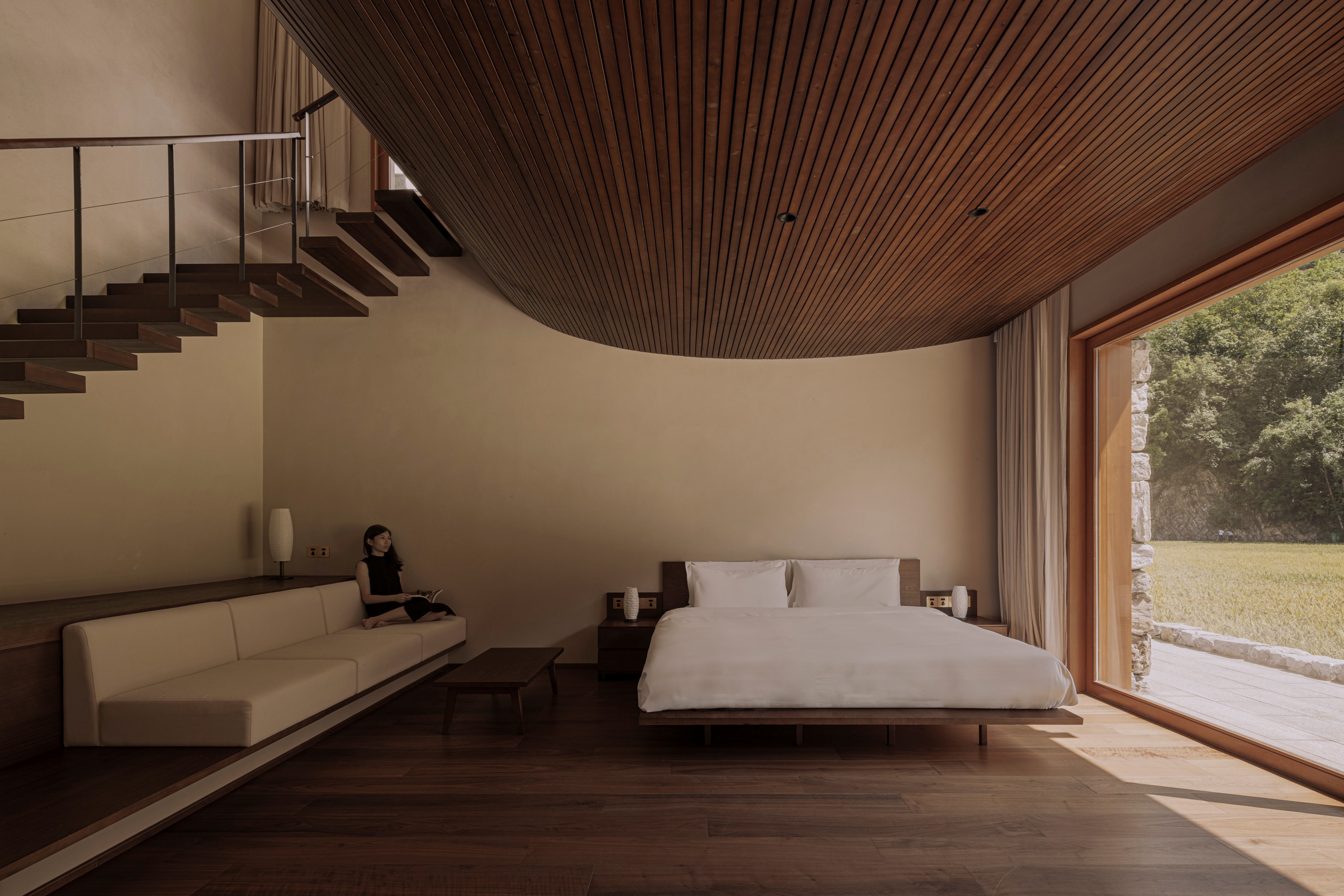
客房01(loft)内部
loft客房中,通过将一层的曲面天花延伸到二层,形成柔和、包裹的空间。同时曲面模糊室内光与室外光之间的边界,室外光在变化时,室内也随之产生不同氛围的空间体验。
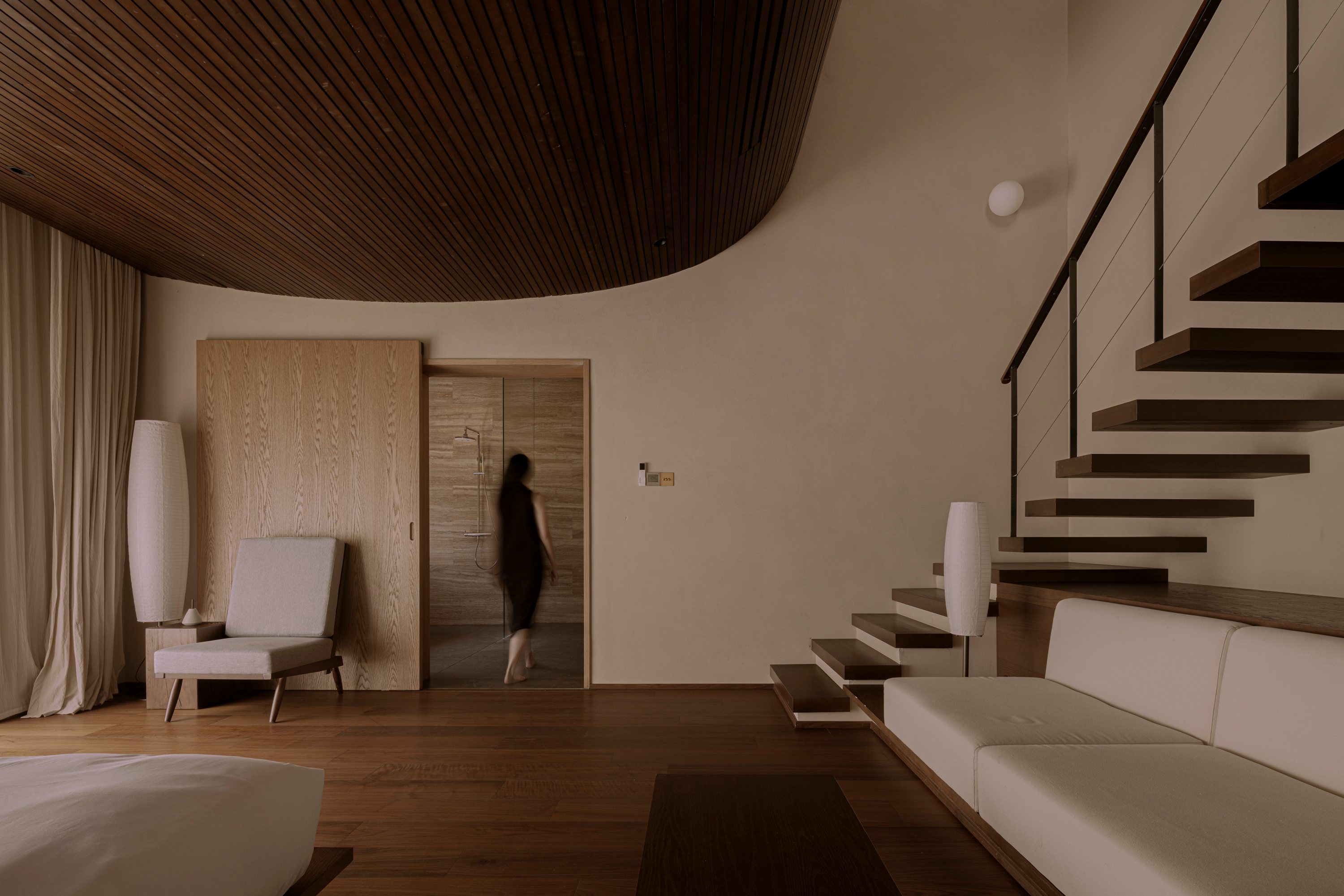
客房02(loft)内部
室内不同材料的运用让一楼和二楼有不同的空间体验。在木制吊顶的客厅和石墙包围的稻田之间创造了开放的双重面,同时保证了私密性和开放性。二层与客厅空间连接的阳台视线开阔 ,一层的落地窗也可以直接走向稻田区域。室内的材料经过缜密推敲,塑造空间拥的整体感,与室外丰富的自然环境形成对比,并将自然环境引入室内成为融合景观。
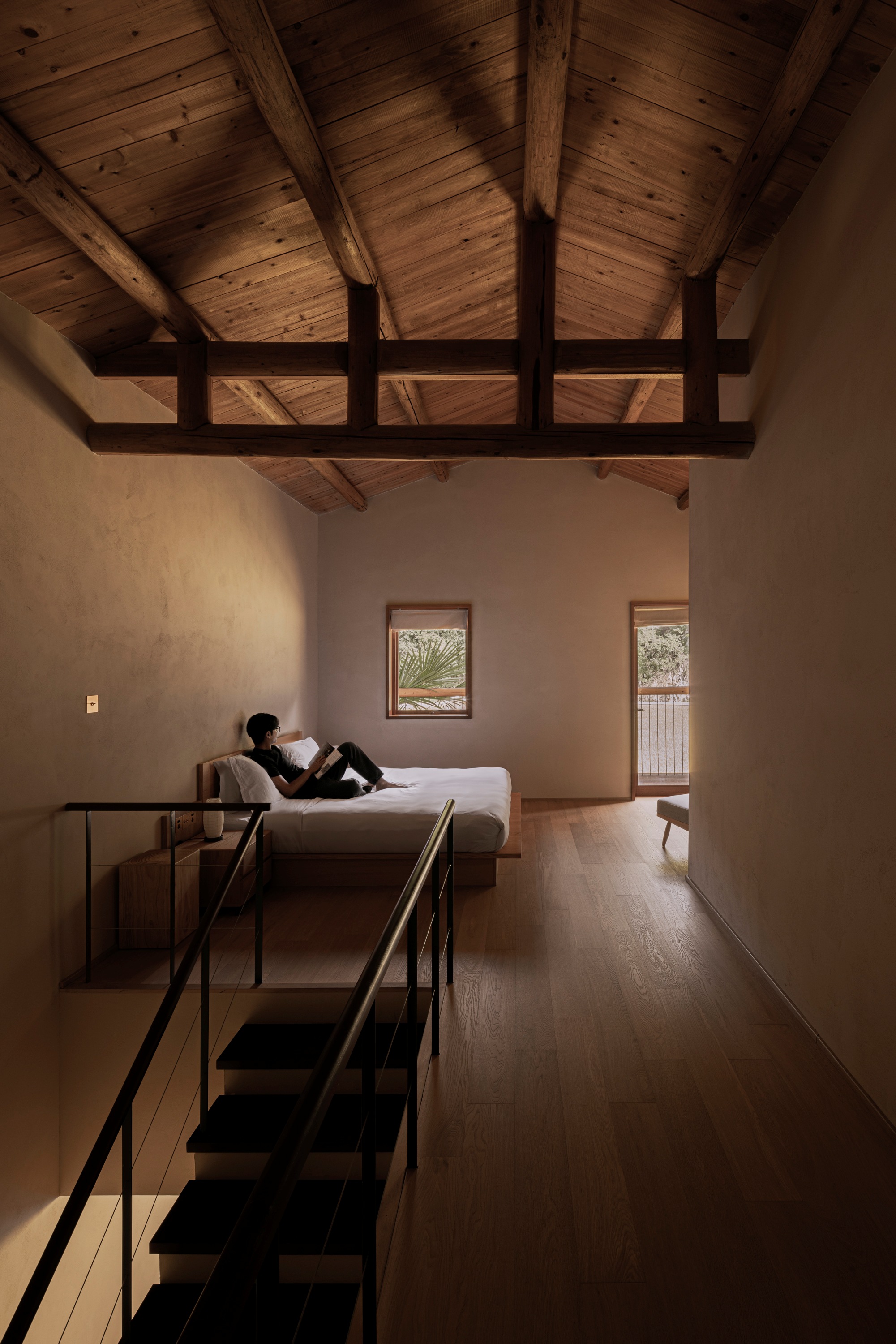
客房05(loft)内部客
极简风格的空间里,通过墙壁与地面简单的材质,突出屋顶独有的木构架。
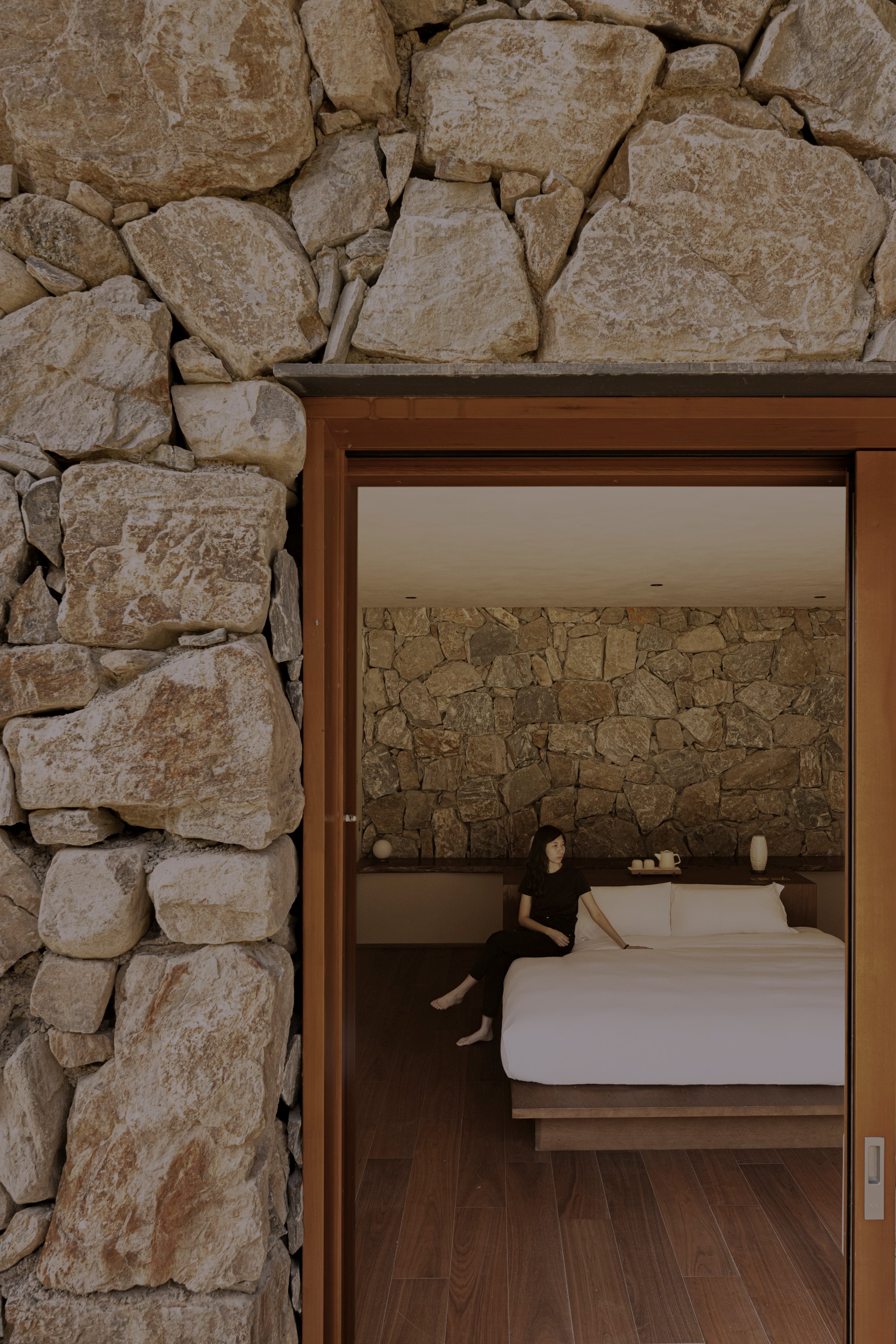
客房06内部
客房07内部
客房08内部
除了外墙使用当地丰富的石材外,通过现代设计手法,将石材以景观墙的形式引入室内,让客人在室内也能感受到当地特有风貌。
1F公共楼梯与走廊内部
2F公共户外阳台走廊
为了使民宿与原有村落的风貌呼应,平衡建筑与自然环境之间的视觉关系,带来开阔的空间,将连续建筑的二层部分打破,使民宿与周边建筑的尺度协调。
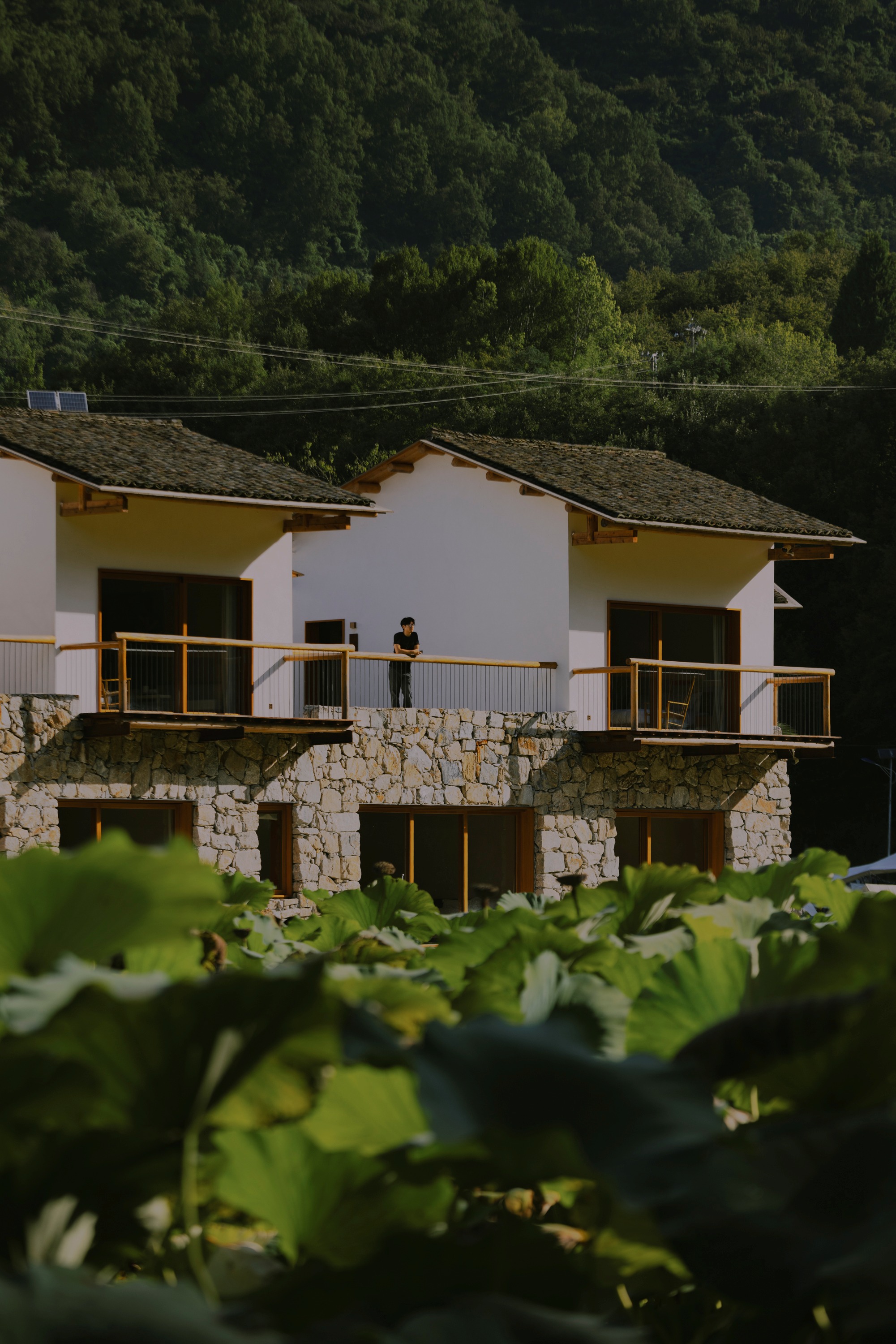
自然的肌理在延续,仿佛从厚重远久的墙体里生长而出的新生命
从河里取来的毛石,纯天然无需雕饰,带着一种自然纯朴的气息。通过堆砌形成坚实的挡土墙,凸显着亘古的久远。丰富空间体验的同时,有效连接起空间之间的动线,交织出空间的层次感。
稻田之上的房子,有着稻田的颜色和质地。跟周边的山石,稻田,树木对话
READ MORE SHOW LESS
- 敷地 site 场地
-
中国安康市宁陕县
Ningshan County, Ankang city, CHINA
中国安康市宁陕县
- 主要用途 program 主要功能
-
ホテル
Hotel
酒店
- 建築面積 site area 建筑面积
-
319㎡
319㎡
319㎡
- 延床面積 floor area 占地面积
-
544㎡
544㎡
544㎡
- 施主 client 业主
-
鹿柴山集·渔湾逸谷
Luzhai shanji・Yuwan
鹿柴山集·渔湾逸谷
- 設計 design 设计
-
株式会社小大建築設計事務所
kooo architects
小大建筑设计事务所
- 担当 staff 负责人
-
小嶋伸也・小嶋綾香・北上紘太郎・林鸿缔・井丹・田哲铭
Shinya Kojima・ Ayaka Kojima・Kotaro Kitakami・Hongdi Lin・Dan Jing・Zheming Tian
小嶋伸也・小嶋綾香・北上紘太郎・林鸿缔・井丹・田哲铭
- 施工 construction 施工
-
杭州戚龙建设有限公司(施工)
陕西一诺装饰装修工程有限公司(家具)Hangzhou Qilong construction (construction)
ShaanXiYiNuo(furnituire)杭州戚龙建设有限公司(施工)
陕西一诺装饰装修工程有限公司(家具)
- 写真 photo 摄影
-
堀越圭晋/ エスエス
HORIKOSHI KEISHIN/SS
堀越圭晋/SS
PROJECT DATA SHOW LESS
集落と敷地前面に広がる開放的な田園風景
本プロジェクトは、中国・陝西省安康市寧陝県漁湾村に位置し、既存の村落と一体となるよう計画されています。
敷地は自然資源に恵まれ、環境も美しく、原生的な自然が良好に保たれた地域であり、トキ(朱鷺)の生息地でもあります。計画地は、段々畑が連なる山腹に位置し、外周には玉石を積み上げた擁壁が巡らされ、正面には開放的な農地の風景が広がる、印象的なロケーションです。
渔湾村に残る、トキの生息地の豊かな自然環境
敷地周囲に残る、既存住宅と石積みの擁壁
集落全体配置図 ©kooo architects
全体鳥瞰
本計画では、民宿を村落に溶け込ませ、生態系への影響を最小限に抑えることを重視しました。周辺環境と一体化するデザインを目指し、新築建築が環境に与える負荷を軽減するとともに、段階的な開発手法を採用しています。
また、設計コンセプトとして、できる限り地域の建築材料を使用し、地元の伝統的な工法を建設プロセスに取り入れることで、建築が土地固有の風景と調和することを目指しました。
現地でのコンセプトスケッチ ©kooo architects
設計上の主な方針
- 建築ボリュームを抑え、従来案の過度な圧迫感を解消
- 切妻屋根を採用し、地域の建築や周辺環境との調和を図る
- 白壁・灰色瓦・部分的な石材など、地域の素材を選定
- 周辺既存建築のスケールやボリューム感と整合させる
高低差のあるL字型敷地に対し、開放的な農地に面した連続する2階建ての建築を計画しました。
1階の床レベルは田畑と同じ高さに設定し、視線が正面に広がる田園風景と水平につながるよう配慮しています。外壁には敷地周辺に見られる玉石積みの擁壁を用い、既存の石積みと呼応することで、風景の一部として建築を成立させています。
2階のテラスや屋根架構には、地域建築と同様に垂木として無垢材を使用し、新築でありながらも、もともと村にあったかのような佇まいを生み出しています。
計画の全体像
蓮池から見る本計画地
地元の職人は地域素材の扱いに精通しており、石材は敷地近くの川から採取したものを使用しています。村落は高低差の大きい地形で、周囲には玉石積みの擁壁が数多く見られます。こうした手法を継承することで、建築を周辺環境の延長として位置づけ、敷地に自然に溶け込ませています。
職人とともに地元の石を選び、運び出す様子
石と木枠の取り合いは丁寧に設計され、石が積層される質感を強調しています。建築同士の間に設けた「隙間」によって視線が抜け、小さなスケールのボリュームとすることで、背後のテラスからの眺望を遮らない構成としました。
屋根やバルコニーには、伝統的な木構法を踏襲し、古材を用いることで、素朴で落ち着いた建築表現を保っています。
客室のあいだに“隙間”を設け、エントランスとすることで、客室間に中庭空間を生み出している
“隙間”コンセプトスケッチ ©kooo architects
“隙間”を介して、室内とテラスを接続している
全体計画では、客室の間に「間隙」となる空間を挿入し、ここをエントランスとして計画しました。この空間は客室専用の屋外庭として機能すると同時に、建築ボリュームを分節し、周辺住宅のスケールや風貌と調和させる役割を担っています。
宿泊客がレセプションから各客室へ向かう際、2階の「間隙」空間を通ることで、外に広がる田園風景を楽しむことができます。滞在中、宿泊客は周囲の自然風景をより深く体験し、都市型ホテルとはまったく異なる滞在体験を味わうことができます。「間隙」空間は単なる廊下ではなく、客室へのアプローチであり、同時に専有庭として機能します。
客室入口の大開口ガラス引き戸を全面開放することで、室内と屋外庭が一体となり、より開放的な空間が生まれます。
村の風景と重なる木架構と瓦屋根
建築間の「隙間」による視線の抜けと、小スケールな構成により、背後のプラットフォームからの眺望を確保しています。屋根やバルコニーには、地域の伝統的な木構法を用い、古材を使用することで、素朴で飾らない建築の表情を維持しています。
民宿は2階建てで、8種類の異なる客室タイプから構成されています。多様な客室プランは、再訪の動機を生み、それぞれ異なる空間体験を提供します。
2階建て・8種類の異なる客室タイプ section diagram ©kooo architects
寝室など、より高いプライバシーが求められる空間は、石壁に囲まれた1階に配置しました。田園風景に面することで、快適な滞在とともに、豊かな屋外景観を楽しむことができます。
客室01(loft)内部
ロフトタイプの客室では、1階の曲面天井を2階まで連続させ、包み込まれるような柔らかな空間を形成しています。この曲面は、室内光と自然光の境界を曖昧にし、外光の変化に応じて、室内にも多様な雰囲気をもたらします。
客室02(loft)内部
室内では、異なる素材の使い分けにより、1階と2階で異なる空間体験を生み出しています。木製天井のリビングと、石壁に囲まれた田園との間に、開放性とプライバシーを両立させた二重的な関係性を構築しました。
2階のバルコニーからは開放的な眺望が広がり、1階の大開口窓からは直接田園へと出ることができます。素材選定は慎重に行われ、空間全体に一体感をもたらすと同時に、屋外の豊かな自然環境と対比させながら、自然を室内へと引き込む設計としています。
客室05(loft)内部
ミニマルな空間構成の中で、壁や床にはシンプルな素材を用い、屋根特有の木構架を際立たせています。
客室06内部
客室07内部
客室08内部
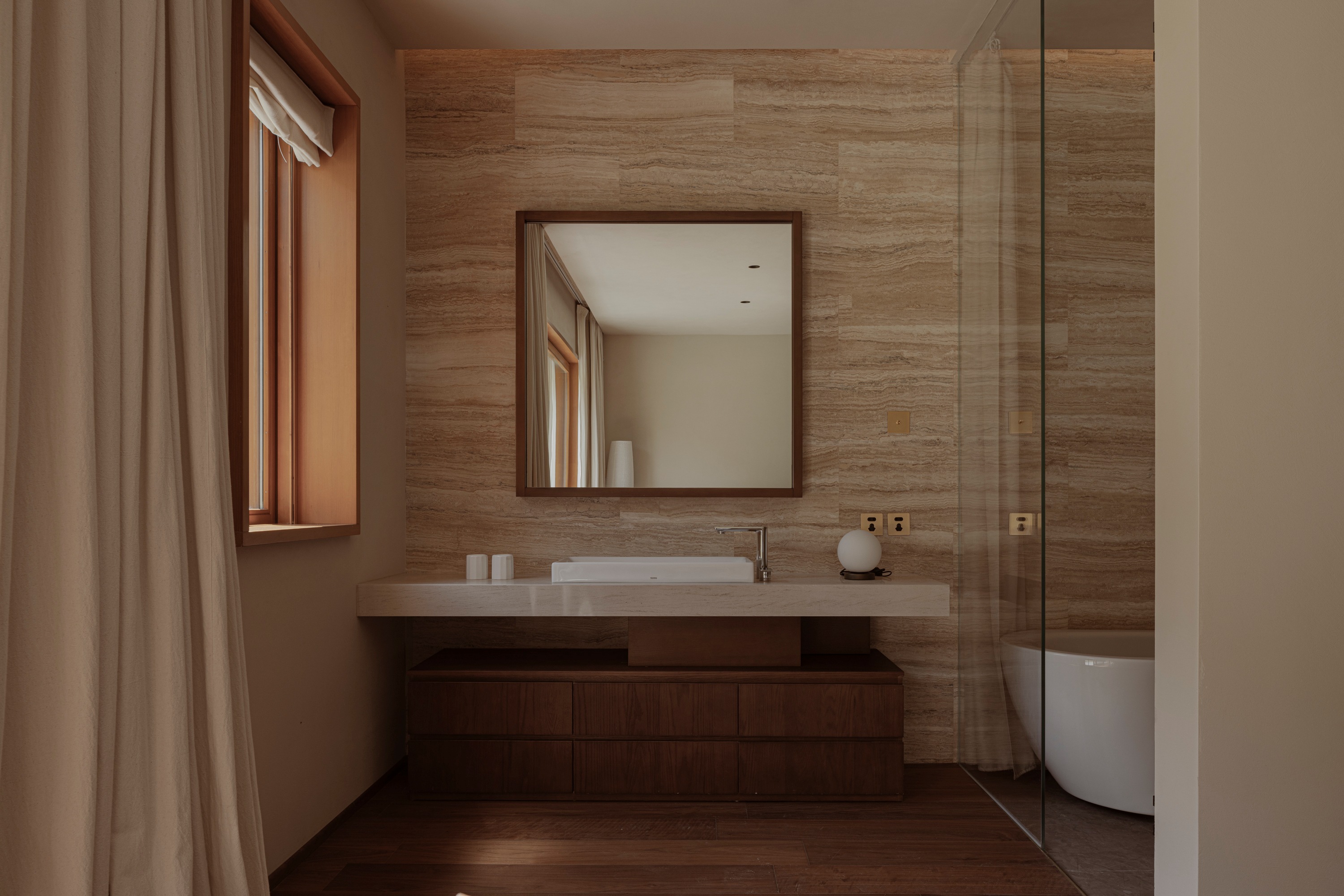
外壁に地域特有の豊富な石材を使用するだけでなく、現代的なデザイン手法によって、石を景観壁として室内にも取り込み、宿泊客が室内にいながら土地固有の風景を感じられるようにしています。
1階 共用階段と室内廊下
2階 屋外の共用廊下
既存村落の景観と呼応し、建築と自然環境との視覚的なバランスを整え、開放感のある空間を生み出すため、連続する建築の2階部分を分節しました。これにより、民宿は周辺建築と調和したスケール感を獲得しています。
自然の肌理は連なり、まるで重厚で悠久の時を刻んできた壁体の内側から、新たな生命が芽吹くかのようです。
川から採取した玉石は、彫刻を施すことのない純粋な自然素材であり、素朴でありながら力強い気配をまとっています。それらを積み重ねることで堅牢な擁壁を形成し、太古から続く時間の厚みを際立たせています。
空間体験に豊かさをもたらすと同時に、各空間をつなぐ動線を効果的に結び、重なり合うような空間のレイヤーを織り成しています。
稲田の上に浮かぶような佇まいで、稲の色や質感を取り込み、周辺の山・田園・樹木と呼応する建築
Open countryside stretching out in front of the site
This project is located in Yuwan Village, Ningshan County, Ankang City, Shaanxi Province, China, and was planned to integrate harmoniously with the existing village fabric.
The site is blessed with abundant natural resources and a beautiful environment, where pristine nature has been well preserved. It is also a habitat of the crested ibis. The project site lies on a mountainside characterized by terraced fields, encircled by retaining walls made of stacked river stones, and opens toward an expansive agricultural landscape at the front — a setting of striking natural presence.
The rich natural environment of the crested ibis habitat in Yuwan Village
The surrounding existing residences and stone masonry retaining walls
Overall site plan ©kooo architects
Overall aerial view
In this project, we placed strong emphasis on integrating the guesthouse into the existing village context while minimizing its impact on the local ecosystem. The design seeks to merge seamlessly with the surrounding environment, reducing the environmental footprint of new construction through a phased development approach.
As a central design principle, we aimed to use locally sourced materials wherever possible and incorporate traditional construction techniques into the building process. Through these efforts, the architecture aspires to harmonize with the site’s inherent landscape and reflect the unique character of the region.
Concept sketch on site ©kooo architects
Key Design Principles
- Reducing the overall building volume to alleviate the excessive sense of enclosure proposed in the previous scheme
- Adopting a gabled roof form to harmonize with local architecture and the surrounding environment
- Selecting regional materials such as white plaster walls, gray roof tiles, and partially exposed stone
- Ensuring consistency with the scale and massing of the existing neighboring buildings
For the L-shaped site with significant level differences, we proposed a continuous two-story building facing the open agricultural landscape, responding carefully to the site’s topography and context.
The ground-floor level is aligned with the surrounding farmland, allowing the interior to connect visually and horizontally with the expansive rural landscape beyond. For the exterior walls, stacked river stones — commonly found in the retaining walls around the site — were used to resonate with the existing masonry, enabling the architecture to become an integral part of the landscape.
For the second-floor terrace and roof structure, solid timber rafters were employed, reflecting local building traditions. Although newly constructed, the architecture is designed to appear as though it has long been part of the village setting.
Project overview
The project site viewed from the lotus pond
Local craftsmen are highly skilled in working with regional materials, and the stone used in the project was sourced from a nearby river close to the site. The village is characterized by significant changes in elevation, with numerous retaining walls constructed from stacked river stones throughout the area.
By inheriting and continuing these traditional construction methods, the architecture is positioned as an extension of its surroundings, allowing it to blend naturally into the site and its broader landscape.
Selecting and transporting local stone with local craftsmen
The junction between the stonework and the timber frames was carefully detailed to emphasize the layered texture of the stacked stone. By introducing “gaps” between the building volumes, visual permeability is maintained, and the overall mass is broken down into smaller-scale forms that do not obstruct the views from the terraces behind.
Traditional timber construction methods were adopted for the roof and balconies, and reclaimed wood was incorporated to preserve a modest and tranquil architectural expression.
Architectural voids are carved out between the guest rooms, serving as entrances and generating intimate courtyard spaces
“Void” concept sketch ©kooo architects
The interior and the terrace are connected through the “void”
In the overall planning, interstitial “void” spaces were inserted between the guest rooms and designated as entrances. These spaces function as private outdoor gardens for each room while simultaneously articulating the building mass, allowing it to harmonize with the scale and character of the surrounding houses.
As guests move from the reception to their rooms, they pass through the second-floor “void” spaces, where they can enjoy views of the expansive rural landscape beyond. Throughout their stay, guests are able to engage more deeply with the surrounding natural scenery, experiencing a form of hospitality entirely distinct from that of an urban hotel. The “void” is not merely a corridor, but an approach to each room that also serves as a semi-private garden.
By fully opening the large sliding glass doors at the guest room entrance, the interior merges seamlessly with the outdoor garden, creating a more open and fluid spatial experience.
Timber structure and tiled roof overlapping with the village landscape
The “voids” between the building volumes create visual permeability and, together with the smaller-scaled composition, secure unobstructed views from the platform behind.
Traditional local timber construction methods were adopted for the roof and balconies, and reclaimed wood was used to maintain a simple and unadorned architectural expression.
The guesthouse is a two-story structure composed of eight distinct room types. This variety of layouts encourages repeat visits, offering guests a different spatial experience with each stay.
Two stories / Eight guest room types section diagram ©kooo architects
Spaces requiring a higher level of privacy, such as the bedrooms, are located on the ground floor and enclosed by stone walls. Facing the rural landscape, these rooms provide a comfortable stay while allowing guests to enjoy the expansive views of the surrounding countryside.
Guest room 01 (loft) – Interior
In the loft-type guest rooms, the curved ceiling of the ground floor extends continuously to the second level, forming a soft, enveloping spatial experience. This curved surface blurs the boundary between interior lighting and natural light, allowing subtle changes in daylight to generate a range of atmospheres within the room.
Guest room 02 (loft) – Interior
Within the interior, different materials are carefully articulated to create distinct spatial experiences on the first and second floors. A layered relationship is established between the timber-ceilinged living space above and the stone-enclosed ground floor facing the rural landscape, balancing openness and privacy.
From the second-floor balcony, expansive views unfold across the countryside, while large openings on the ground floor allow direct access to the fields. The selection of materials was undertaken with great care, ensuring a cohesive spatial atmosphere while simultaneously contrasting with the richness of the surrounding natural environment — drawing the landscape inward and integrating it into the interior experience.
Guest room 05 (loft) – Interior
Within the minimal spatial composition, simple materials are applied to the walls and floors, allowing the distinctive timber roof structure to stand out.
Guest room 06 (loft) – Interior
Guest room 07 (loft) – Interior
Guest room 08 (loft) – Interior
In addition to using the region’s abundant local stone for the exterior walls, contemporary design strategies have been employed to incorporate the stone as an interior feature wall. This allows guests to experience the site-specific landscape from within the building itself.
Ground floor – Shared staircase and interior corridor
Second floor – Outdoor shared corridor
To respond to the visual character of the existing village and balance the architecture with its natural surroundings while creating a sense of openness, the continuous second-floor volumes of the building were segmented. This allows the guesthouse to achieve a scale that harmonizes with the neighboring structures.
The textures of nature unfold continuously, as if from within the walls that have weathered the passage of time, new life begins to emerge. River stones, sourced directly from the nearby stream, are pure natural materials left uncarved, conveying both simplicity and a quiet strength. Stacking these stones forms robust retaining walls, emphasizing the profound depth of time that has flowed through this landscape.
These design strategies not only enrich the spatial experience but also effectively connect circulation paths, weaving overlapping layers of space that guide movement and frame views throughout the architecture.
Floating above the rice fields, the building reflects the colors and textures of the crops and the surrounding landscape
村落整体与场地前面有开敞的稻田
项目位于中国陕西省安康市宁陕县渔湾村,与村庄聚落融为一体。
场地自然资源丰富,环境优美,原生态保护良好,是朱鹮的栖息地。项目选址在梯田层叠的山坡上,山坡外围环绕着毛石堆砌的挡墙,面向开敞的农田景象,令人印象深刻。
渔湾村的朱鹮栖息地自然环境
场地周围村里的原有的房子与石头挡墙
整体村子布置图 ©kooo architects
整体鸟瞰视角
在这个项目中,为了让民宿融入到村庄,减少对生态系统的破坏,我们努力创造一种与周边环境融为一体的设计,以减轻新建建筑对环境的负担,并采取项目分阶段开发的策略。同时,我们在设计概念中,提出尽可能多地使用当地的建筑材料,并将当地的传统工艺引入到建造过程中,以此让建筑与当地的风貌相协调。
现场概念草图 ©kooo architects
- 减小建筑体量,消除原有设计过大体量带来的压迫感。
- 采用坡屋顶形式,与当地建筑及环境协调。
- 选择当地的材料,白墙灰瓦及局部石材。
- 与周边既有建筑的尺度体量相协调。
在有高差的L形场地上,我们规划了一座连续的两层建筑,面向开敞的农田。
建筑与稻田的视角
建筑一楼的地坪同田野的标高一致,旨在将视线与前面展开的田野保持齐平。外墙采用了在地的毛石挡墙,与既有石墙呼应,成为一个整体。二楼的露台和屋顶构架,与当地建筑类似,椽子均使用原木,即使是一座新建筑,也能让其融入到原有的村落中。
整体鸟瞰视角整体鸟瞰视角
建筑与荷花塘视角
当地的工匠对本地材料的使用比较熟悉,因此石材在场地边的河流中就地取材。村庄的地形高差较大,周边有很多毛石堆砌的挡土墙。延用这个方式,让建筑成为周边环境的延续,融入到场地中。
和工匠们一起从场地旁的河里挑选并运输当地的石头
石头和木框的收口节点经过精心设计,强调了石头相互堆叠的感觉
在整体规划中,我们在客房之间插入了一个“间隙”空间作为入口,成为客房户外庭院的同时,可以使建筑的体量分散,以同周边住宅尺度风貌相协调。当客人从接待处前往每间客房,经过二楼的“间隙”空间时,可以欣赏到外面开阔的田野景观。
在客房之间插入了一个“间隙”空间作为入口,形成客房间的户外庭院
“间隙”空间概念草图 ©kooo architects
室内空间和露台通过建筑内的“间隙”空间连接
客人入住时,能更好地体验、融入周边自然风景,感受与城市酒店完全不同的体验。“间隙”空间不只是走廊,是进入客房的入口也是客房独享的庭院。客房入口的大面积玻璃推拉门完全打开后,可以使室内空间与户外庭院结合形成更加开阔的空间。
木框架和瓦屋顶的适合村庄重叠
建筑之间的“缝隙”能让视线穿透。小尺度的体量,减少对建筑后平台视线的遮挡。延续当地传统木构手法,用老木搭建屋顶及阳台,保持建筑朴素的感觉。
民宿是由2层楼,8 种不同户型的客房组成。丰富的客房类型,增加了客人再次入住的理由,体验不同客房特有空间体验。
2层楼的8 种不同户型section diagram ©kooo architects
卧室等私密性要求较高的空间,布置在由石墙包裹的一层。面向田野景观,让客人享受舒适入住的同时,还能体验到丰富的室外景观。
客房01(loft)内部
loft客房中,通过将一层的曲面天花延伸到二层,形成柔和、包裹的空间。同时曲面模糊室内光与室外光之间的边界,室外光在变化时,室内也随之产生不同氛围的空间体验。
客房02(loft)内部
室内不同材料的运用让一楼和二楼有不同的空间体验。在木制吊顶的客厅和石墙包围的稻田之间创造了开放的双重面,同时保证了私密性和开放性。二层与客厅空间连接的阳台视线开阔 ,一层的落地窗也可以直接走向稻田区域。室内的材料经过缜密推敲,塑造空间拥的整体感,与室外丰富的自然环境形成对比,并将自然环境引入室内成为融合景观。
客房05(loft)内部客
极简风格的空间里,通过墙壁与地面简单的材质,突出屋顶独有的木构架。
客房06内部
客房07内部
客房08内部
除了外墙使用当地丰富的石材外,通过现代设计手法,将石材以景观墙的形式引入室内,让客人在室内也能感受到当地特有风貌。
1F公共楼梯与走廊内部
2F公共户外阳台走廊
为了使民宿与原有村落的风貌呼应,平衡建筑与自然环境之间的视觉关系,带来开阔的空间,将连续建筑的二层部分打破,使民宿与周边建筑的尺度协调。
自然的肌理在延续,仿佛从厚重远久的墙体里生长而出的新生命
从河里取来的毛石,纯天然无需雕饰,带着一种自然纯朴的气息。通过堆砌形成坚实的挡土墙,凸显着亘古的久远。丰富空间体验的同时,有效连接起空间之间的动线,交织出空间的层次感。
稻田之上的房子,有着稻田的颜色和质地。跟周边的山石,稻田,树木对话
READ MORE SHOW LESS